
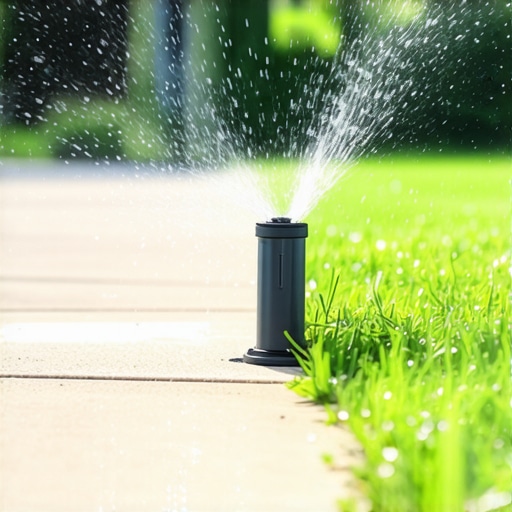
I always drill into my new crew members: if you don’t fix the soil grading and irrigation alignment first, every plant you put in the ground is just expensive compost. I saw it again last week on a site in a high-end development. The homeowner had a brand-new sod install that looked great for exactly fourteen days. By day fifteen, the concrete driveway was stained rust-orange from high iron content in the well water, and the edges of the fescue were turning into a brown, crispy mess. The culprit? Half of the GPM (gallons per minute) was hitting the asphalt instead of the root zone. Watering the sidewalk isn’t just a nuisance for walkers; it is a fundamental engineering failure that destroys hardscapes and starves your biology. We are going to treat your yard like the hydraulic system it is.
Why Sprinkler Overspray is a Structural and Biological Failure
Stopping sprinkler overspray requires a technical adjustment of the nozzle arc and radius to ensure the distribution uniformity matches the physical boundaries of the turf. This prevents hydrostatic pressure buildup under adjacent hardscapes and stops the waste of municipal water resources that leads to soil leaching. When you spray concrete, you aren’t just wasting water. You are actively undermining the sub-base of your driveway. Water finds the path of least resistance. It travels down the edge of the slab, saturates the compacted gravel underneath, and leads to shifting, cracking, and eventual failure of the hardscape. From a horticultural perspective, you are creating a ‘dry zone’ at the most vulnerable part of the lawn—where the heat-sink of the sidewalk cooks the soil. It is a double-edged sword of incompetence. Every drop of water that hits the sidewalk is a drop that isn’t driving nitrogen deeper into the soil profile.
“A retaining wall doesn’t fail because of the stone; it fails because of the water trapped behind it.” – Hardscape Engineering Axiom
The Mechanics of Nozzle Calibration and Head Alignment
Achieving precision irrigation requires understanding the difference between precipitation rates and nozzle trajectories. If your heads are ‘fogging’—creating a fine mist that drifts away in the slightest breeze—your PSI (pounds per square inch) is too high for the hardware. You don’t need a miracle; you need a pressure regulator and a screwdriver. Most modern rotors and spray heads have a radius reduction screw. By turning this screw clockwise, you break the stream of water, forcing it to drop sooner. However, if you over-tighten it, you destroy the distribution uniformity, creating a wet spot at the head and a dry spot five feet out. This is where the hacks fail. They just turn the screw and walk away. A pro swaps the nozzle entirely. If you have a 15-foot throw but only 10 feet of grass, stop trying to choke down a 15H nozzle. Install a 10H. It is a five-minute fix that saves thousands of gallons over the season.
How do I adjust my sprinkler head radius?
To adjust the radius, locate the stainless steel screw on top of the nozzle and turn it clockwise while the zone is active to see the immediate impact on the water’s throw distance. For arc adjustment, you must set the fixed left-stop and then use the adjustment key to expand or contract the right-side rotation to match the perimeter of your landscaping. Do not force the head beyond its mechanical limits; if it doesn’t reach, you may need to excavate and re-position the head relative to the sod install edge. [image placeholder]
| Nozzle Type | Standard Precipitation Rate | Wind Resistance | Best Application |
|---|---|---|---|
| Fixed Spray | 1.5 – 2.0 in/hr | Low | Small, confined turf areas |
| Rotary (MP Rotator) | 0.4 – 0.6 in/hr | High | Slopes and heavy clay soils |
| Impact Rotor | 0.5 – 0.8 in/hr | Medium | Large open spaces |
Hydrodynamics and Soil Infiltration Rates
The goal of irrigation is to match the precipitation rate of the sprinkler to the infiltration rate of the soil. If you have heavy clay, the soil can only absorb about 0.2 inches of water per hour. If your spray heads are dumping 1.5 inches per hour, you get runoff. This is why you see water running down the gutter even if the sprinklers are aimed correctly. The water literally cannot move through the soil fast enough. This is where the ‘Cycle and Soak’ method becomes mandatory. Instead of running a zone for 20 minutes and watching 10 minutes of that water run into the sewer, you run it for 10 minutes, let it soak for an hour, and run it for another 10. You force the roots to chase the moisture down. This builds a resilient root system that can survive a drought, unlike the shallow-rooted turf produced by the daily ‘mow-and-blow’ schedule.
“Irrigation efficiency is defined as the ratio of the volume of water used beneficially to the volume of water delivered from the source.” – Texas A&M AgriLife Extension
The Irrigation Efficiency Checklist
- Check for ‘Head-to-Head’ Coverage: Ensure the spray from one head reaches the base of the next to prevent ‘donuts’ or dry spots.
- Inspect for Clogged Nozzles: During your yard cleanup, remove the internal filters and flush the lines to prevent skewed spray patterns.
- Monitor Pressure: Install a pressure regulator if your system exceeds 45 PSI for spray heads or 65 PSI for rotors to prevent atomization.
- Verify Vertical Alignment: Heads must be perpendicular to the grade. If the mower bumped a head and tilted it, it will spray the sidewalk or the fence instead of the lawn.
- Match Nozzles: Never mix rotors and spray heads on the same zone; their precipitation rates are too different, leading to localized flooding.
How much water is wasted by sidewalk overspray?
A single misaligned sprinkler head can waste up to 3,000 gallons of water per month, significantly increasing utility costs and causing soil compaction in unintended areas. This waste also leads to the premature degradation of landscaping mulch and can cause fungal pathogens like Large Patch to develop in overly saturated perimeter soil. Stop the waste. Fix the arc. Save the lawn.
The Final Word on Professional Calibration
If you’re serious about your property, you need to stop looking at your yard as a chore and start looking at it as an ecosystem. Every mechanical choice you make—from the micron rating of your irrigation filter to the NPK ratio of your fertilizer—dictates the success of your outdoor space. Yard cleanup isn’t just about raking leaves; it’s about clearing the debris that prevents your pop-up heads from retracting fully. If a head stays up, the mower clips it. If the mower clips it, the nozzle shatters. If the nozzle shatters, you have a geyser watering the sidewalk for eight hours while you’re at work. It’s a chain reaction of failure. Be precise. Be mechanical. Get the water where it belongs—in the dirt.