
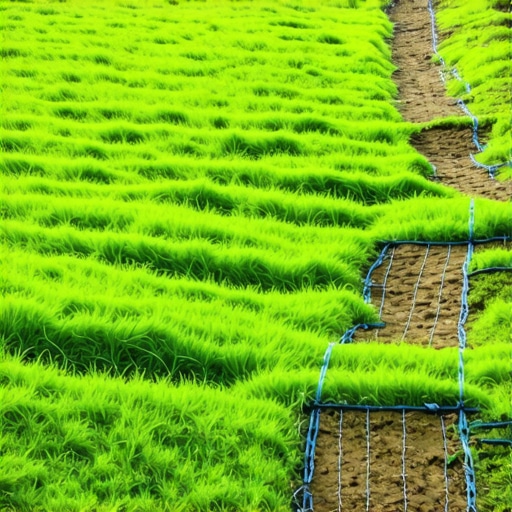
The Engineering Behind Slope Stability and Turf
Preventing sod washout on steep inclines requires managing water velocity and soil shear strength through proper grading, mechanical pinning, and diversion swales to ensure the sod install bonds with the subsoil before the 2026 rainy season. If you treat a 30-degree slope the same way you treat a flat suburban lot, your investment will be at the bottom of the street after the first three-inch rain event. Physics doesn’t care about your weekend plans.
The Apprentice Lesson: Why Grading is Non-Negotiable
I always drill into my new crew members: if you don’t fix the soil grading first, every plant you put in the ground is just expensive compost. I remember a project in 2019 where a homeowner tried to save two grand by skipping the sub-grade preparation. They laid 4,000 square feet of Tall Fescue directly onto compacted red clay. Two weeks later, a summer thunderstorm rolled through and literally peeled the grass off the hillside like a wet rug. We had to excavate the entire mess, haul away the dead organic matter, and start from the dirt up. It cost them double. Soil is a living, structural foundation, not just a place to stick green things.
Preparation: The Sub-Soil Architecture
To stop a 2026 washout, you must address the bulk density of the soil underneath the sod. Most new construction sites are compacted to a PSI that mimics concrete. You cannot lay sod on this. You need to scarify the top 3 to 4 inches of soil. This creates ‘teeth’ for the new roots to grab onto. If the sub-soil is too smooth, water will travel between the sod and the earth, creating a lubricant layer that facilitates a massive slide. Use a Harley rake or a heavy-duty tiller to break up the surface tension.
“Surface runoff velocity increases exponentially with slope gradient, requiring mechanical intervention to ensure turf establishment.” – Agronomy Extension Manual
Mechanical Anchorage: Beyond the Basics
Gravity is the enemy of landscaping on hills. You must use 6-inch, 11-gauge steel sod staples. For heavy slopes (anything greater than a 3:1 ratio), you aren’t just using two staples per piece; you are using a staggered ‘W’ pattern with at least five staples per slab. This pins the turf into the scarified subsoil. In extreme cases, we use a biodegradable jute netting or a coconut-fiber coir log at the top of the slope to dissipate the energy of incoming water. Stop thinking about aesthetics and start thinking about civil engineering.
Markdown Comparison: Slope Material Performance
| Slope Ratio | Anchorage Requirement | Water Strategy | Risk Level |
|---|---|---|---|
| 4:1 (Gentle) | Standard Pinning | Standard Irrigation | Low |
| 3:1 (Moderate) | 5 Staples per Slab | Cycle and Soak | Moderate |
| 2:1 (Steep) | Netting + Staples | Diversion Swales | High |
Irrigation Logistics for Sloping Turf
Watering sod on a hill is a delicate balance. If you run a standard 20-minute irrigation cycle, 15 minutes of that water will simply run off the surface, carving gullies into your new sod install. Use the ‘Cycle and Soak’ method. Program your controller to run for 5 minutes, wait 30 minutes for the water to infiltrate, and then repeat. This forces the water into the soil profile rather than over it. We recommend high-efficiency rotary nozzles like the MP Rotator series because they have a lower precipitation rate (0.4 inches per hour) which matches the soil’s natural infiltration rate. Don’t drown it. Don’t starve it.
How much water does new sod on a hill need?
New sod on a slope requires roughly 0.25 inches of water twice daily for the first 14 days to prevent the edges from shrinking and curling. If the seams gap, the water will find those cracks, get under the sod, and wash out the topsoil, leading to total failure. Use a soil moisture meter to check the depth. Roots follow water. If you only wet the top half-inch, those roots will stay shallow and weak. You want them deep. Deep roots mean a stable hillside.
The Yard Cleanup and Prep Checklist
- Call 811 to mark all underground utilities before any grading or trenching begins.
- Clear all debris, rocks larger than 1 inch, and existing weed growth using a non-selective herbicide.
- Apply a high-phosphorus starter fertilizer (e.g., 12-24-14) to encourage immediate root elongation.
- Lay sod perpendicular to the slope, staggered like bricks, to break up water flow channels.
- Roll the sod with a water-filled roller to ensure 100% soil-to-root contact.
“A retaining wall doesn’t fail because of the stone; it fails because of the water trapped behind it.” – Hardscape Engineering Axiom
Long-Term Maintenance and the 2026 Outlook
Once the sod is tacked down and rooted, the job isn’t over. Yard cleanup in the fall must include removing heavy leaf litter which can smother the grass and weaken the root-soil bond. Mow at the highest recommended setting for your specific grass type. Longer blades mean longer roots. Longer roots mean more structural integrity for your hill. It is that simple. If you scalp the grass, you are inviting erosion. Don’t be the neighbor with the muddy mess. Follow the physics, respect the soil, and your slope will stay where it belongs.