
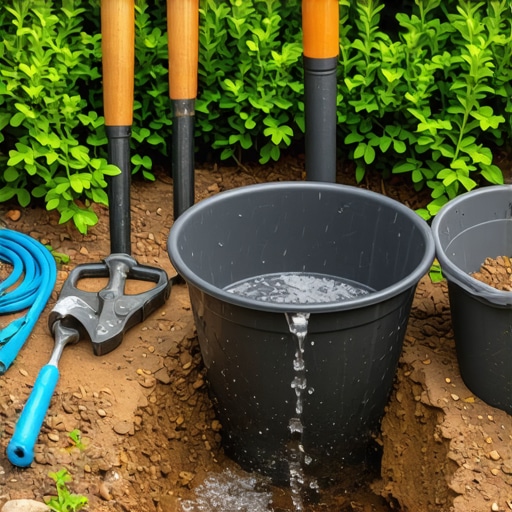
The Forensic Reality of Water Management
I recently got called out to tear up a $30,000 patio that was sinking because the previous contractor failed to account for basic hydrostatic pressure. They built a beautiful surface on a foundation of lies and soft clay. The water had nowhere to go, so it sat under the pavers, turned the subgrade into a slurry, and eventually the entire structure shifted three inches toward the neighbor’s fence. This is what happens when you treat landscaping as a cosmetic exercise rather than a civil engineering project. A backyard water basin is not just a hole in the ground filled with water; it is a complex hydraulic system that requires precise calculations regarding soil displacement and moisture migration. If you do not respect the physics of water, it will destroy your property. Period.
Site Evaluation and Hydraulic Fundamentals
To install a backyard water basin correctly, you must first calculate the watershed volume and evaluate the soil load-bearing capacity to prevent structural settling or catastrophic overflow during a 100-year storm event. The first step is not buying a pump; it is identifying the high and low points of your property with a laser level. You need to know exactly where the water will travel if the basin breaches. Most DIYers ignore the sod install requirements nearby, failing to realize that runoff from a new water feature can oversaturate turf roots, leading to anaerobic soil conditions and root rot. You must manage the irrigation needs of the surrounding flora while keeping the basin chemically isolated. It is a delicate balance. Don’t skip the site survey.
“A retaining wall doesn’t fail because of the stone; it fails because of the water trapped behind it.” – Hardscape Engineering Axiom
How much modified gravel do I need for a patio base?
For a standard patio or a structural basin perimeter, you need a minimum of 6 inches of compacted 2A modified gravel for pedestrian loads. This requires calculating the square footage and multiplying by the depth in feet to determine the cubic yardage needed. If the soil is heavy clay, you may need to increase the base depth to 8 or 10 inches to allow for proper drainage and to prevent frost heave. Always use a plate compactor in 2-inch lifts. Hand tamping is a waste of time. The base should be so solid it feels like concrete before you even think about laying a stone.
Excavation and Soil Mechanics
The excavation process is where most yard cleanup projects turn into disasters because homeowners fail to call 811. Before you strike the dirt, you need to know exactly where your gas and water lines are buried. Once the utilities are marked, you begin the dig by stripping the sod install layer and stockpiling it for remediation later. The walls of your basin must be sloped at a 45-degree angle to prevent collapse during the landscaping process. If you dig a vertical wall in sandy loam, it will cave in the moment you walk near the edge. You are fighting gravity. Don’t lose.
| Material Type | Durability (Years) | Puncture Resistance | UV Resistance |
|---|---|---|---|
| 45 Mil EPDM | 25+ | High | Excellent |
| PVC Liner | 5-10 | Low | Poor |
| Preformed Plastic | 10-15 | Medium | Moderate |
| RPE (Reinforced Polyethylene) | 30+ | Extreme | Superior |
Liner Integration and Filtration Logic
The liner is the most critical component of the basin, and anything less than 45 mil EPDM is a recipe for failure. Cheap liners from big-box stores are brittle and will crack after two seasons of freeze-thaw cycles. You must use a non-woven geotextile underlayment to protect the EPDM from sharp rocks and root intrusion. When calculating pump size, you must understand head pressure. A pump rated for 3000 GPH at zero feet of lift might only produce 1200 GPH once you account for the vertical climb and pipe friction. If your pump is undersized, the water stays stagnant. Stagnant water is a mosquito factory. You need a turnover rate of at least once per hour to maintain biological stability.
“Effective pond filtration requires a combination of mechanical removal of solids and biological conversion of ammonia to nitrate by aerobic bacteria.” – Penn State Agricultural Extension
What is the best pump size for a small water basin?
The best pump size for a small basin is one that can cycle the total volume of the water every 45 to 60 minutes while accounting for total dynamic head (TDH). You must calculate the height from the water surface to the highest point of the feature and add the friction loss from the pipe length and fittings. A 500-gallon basin needs a pump that can move at least 750 GPH at your specific lift height. Go larger if you want a robust waterfall effect. It is easier to throttle a pump down than it is to squeeze more power out of an undersized motor.
The Critical Installation Checklist
- Call 811 to mark underground utilities at least 48 hours before digging.
- Calculate the basin volume to determine exactly how much 2A modified gravel and decorative stone you require.
- Install a dedicated 20-amp GFCI circuit for the irrigation pump and lighting systems.
- Use only 45 mil EPDM liner with a 6-ounce non-woven underlayment.
- Compact the subgrade with a plate compactor to a minimum 95 percent Proctor density.
- Level the basin rim within 1/8th of an inch to ensure even water overflow.
Refining the Ecosystem and Final Grading
Once the basin is installed and the pump is humming, you aren’t done. The landscaping around the unit will dictate whether it looks like a natural feature or a plastic tub in the grass. You must address the yard cleanup by removing all excavated fill or using it to create berms that direct surface water away from the basin. If runoff from the lawn enters the basin, it will carry fertilizers and pesticides that will trigger massive algae blooms. Use native plants with deep root systems to stabilize the edges. Avoid sod install directly up to the water’s edge because you will inevitably get grass clippings in the water, which spikes nitrogen levels. A three-foot buffer of river rock or mulch is a requirement, not a suggestion. Watch the water levels for the first week. If you lose more than half an inch a day, you have a leak in your plumbing or a puncture in the liner. Fix it now. It won’t get better with time. Done right, this feature will outlast your mortgage. Done wrong, it will be a mud hole by next July.”