
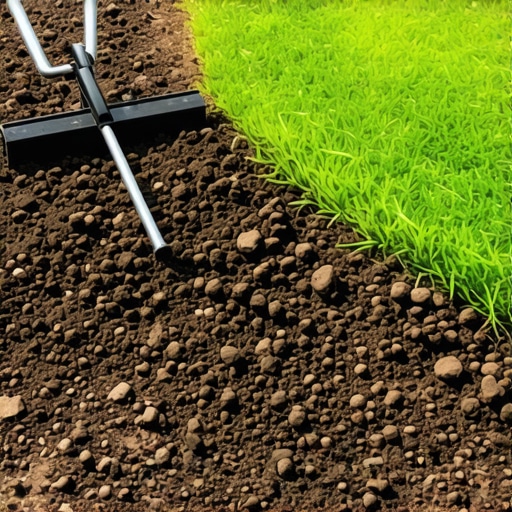
The Forensic Autopsy of a Dying Lawn
You see the symptoms every year: water pooling on the surface for days after a light rain, or turf that turns into a cracked, sun-baked brick by July. Most homeowners think they have a grass problem. They don’t. They have a soil physics problem. Clay soil is composed of microscopic, flat platelets that stack together like a deck of wet cards. This eliminates pore space, kills oxygen exchange, and physically crushes the roots of your turf. If you try to just throw seed or lay sod on top of raw clay, you are wasting money. It will die. I have spent two decades fixing the messes left behind by contractors who didn’t understand the difference between dirt and soil.
The Chemical Nightmare: Why Your Fertilizer is Killing Your Clay
Prepping clay soil for grass requires mechanical aeration and the aggressive incorporation of organic matter to break the ionic bonds of clay particles. By using core aeration, compost top-dressing, and gypsum applications, you create the necessary macropores for water infiltration and root respiration.
A homeowner once called me in a panic after they completely torched their front lawn by applying three times the recommended amount of high-nitrogen weed-and-feed on a 90-degree day. In clay soil, the drainage is so poor that those chemicals didn’t wash through. They sat in the top inch of the soil, concentrating as the water evaporated. The result was a chemical burn that looked like someone had used a flamethrower on the yard. The clay held those salts like a sponge, and we had to excavate four inches of material just to make the ground hospitable again. Don’t be that guy. Clay doesn’t forgive laziness.
| Soil Component | Particle Size | Drainage Rate | Nutrient Retention |
|---|---|---|---|
| Sand | 2.0 – 0.05 mm | Very High | Low |
| Silt | 0.05 – 0.002 mm | Moderate | Medium |
| Clay | Less than 0.002 mm | Very Low | Extremely High |
Why Clay Soil Resists Traditional Landscaping Methods
Clay has a high Cation Exchange Capacity (CEC). This sounds like a good thing because it holds onto nutrients, but it also holds onto water with a death grip. This is called matric potential. The water molecules are so tightly bound to the clay surfaces that the grass roots cannot physically suck them away. To fix this, you need to change the soil structure, not just the chemistry.
“Clay soils are often characterized by high water-holding capacity but low permeability, leading to anaerobic conditions that inhibit root respiration.” – Agronomy Extension Manual
How much topsoil do I need to fix clay?
You cannot simply put two inches of topsoil over clay and expect results. This creates a boundary layer that prevents water from moving between the two distinct soil textures. You must till or incorporate at least 3 to 4 inches of organic matter into the top 6 inches of the existing clay to create a transitional zone. This ensures roots don’t stop at the clay line.
Does gypsum really fix clay soil?
Gypsum is not a magic wand. It works specifically on sodic soils where high sodium levels cause clay particles to repel each other and collapse (dispersive soil). In most residential yards, gypsum helps with flocculation—clumping small particles into larger ones—but it requires years of application and supplemental organic matter to see a 10% improvement in drainage. Do not rely on it as a quick fix.
The Operational Lane: Turf Remediation and Sod Install
If you are planning a sod install on clay, your prep work is 90% of the job. Once the sod is down, you cannot easily fix the soil beneath it. First, perform a jar test. Fill a mason jar one-third with your soil, add water, shake it, and let it settle. If the water stays cloudy for 24 hours, you have high clay content. Here is the professional checklist for yard cleanup and prep before the first piece of sod touches the ground.
- Excavate to 4 inches below the desired final grade to allow for amendments.
- Test pH levels; clay is often alkaline or extremely acidic depending on your region.
- Apply 1 inch of leaf compost or aged manure across the entire surface.
- Use a heavy-duty rear-tine tiller to integrate the organic matter.
- Level the area using a landscape rake to prevent low spots where water will sit.
- Roll the soil with a half-filled water roller to firm the surface without over-compacting.
“A retaining wall doesn’t fail because of the stone; it fails because of the water trapped behind it.” – Hardscape Engineering Axiom
The same logic applies to your lawn. If your yard has a slope that dumps water into a flat clay area, you need to install a French drain or a catch basin before you even think about grass. No amount of soil prep will save a lawn that is under a constant hydrostatic load from uphill runoff.
Irrigation Logic for Heavy Soils
Most people kill their grass on clay by watering every single day for 10 minutes. This is a mistake. It keeps the top half-inch of clay saturated while the roots stay shallow. You need to water deep and infrequent. Aim for 1 inch of water per week, delivered in two 45-minute sessions. This forces the roots to dive deep into the clay to find moisture, which naturally aerates the soil over time. Stop the cycle of light watering. It leads to shallow roots and fungal rot.
Final Maintenance Requirements for Clay-Based Lawns
You are never truly finished with clay soil. It is a living, shifting medium. Every fall, you should perform a core aeration. Do not use those spike aerators; they actually increase compaction by pushing soil sideways. Use a machine that pulls 3-inch plugs out of the ground. Leave the plugs to melt back into the yard, and immediately top-dress with a fine layer of compost. This is the only way to keep the oxygen channels open. It is hard work. It is dirty. But it is the only way to get a professional-grade lawn on a clay base.