
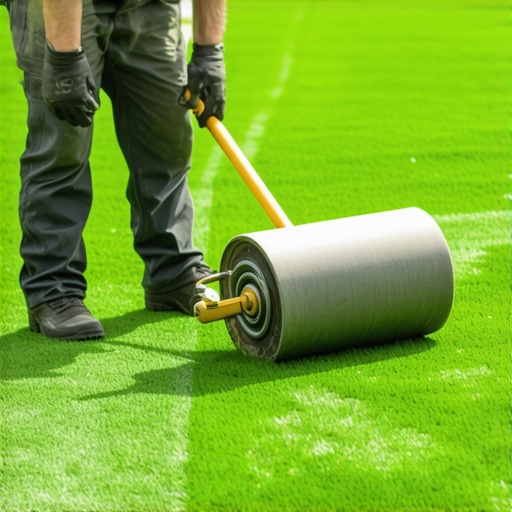
I always drill into my new crew members: if you don’t fix the soil grading first, every plant you put in the ground is just expensive compost. Last season, I watched a guy down the street lay $5,000 worth of premium Zeon Zoysia over a yard that looked like a lunar crater. He didnt prep the grade, and he certainly didnt use a roller. Three weeks later, the edges were curling like burnt paper. He called me asking for a magic spray. There is no magic spray for poor physics. Landscaping is a game of contact and moisture. If the roots arent touching the dirt, they are dying. It is that simple.
Why New Sod Fails to Take Root
The primary cause of new sod failure is poor root-to-soil contact which creates deadly air pockets that desiccate the tender root system before it can establish capillary action with the subsoil. Without mechanical compression from a weighted roller, the sod remains suspended above the grade, leading to hydrophobic conditions and eventual death.
When you lay a piece of sod, you are essentially performing a massive transplant surgery. The grass has been sliced away from its life support system at the sod farm. It arrives with a root system that is maybe half an inch thick. If there is even a two-millimeter gap between that root mat and your yard soil, the air in that gap will suck the moisture out of the roots. This is called desiccation. You can water all day, but if the water just runs through the gaps and the roots are hanging in the air, the grass will brown out. Most homeowners think they need more fertilizer. They dont. They need a heavy metal drum filled with water.
“Turfgrass establishment success is directly proportional to the percentage of root-to-soil contact achieved during the first 24 hours of installation.” – Texas A&M Agrilife Extension
The Physics of the Heavy Roller
The heavy roller trick is not about flattening the grass; it is about eliminating the micro-voids in the soil surface. We use a roller that weighs at least 200 to 300 pounds when filled. This provides enough pounds per square inch (PSI) to press the sod into the grade without causing anaerobic compaction. You want the sod to feel like it is part of the earth, not a carpet laid on a floor. When you walk on properly rolled sod, your foot shouldn’t feel any ‘squish’ or ‘give.’ It should feel firm.
The Critical Yard Cleanup and Prep Phase
Before the first piece of sod touches the ground, your yard cleanup must be surgical. You cannot lay sod over old dead grass or weeds. That organic matter will rot, creating a layer of slime that prevents roots from penetrating. We use a sod cutter to take the yard down to the bare dirt. Then, we check the soil pH. Most turf prefers a pH between 6.0 and 7.0. If your soil is sitting at a 5.0, your new sod will go into shock the moment it hits the ground. We use pelletized lime to correct acidity or sulfur for alkalinity, but this has to be tilled in before the sod arrives.
How much modified gravel do I need for a patio base?
While we are talking about grading, remember that if you are doing a hardscape next to your sod, you need a minimum of 4 to 6 inches of compacted 21A or CR-6 modified gravel to prevent shifting. This base must be mechanically vibrated to achieve 98 percent Proctor density. If the base fails, the drainage fails, and your new sod will end up underwater every time it rains.
Irrigation Engineering for Sod Survival
Irrigation is where most people fail after the roller does its job. You cannot just turn on a hose and hope for the best. You need to understand precipitation rates. New sod needs to be kept in a state of constant moisture for the first 14 days. We are talking about watering 3 to 4 times a day for short bursts. The goal is to keep the sod mat and the top 2 inches of soil wet. After day 14, you pivot. You stop the frequent light watering and move to deep, infrequent watering. This forces the roots to grow downward to find water. If you keep the surface wet forever, the roots will stay shallow. Shallow roots mean the lawn will die the first time the temperature hits 90 degrees.
“A retaining wall doesn’t fail because of the stone; it fails because of the water trapped behind it.” – Hardscape Engineering Axiom
This same logic applies to your lawn. If your irrigation system creates puddles, you are drowning the roots. We check for head-to-head coverage. Every sprinkler head must reach the base of the next head. If you have a dry spot, that sod will peel up. Once it peels, it is hard to save.
Professional Sod Installation Comparison Table
| Soil Type | Roller Weight (Empty/Full) | Compaction Risk | Watering Frequency (Week 1) |
|---|---|---|---|
| Heavy Clay | Fill 1/2 Full (150 lbs) | High – Avoid Over-rolling | 3x Daily / 10 Mins |
| Sandy Loam | Fill Full (300 lbs) | Low – Needs High PSI | 4x Daily / 15 Mins |
| Silty Soil | Fill 3/4 Full (225 lbs) | Medium | 3x Daily / 12 Mins |
Can you over-roll new sod?
Yes, you can over-roll if the soil is saturated. If you see water squeezing out of the sod like a sponge while you roll, stop immediately. You are destroying the soil structure and crushing the macropores that allow oxygen to reach the roots. Roll once in one direction, and once perpendicular. That is it. Don’t play around with it.
The Professional Sod Installation Workflow
- Step 1: Complete 811 utility marking and remove all existing vegetation.
- Step 2: Grade the subsoil to a 2 percent slope away from any foundations.
- Step 3: Apply a high-phosphorus starter fertilizer (e.g., 10-20-10) to promote root initiation.
- Step 4: Lay sod in a staggered, brick-like pattern to minimize seam evaporation.
- Step 5: Fill the lawn roller with water and execute the 2-way rolling pattern.
- Step 6: Initiate first irrigation cycle within 30 minutes of rolling.
It will rot. If you leave your sod on the pallet for more than 24 hours in the summer, the internal temperature will exceed 120 degrees due to microbial activity. You are essentially cooking the grass from the inside out. Get it off the pallet, get it on the ground, and get the roller on it. Don’t skip this. If you follow these mechanical steps, you won’t need a miracle to have a green lawn.
Comments are closed.