
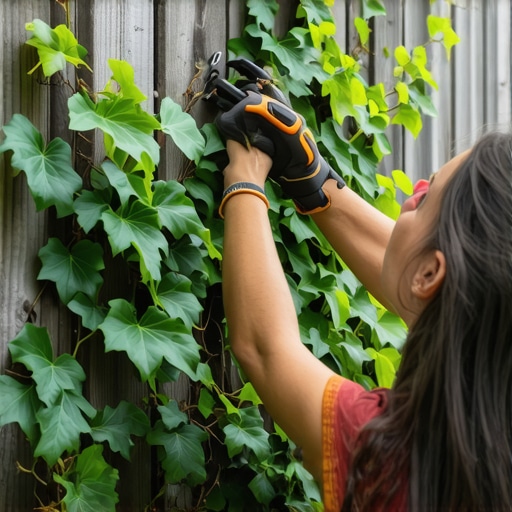
Why Ivy is a Structural Hazard to Your Perimeter
Thick ivy like English Ivy (Hedera helix) traps moisture against wood grain, creating a micro-environment for rot-inducing fungi and wood-boring insects to compromise structural integrity. Leaving it unchecked leads to catastrophic weight loads that can snap fence posts at the frost line or soil grade. I always drill into my new crew members: if you don’t fix the soil grading first, every plant you put in the ground is just expensive compost. I saw this firsthand last July on a yard cleanup job in the suburbs. The homeowner thought their fence was just covered in a picturesque green coat. I touched it, and the entire 8-foot section swayed four inches. The ivy had grown so thick it was literally the only thing holding the rotted cedar posts upright. When we finally stripped it, the wood underneath had the consistency of wet cardboard. We had to pivot from a simple cleanup to a full landscaping overhaul, including sod install and new 4×4 pressure-treated posts set in 3000 PSI concrete. Don’t let a $50 vine turn into a $5,000 fence replacement.
“The persistence of aerial rootlets in Hedera species allows for significant mechanical attachment to substrates, often leading to moisture retention and structural decay in softwoods.” – Horticultural Science Bulletin
How long does it take for ivy to rot a wood fence?
Depending on the species and the local humidity, English Ivy can compromise a standard cedar fence in as little as five to seven years. The aerial rootlets penetrate the soft summerwood between the harder growth rings, creating pathways for water to enter the core of the lumber. This isn’t just about aesthetics; it is about the biology of lignin breakdown. Once those rootlets find a gap, they expand, acting like tiny wedges that split the wood grain from the inside out.
The Strategic Removal Process: Cutting the Lifeline
To safely remove thick ivy without splintering the wood, you must first perform a girdle cut at the base of the plant. By severing the main vascular system near the soil, the vine loses turgor pressure, causing the aerial rootlets to desiccate and lose their grip over 3 to 4 weeks. Attempting to rip live, hydrated ivy off a fence is a rookie mistake. The suction is too high, and you will take half the wood finish with it. You need patience. Cut the main trunks at the ground level with bypass loppers, leaving a 6-inch gap between the soil and the remaining vine. This also gives you a chance to check your irrigation lines. Often, ivy thrives because a leaky sprinkler head is keeping the fence line perpetually damp.
Can I use a pressure washer to remove ivy from a fence?
You can, but you must keep the pressure under 1500 PSI and use a 25-degree wide-fan tip. Anything higher will defibrillate the wood, tearing the soft fibers and leaving a fuzzy texture that is impossible to stain properly. The goal isn’t to blast the ivy off; it is to use the water to lubricate the remaining dried rootlets so they slide off the grain. Stop if you see the wood turning white or “fuzzing.”
The Forensic Autopsy of Ivy Damage
Before you even think about sod install or new landscaping, you need to assess the damage left behind. Once the ivy is gone, look for “pocket rot.” This usually occurs where the horizontal rails meet the vertical posts. If you can poke a screwdriver more than half an inch into the wood, the structural integrity is gone. This is often caused by poor yard cleanup habits where leaf litter is allowed to pile up against the fence, creating a bridge for moisture. Check the table below to identify what you are dealing with.
| Ivy Species | Attachment Method | Wood Damage Risk | Removal Difficulty |
|---|---|---|---|
| English Ivy | Aerial Rootlets | Extreme (Moisture Trap) | High |
| Boston Ivy | Adhesive Disks | Moderate (Staining) | Medium |
| Creeping Fig | Suction/Roots | High (Penetrative) | High |
| Trumpet Vine | Twining/Roots | Severe (Weight) | Medium |
Notice that English Ivy is the worst offender. It doesn’t just sit on the surface; it integrates into the material. If your fence is made of pine or spruce, the damage will be 40% faster than with cedar or redwood due to lower natural tannin levels. I have seen irrigation systems that were poorly aimed contribute to this, spraying the ivy daily and essentially feeding the rot. Ensure your zones are adjusted to hit the root zone of your landscaping, not your structural wood.
“A retaining wall or fence doesn’t fail because of the material; it fails because of the water trapped behind or within it.” – Hardscape Engineering Axiom
Step-by-Step Remediation Checklist
- Girdle the vines: Cut a 6-inch section out of every main stem at the base.
- Wait 21 days: Let the foliage turn brown and the rootlets dry out.
- Manual Removal: Pull downwards, not outwards, to minimize grain lift.
- Nylon Scrubbing: Use a stiff nylon brush to remove residual “feet.” Avoid steel brushes.
- Wood Brightener: Apply an oxalic acid-based brightener to kill remaining fungal spores.
- Seal: Once the wood moisture content is below 12%, apply a high-quality oil-based sealer.
Should I use chemicals to kill the ivy first?
Avoid using non-selective herbicides like glyphosate on vines still attached to the fence. The chemical won’t magically make the vine fall off, and the overspray will kill your sod and surrounding landscaping. Stick to mechanical cutting and patience. If you must use a killer, paint it directly onto the freshly cut stumps at the ground level to kill the root ball without affecting the fence or other plants. When we do a yard cleanup, we prioritize the health of the soil microbiology; dumping gallons of herbicide is a hack move that ruins the pH for future planting.
The Post-Removal Maintenance Schedule
Once the fence is clear, the job isn’t over. Ivy is resilient. You will see new shoots appearing from the ground within weeks. This is where landscaping discipline comes in. Mulch the area with 3 inches of double-ground hardwood mulch to suppress new growth. Keep a 12-inch “no-fly zone” between your sod install and the fence line. This allows for airflow and prevents the grass-to-wood moisture transfer. Check your irrigation timers. If the fence stays wet for more than 4 hours after a cycle, you are asking for the rot to return. Every two years, inspect the wood finish. If water stops beading, it is time for a new coat. Don’t be lazy. A well-maintained fence lasts 25 years; a neglected one lasts 8. Pick your side.
Comments are closed.