
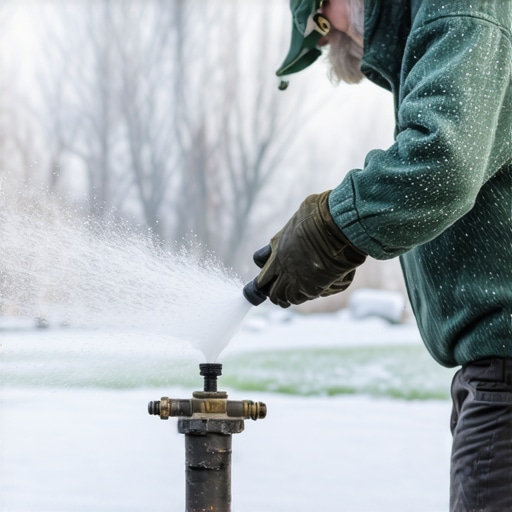
Why Professional Irrigation Winterization is Non-Negotiable
To effectively blow out your sprinklers, you must use a high-volume air compressor to purge every drop of water from the lines, valves, and heads. This prevents hydrostatic expansion from shattering PVC pipes and cracking expensive brass backflow preventers when the ground temperature drops below 32 degrees Fahrenheit. Most DIY attempts fail because they lack the Cubic Feet per Minute (CFM) necessary to move water out of the low spots in the piping.
I always drill into my new crew members: if you don’t fix the soil grading first, every plant you put in the ground is just expensive compost. It is the same with irrigation. If you do not understand the physics of the system, you are just blowing hot air into a disaster. I remember a kid we hired three years ago who thought he could use a little 5-gallon pancake compressor to winterize a 12-zone estate. He spent six hours on site. The first hard freeze hit in November, and by March, that yard was a swamp. The lateral lines had hairline fractures every six feet because the air just skipped over the water sitting in the pipe bellies. We had to rip up the entire sod install to fix his laziness. It cost the company five figures. Now, we do it the right way: high volume, controlled pressure, and zero shortcuts.
“Residual water in irrigation lines can expand by 9 percent upon freezing, generating enough internal pressure to shatter schedule 40 PVC or rupture polyethylene tubing.” – University of Nebraska-Lincoln Extension
How much air pressure is safe for PVC pipes?
When winterizing a system, air pressure should never exceed 50 to 80 PSI for PVC mainlines or 50 PSI for polyethylene tubing. While the pipes might be rated for higher water pressure, compressed air carries significantly more kinetic energy. Excessive pressure or heat from the compressor can melt the internal seals of your zone valves or literally explode a sprinkler head out of the ground. It is about volume, not just raw force.
[IMAGE_PLACEHOLDER]
Can I use a small pancake compressor for a blowout?
A small pancake compressor is wholly inadequate for irrigation winterization because it lacks the necessary volume (CFM) to keep the water moving as a solid slug. You need a compressor capable of delivering 80 to 100 CFM to properly clear a residential system. Small DIY units usually provide less than 5 CFM, which only creates a small channel of air above the water, leaving the pipes vulnerable to ice expansion.
The Engineering of a Perfect Blowout
The goal is to move a wall of air through the pipes. Water is heavy. If the air velocity is too low, the air will simply bubble over the water trapped in the dips of the trench. This is especially true if your landscaping contractor didn’t grade the trenches properly. We use industrial-grade tow-behind compressors. We hook into the blowout port after the backflow preventer. We run each zone until the heads mist and then stop. Running them dry for too long creates friction heat. That heat melts the plastic gears inside rotary heads. You have to be precise. It is a balance of thermodynamics and mechanical engineering.
| System Component | Failure Risk Level | Replacement Cost (Estimated) |
|---|---|---|
| Backflow Preventer | Critical | $400 to $900 |
| Zone Control Valve | Moderate | $150 to $300 |
| Lateral PVC Lines | High | $500 to $2000 (plus labor) |
| Pop-up Sprinkler Heads | Low | $20 to $50 per head |
Integrating Winterization into Your Yard Cleanup
Irrigation shut-off is just one piece of a professional yard cleanup. If you are doing a late-season sod install, the timing is even more delicate. New turf needs moisture to survive the winter dormancy, but the pipes cannot hold water once the frost depth reaches six inches. We often install the sod, give it a deep soak (at least 1 inch of water to reach the root zone), and then immediately blow the lines. This forces the roots to chase the receding moisture deeper into the soil profile as the surface dries out. It makes for a hardier lawn in the spring.
“A retaining wall doesn’t fail because of the stone; it fails because of the water trapped behind it, and irrigation leaks are the primary culprit for sub-grade saturation.” – Hardscape Engineering Axiom
- Shut off the main water supply valve inside the basement or crawlspace.
- Verify the air compressor is set to the correct CFM and PSI before connecting.
- Open the furthest zone valve manually or via the controller.
- Blow through each zone until only a fine mist exits the heads.
- Leave all test cocks on the backflow preventer open at a 45-degree angle.
The Post-Blowout Checklist
Once the air is through, you aren’t done. You must drain the “dead leg” of the pipe inside the house. If that small section of copper freezes, it will burst inside your wall. We also check the rain sensor. If it’s full of water, it will crack. Most homeowners forget the small details. They forget that the irrigation system is a closed loop. Any trapped pocket of liquid is a ticking time bomb. We treat every system like it is a $100,000 asset because, between the plants, the hardscape, and the turf, it usually is. Do not trust your yard to a guy with a shop vac. It will rot. It will fail. And you will be the one paying the bill in May.