
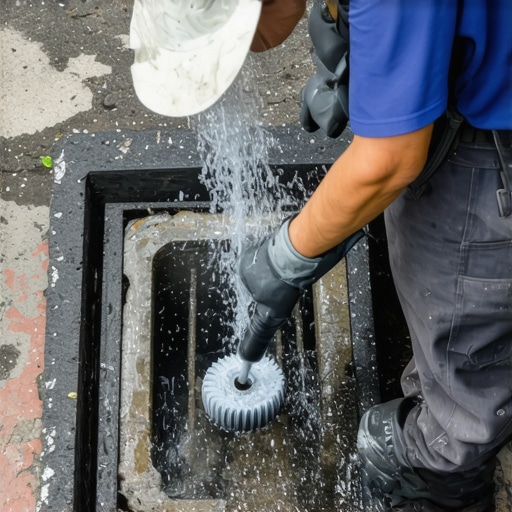
Why Your Yard Drain Keeps Failing
The secret to clearing clogged drain grates forever involves proper catchment design, sediment filtration, and regular maintenance schedules that prevent organic debris and siltation from compromising the hydrostatic pressure limits of your drainage system. Most homeowners focus on the grate surface, but the real failure happens in the catch basin or discharge pipe due to improper slope gradients or soil migration.
I recently got called out to tear up a $30,000 patio that was sinking because the previous contractor failed to account for basic fluid dynamics. The homeowner was furious, watching their high-end pavers dip into a bowl of stagnant water every time it rained. When we excavated, we found the drainage grates were pristine on top but completely packed with compacted clay and decomposed leaf litter underneath. The installer had used cheap, non-woven fabric that had blinded—meaning the pores were totally plugged—preventing water from ever reaching the 4-inch corrugated pipe. It was a structural autopsy of a preventable disaster. If you don’t fix the soil grading and the sub-surface filtration first, every grate you install is just a decorative lid on a future swamp.
The Mechanics of Siltation and Surface Runoff
Siltation occurs when suspended solids in stormwater runoff settle in areas of low velocity, typically within drainage channels or catch basins where the flow rate drops below 2 feet per second. To prevent this, you must understand the Bernoulli principle as it applies to open-channel flow and ensure your landscaping elements, such as sod install and yard cleanup, are managed to minimize erosive forces on bare soil.
“A retaining wall doesn’t fail because of the stone; it fails because of the water trapped behind it.” – Hardscape Engineering Axiom
The problem with most irrigation setups is they contribute to the problem by keeping the soil at a high saturation point. When the rain hits, the ground has zero infiltration capacity. This leads to immediate surface runoff, carrying mulch, fines, and organic matter directly toward your grates. If your sod install wasn’t rolled properly, those loose edges become a primary source of sediment transport. You aren’t just clearing a grate; you are managing a watershed. I tell my crew: if the compaction isn’t at 95% Proctor density around those basins, they will shift, the seals will break, and dirt will find its way in. It is inevitable.
How much modified gravel do I need for a patio base?
For a standard hardscape installation, you need a minimum of 6 inches of modified gravel (2A or 2B), compacted in 2-inch lifts to ensure stability and proper pore space for vertical drainage. This base prevents the capillary rise of water which often pushes fine particulates into your drainage grates from below.
| Grate Material | Load Class | Best Use Case | Clog Risk |
|---|---|---|---|
| Plastic/Polymer | Class A/B | Residential Walkways | High (Lightweight) |
| Cast Iron | Class C/D | Driveways/Heavy Traffic | Medium (Heavy Weight) |
| Stainless Steel | Class A | Modern Patios/Pools | Low (Precision Slots) |
To keep these systems running, you must implement a technical maintenance protocol. This isn’t just a yard cleanup; it’s a preventative engineering task. You need to inspect the invert elevation of your pipes twice a year. If the pipe is half-full of silt, your flow capacity is reduced by 70%. That’s math, not an opinion. We use high-pressure water jetting to clear lines, but the secret is the sump. A proper catch basin should have at least 6 inches of space below the outlet pipe. This creates a settling chamber where heavy solids drop out before they can enter the horizontal run.
How do I stop dirt from clogging my drain grates?
To stop dirt from clogging grates, you must install a sediment filter bag or non-woven geotextile liner inside the catch basin and maintain a 2% positive grade away from the grate to prevent ponding and sediment drop-out. Regular irrigation audits help ensure that overspray isn’t eroding the soil profile adjacent to the drainage inlet.
“Effective site drainage requires a holistic approach, integrating soil permeability, surface slope, and mechanical conveyance systems to mitigate peak flow events.” – Penn State Agricultural Extension
- Pre-Season Inspection: Remove grates and vacuum out the basin sumps.
- Filter Replacement: Swap out saturated sediment bags every 6 months.
- Gully Guarding: Use cobble or rip-rap around inlets to slow water velocity.
- Root Management: Apply a copper-sulfate based root foam if you suspect root intrusion near PVC joints.
Don’t ignore the discharge point. If your pop-up emitter or daylight exit is buried in turf grass or thatch, the water backs up. When water stops moving, the silt drops. Once that silt dries, it becomes a brick-like plug. You cannot clear that with a garden hose. You’ll be digging it up. I’ve seen 4-inch SDR-35 pipes completely occluded because a mow-and-blow guy blew grass clippings into the drainage channel for three years. It’s a slow death for your landscaping. Clean the grates. Flush the lines. Keep the water moving. It’s that simple, and that difficult.
{“@context”: “https://schema.org”, “@type”: “FAQPage”, “mainEntity”: [{“@type”: “Question”, “name”: “How often should I clean my yard drain?”, “acceptedAnswer”: {“@type”: “Answer”, “text”: “You should inspect and clean your yard drain grates and catch basins at least twice a year, ideally in the spring and fall, or after any major storm event exceeding 1 inch of rainfall to prevent sediment build-up.”}}, {“@type”: “Question”, “name”: “What is the best way to unclog a buried drainage pipe?”, “acceptedAnswer”: {“@type”: “Answer”, “text”: “The most effective professional method is hydro-jetting, which uses high-pressure water to break up compacted debris and flush it out of the system without damaging the pipe walls.”}}]}