
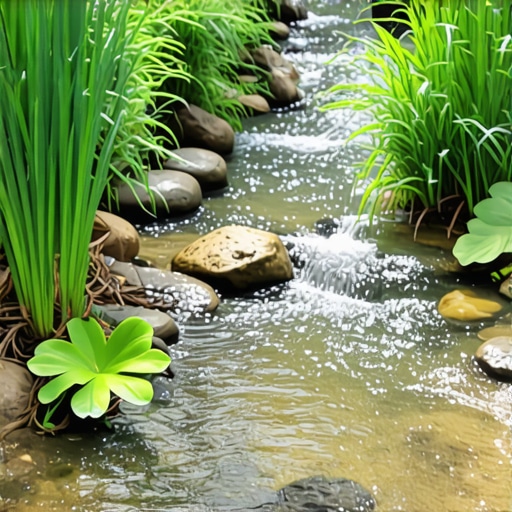
Engineering the Perfect Backyard Stream: Why Most Water Features Fail
A clear backyard stream requires a robust biological filtration system using beneficial bacteria to convert ammonia into nitrates. Maintaining a dissolved oxygen level above 6 mg/L prevents anaerobic conditions that cause foul odors. If you fail to account for the nitrogen cycle, you are not building a stream; you are building a stagnant open-air sewer. I always drill into my new crew members: if you don’t fix the soil grading first, every plant you put in the ground is just expensive compost. This technical wisdom is the difference between a high-end landscape and a muddy mess. When we tackle a stream build, we are looking at the hydrostatic pressure of the surrounding soil and the exact flow rate required to prevent stagnation. If your landscaping team does not talk about GPH (gallons per hour) or head pressure, they are the wrong team. You cannot just dig a trench, throw in a liner, and expect a crystal-clear result. It requires an understanding of fluid dynamics and soil microbiology. Most homeowners think they can skip the yard cleanup phase, but allowing decaying organic matter to sit in the stream bed is a recipe for a nitrogen spike that will kill your water quality. We use 45-mil EPDM liners and heavy-duty underlayment because the soil will shift. It is a mathematical certainty. Without that protection, your stream is doomed before the first pump turns on.
The Role of Biological Filtration in Water Clarity
To keep water clear, you must manage the NPK ratios of the water itself, particularly the phosphorus and nitrogen levels that feed algae. We install massive bio-falls that act as the lungs of the system.
“A retaining wall doesn’t fail because of the stone; it fails because of the water trapped behind it.” – Hardscape Engineering Axiom
This same principle applies to stream banks. If you don’t manage the water behind the liner, the entire structure will heave and collapse. We also focus on the bacterial colonies. You need Nitrosomonas and Nitrobacter to process the fish waste and decaying leaves. If your irrigation system is spraying treated city water directly into the stream, the chlorine will nukes these colonies instantly. You need a buffer zone.
How often should I clean my backyard stream filter?
You should inspect your mechanical skimmer every 48 hours during the autumn and perform a deep-clean of the biological filter mats once every six months using de-chlorinated water. Cleaning mats with a garden hose will kill the beneficial bacteria and reset your nitrogen cycle. We recommend a sod install around the perimeter using a high-density fescue to create a natural silt barrier. This prevents soil runoff from entering the stream during heavy rains. Use a 1-inch per week watering schedule to ensure those roots go deep, locking the soil in place.
| Component | Purpose | Maintenance Frequency |
|---|---|---|
| Mechanical Skimmer | Removes surface debris | Weekly |
| Bio-Falls | Biological filtration | Biannually |
| UV Clarifier | Kills planktonic algae | Annually (Bulb) |
| Bottom Drain | Removes sludge | Monthly Flush |
Why does my backyard stream smell like rotten eggs?
A rotten egg smell indicates anaerobic decomposition, meaning there is zero oxygen at the bottom of your stream or pond, allowing hydrogen sulfide gas to build up. This usually happens when the pump is undersized or the yard cleanup was neglected, leaving 4 inches of muck on the bottom. You need a pump that can turn over the entire volume of the stream at least twice per hour. If you have 500 gallons of water, you need a 1,000 GPH pump at minimum, accounting for the vertical lift or “head height.”
“Maintain a pH between 6.5 and 8.5 to ensure microbial activity remains optimal for nitrogen processing.” – Penn State Agricultural Extension
We use specific gravity tests and pH meters to verify these levels during the first month of any new install. It is not about guessing; it is about chemistry.
- Check the pump intake for leaf clogs daily.
- Maintain a 2% slope for optimal oxygenation.
- Avoid overfeeding fish to reduce ammonia levels.
- Add aquatic plants like Anacharis for natural oxygenation.
- Use 811 before any excavation for stream plumbing.
The Structural Integrity of the Stream Bed
We use modified gravel bases and screed pipes even for the stream segments. This isn’t just for aesthetics. A compacted base prevents the settling that leads to liner punctures. When we perform a sod install near the water, we ensure the grade slopes away from the stream at a minimum 2% pitch. This is the only way to prevent fertilizer runoff from your landscaping from turning your stream into a green algae soup. The phosphorus in standard lawn fertilizers is absolute poison for water clarity. Always use a phosphorus-free blend near water features. We also look at the local soil. If you have heavy red clay, we have to engineer a drainage solution behind the stream walls to prevent the clay from expanding and crushing the feature. It’s about managing the forces of nature through civil engineering. Don’t let a contractor tell you otherwise. They are either lying or they don’t know the math. Your stream should be a closed-loop system, losing water only to evaporation, not to leaks or poor engineering. Perform a bucket test if you suspect a leak. Check the edges. Look for wet spots in the mulch. It is usually a low edge on the liner. Fix it immediately. Use polymeric sand between any decorative boulders to prevent shifting. This keeps the structure rigid and prevents the liner from being exposed to UV rays, which will make it brittle over time. Keep the water moving. Stagnation is the enemy. Flow is the cure.