
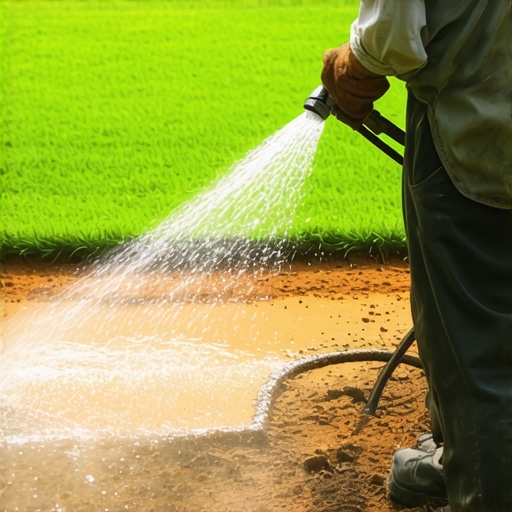
The High Stakes of Clay-Base Sod Installation
Watering new 2026 sod on clay requires a precise balance of low-volume, high-frequency irrigation to accommodate clay’s low infiltration rate and high water-holding capacity. Over-saturating clay soils eliminates necessary oxygen from the root zone, leading to rapid root rot and the failure of the expensive turf investment within days of installation.
I always drill into my new crew members: if you don’t fix the soil grading first, every plant you put in the ground is just expensive compost. I recently watched a competitor lay forty pallets of premium fescue over a site with zero internal drainage. Two weeks later, the yard smelled like a sewer because the clay had trapped three inches of standing water beneath the root mat. The homeowner was out fifteen grand because they didn’t understand the physics of the ground they were standing on. Clay isn’t just ‘dirt’; it is a collection of microscopic plate-like particles that stack together so tightly they can hold water for weeks. When you slap new sod on top of that, you aren’t just planting a lawn; you are managing a biological sponge on a concrete floor.
The Physics of Water Movement in Heavy Clay
Water movement in heavy clay is dictated by hydraulic conductivity, which is significantly lower than in sandy or loamy soils due to the lack of macropores. Because clay particles are chemically charged to hold onto water molecules, the soil stays wet longer but absorbs moisture at a glacial pace, often less than 0.1 inches per hour.
“Clay soils have a low infiltration rate, often less than 0.2 inches per hour, necessitating short, frequent irrigation cycles to prevent runoff.” – NRCS Soil Mechanics Guide
In a standard yard cleanup and sod install, the biggest mistake is running a 20-minute irrigation cycle. On clay, after the first seven minutes, the soil is capped. The remaining thirteen minutes of water simply run off into the street or pool in low spots. This creates a ‘perched water table.’ The sod sits in a literal puddle, the roots suffocate because they can’t exchange gases, and the plant enters a death spiral. You must use ‘cycle and soak’ settings on your irrigation controller. Set it for 5 minutes, let it soak for an hour, and repeat. This forces the water to move deeper into the clay profile through capillary action rather than flooding the surface.
How Much is Too Much? The Saturation Point
Determining the saturation point for new sod on clay involves checking the interface between the sod’s peat or soil base and the native clay subgrade. If the ground feels ‘squishy’ or ‘spongy’ underfoot more than thirty minutes after watering, the soil has reached its field capacity and is now at risk of anaerobic failure.
| Soil Metric | Sandy Loam Standard | Heavy Clay Reality |
|---|---|---|
| Infiltration Rate | 0.5 – 1.0 in/hr | 0.01 – 0.2 in/hr |
| Water Retention | Low (fast drying) | Extreme (stays wet) |
| Root Oxygen Level | High | Low/Critical |
| Irrigation Strategy | Longer, deeper sets | Short, pulsed sets |
You need to be out there with a soil probe or a long screwdriver. Push it into the ground. If it comes up with slick, greyish mud, stop the water. You are drowning the turf. New 2026 sod cultivars are bred for drought resistance, but they still need to establish their roots in the first 14 days. If the clay is too wet, the roots have no reason to grow downward. They will stay in the top half-inch of the sod mat, and as soon as the summer heat hits, that shallow root system will cook. You want the roots to ‘chase’ the moisture down into the clay.
How do I tell if my clay soil is waterlogged?
The most reliable method to identify waterlogged clay is the ‘lift and look’ test, where you peel back a corner of a sod piece to inspect the subgrade. If the clay is glistening with standing water or has developed a blue-grey tint—a sign of gleying—the soil is anaerobic and irrigation must be ceased immediately to allow gas exchange.
What is the best time of day to water new sod?
The optimal time to water new sod is between 4:00 AM and 8:00 AM to minimize evaporative loss and prevent fungal pathogens. Watering in the late evening on clay is dangerous, as the low infiltration rate keeps the foliage wet all night, creating a breeding ground for Pythium blight and Rhizoctonia.
The Sod Survival Checklist for Clay Landscapes
- Verify subgrade compaction; it should be firm but not like kiln-fired brick.
- Apply a gypsum-based soil conditioner before laying sod to improve clay flocculation.
- Set irrigation timers to 4-6 short bursts per day rather than one long soak.
- Check the ‘sod-to-soil’ contact; air pockets will kill roots faster than dry soil.
- Reduce watering frequency by 25% every three days after the first week.
- Never mow until the roots have knitted into the clay, usually 10-14 days.
“Excessive soil moisture in the root zone displaces oxygen, leading to anaerobic conditions that trigger root decay and pathogen proliferation.” – University of California Division of Agriculture and Natural Resources
The Long-Term Maintenance of Clay-Based Lawns
Once the sod is established, the game changes. You have to break the clay’s habit of holding water at the surface. This is where aeration comes in. Every fall, you need to pull deep cores—at least 3 inches. This breaks the surface tension of the clay and allows air to reach the roots. Don’t use those spike aerators; they just compact the clay further. You need a reciprocating power aerator that removes a plug. In the landscaping world, we call this ‘letting the yard breathe.’ Without it, your new sod will eventually thatch over and die. It will rot. Don’t skip this. A yard cleanup isn’t just about raking leaves; it’s about managing the soil biology. If you treat your clay like a living organism, your 2026 sod will last a decade. If you treat it like a bathtub, you’ll be calling me for a rip-and-replace by July.