
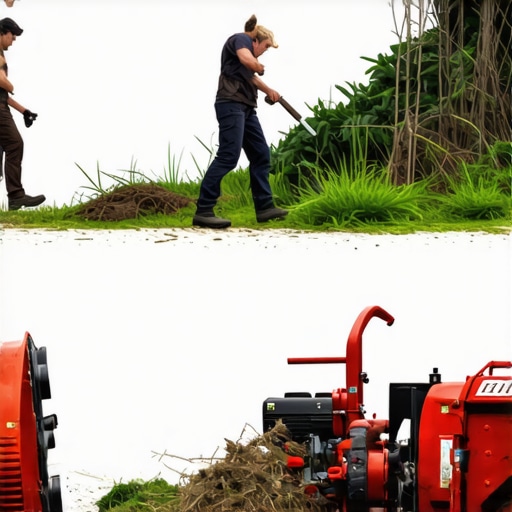
Clearing Thick Brush Piles: 3 Ways to Shred Overgrowth Fast
Landscaping is not about planting petunias. It is about the violent reclamation of space from a forest that wants your property back. I have spent thirty years in the dirt. My hands are calloused because I do not negotiate with invasive overgrowth. When you let a field or a backyard go for three years, you are not looking at a yard anymore. You are looking at a fuel load of woody biomass that will choke out your drainage and harbor every pest known to man. Most homeowners think they can tackle a three-acre thicket with a plastic-string trimmer they bought at a big-box store. That is a joke. You will burn out the motor in twenty minutes. To clear brush fast, you need mechanical advantage and an understanding of biological decomposition.
The Engineering of Brush Reclamation
To clear thick brush fast, you must leverage forestry mulchers, heavy-duty brush hogs, or industrial-grade wood chippers depending on the stem diameter. These machines reduce biomass into a manageable carbon layer that suppresses regrowth while protecting the underlying soil microbiology from erosion and heat. This is the foundation of any high-end yard cleanup.
I always drill into my new crew members: if you do not fix the soil grading and the biomass volume first, every plant you put in the ground later is just expensive compost. I remember a kid named Mike. He spent eight hours hacking at a stand of Multiflora Rose with a machete. He looked like he had been in a cage fight with a mountain lion. I told him to step aside. I brought in the skid steer with a mulching head. In twelve minutes, that rose bush was a two-inch layer of organic mulch. Work smarter. The soil does not care about your sweat; it only cares about the results. If you do not manage the seed bank in that soil during the clearing, the weeds will return before your sod install even takes root.
“Successful brush management requires a multi-year commitment to exhausting the energy reserves stored in the root systems of perennial woody species.” – Texas A&M AgriLife Extension Service
1. Forestry Mulching: The One-Pass Solution
Forestry mulching is the gold standard for high-speed clearing. It involves a high-flow skid steer equipped with a drum or disk that features carbide teeth. These teeth spin at over 2,000 RPM. When they hit a sapling, they do not just cut it. They atomize it. The result is a fine mulch that stays on-site. You do not have to haul anything away. This is critical for soil health. That mulch acts as a temporary erosion control blanket. It keeps the moisture in the ground. It prevents the sun from baking the life out of the earth. We use this when we are preparing a site for a major landscaping overhaul. If the stems are under 6 inches in diameter, the mulcher is king. It handles the brush and the small trees in one motion. It is fast. It is efficient. It leaves the site ready for a rough grade. Do not use this if you have irrigation lines near the surface. The ground pressure and the mulching teeth will shred your pipes.
2. Industrial Brush Hogging for Heavy Grass and Saplings
If you are dealing with tall grass, brambles, and saplings under 2 inches, a brush hog is your tool. This is a rotary cutter. It does not mulch; it shreds. It is essentially a lawnmower on steroids. It uses massive, dull blades that rely on centrifugal force to shatter wood. It is not pretty. The debris is chunkier than what a mulcher produces. However, it is the most cost-effective way to maintain large acreages. We often use this during the first phase of a yard cleanup to see what we are actually dealing with. You cannot grade a yard if you cannot see the ground. Once the brush hog passes, we can see the stumps. We can see the rocks. We can see where the previous contractor buried his mistakes. It is the diagnostic tool of the clearing world. Use it when speed matters more than the final aesthetic of the ground cover.
3. The Manual Extraction and Chipper Workflow
Sometimes you cannot get a machine into the space. Maybe it is a tight side yard or a steep embankment near a retaining wall. This is where we go back to basics, but with better tools. We use chainsaws and high-torque brush saws. Every piece of wood is hand-carried to a commercial-grade chipper. This chipper must have a hydraulic feed. If it does not have a hydraulic feed, it is a hobbyist toy. We feed the brush into the machine, and it spits the chips into the back of a truck or a designated pile. This method is slow. It is labor-intensive. But it is precise. You use this when you need to protect existing high-value trees or delicate irrigation systems. You do not want a 10,000-pound machine rolling over your lateral lines. We follow this up with a herbicide application to the cut stumps. If you do not treat the stump of an invasive species, it will sprout three new heads like a hydra.
“Hydrostatic pressure from trapped water is the primary cause of structural failure in landscape walls and embankments; clearing overgrowth is the first step in restoring proper drainage.” – Hardscape Engineering Axiom
How do you stop brush from growing back after clearing?
To prevent regrowth, you must address the root systems and the seed bank. After shredding, we apply a selective pre-emergent herbicide if the area is going to be turf. If it is going to be a planting bed, we use a heavy layer of wood chips to block light. Light is the trigger for dormant seeds. No light, no weeds. For woody stems, a basal bark treatment with triclopyr is often necessary. This kills the root system without killing the surrounding grass. It is a surgical strike. Don’t just cut it. Kill it.
What is the fastest way to clear brush by hand?
The fastest way to clear by hand is using a high-tension brush scythe or a professional-grade clearing saw with a circular blade. Forget the hand loppers for large areas. You need a tool that allows you to stand upright. Swing in a low, flat arc. Cut the stems at ground level. Pile the brush in a way that the butts are all facing the same direction. This makes feeding the chipper 50% faster. Efficiency is found in the small details. If your pile is a mess, your chipper time doubles.
| Method | Max Stem Diameter | Speed (Acres/Day) | Surface Finish |
|---|---|---|---|
| Forestry Mulcher | 6-8 Inches | 2-4 | Fine Mulch (Walkable) |
| Brush Hog | 1-2 Inches | 5-10 | Rough Shred (Shaggy) |
| Hand Clearing | Unlimited | 0.1-0.2 | Variable/Clean |
Before you even think about a sod install, you have to look at the soil pH. Clearing brush, especially pine or oak, can leave the soil acidic. We always run a soil test. We check the NPK levels and the organic matter percentage. If the brush was thick, the soil is likely depleted. We might add lime to raise the pH. We might add nitrogen to offset the carbon load from the new mulch. Fresh wood chips pull nitrogen out of the soil as they break down. If you lay sod over fresh chips without adding nitrogen, your new grass will turn yellow in a week. It will starve. We plan for this months in advance. Landscaping is a long game. The clearing is just the opening move. Once the ground is bare, we check the irrigation. Roots from brush piles love to wrap around pipes. They crush them. They clog the emitters. We pressure test the whole system before any new plants go in. Don’t skip the testing. It will save you thousands.
- Personal Protective Equipment: Chainsaw chaps, eye protection, and steel-toe boots are non-negotiable.
- Utility Marking: Call 811 before you bring in any heavy machinery.
- Stump Management: Grind them or treat them; never leave a raw stump.
- Soil Testing: Check pH and Nitrogen levels immediately after clearing.
- Debris Plan: Decide if mulch stays on-site or goes to a landfill before you start.
The first year after clearing is the “settling in” period. You will see things pop up. Buried seeds from twenty years ago will finally see the sun and germinate. Do not panic. This is normal. It is just the soil finishing its conversation. You keep mowing. You keep treating. By year two, the site will be stabilized. The root systems of your new sod will have locked into the earth. The irrigation will be dialed in. You will have a yard again. But remember: nature is waiting. If you stop maintaining it, the brush will be back. The forest never sleeps. It just waits for you to get lazy with the mower. Keep the blades sharp. Keep the edges clean. That is how you win.