
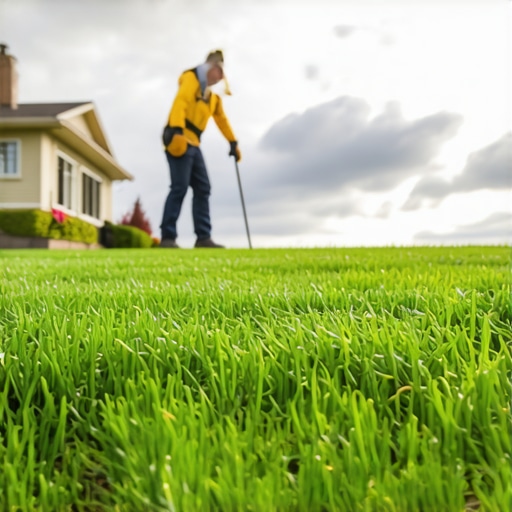
The Anatomy of an Expensive Failure
New sod fails within the first fourteen days primarily due to hydrophobic soil layers, root-zone air pockets, and osmotic stress caused by improper nutrient timing. If the root system cannot establish capillary action with the native subgrade within 72 hours, the plant enters a state of permanent wilting point from which recovery is biologically impossible.
I recently walked a site where a homeowner had just dropped twelve thousand dollars on premium Zoysia. Within nine days, the yard looked like a burnt biscuit. They were frantic. They claimed they watered every day. I took my spade and flipped a piece of the sod over. The soil underneath was bone dry. The contractor had laid the sod over a layer of dead, matted grass from an incomplete yard cleanup. That dead organic matter acted like a sponge, soaking up the water and never letting it reach the actual soil. The roots were literally dangling in mid-air, drying out in the 90-degree heat. This is not a ‘bad batch’ of grass. It is a failure of physics and engineering. If you don’t prep the base, you are just buying expensive compost. Don’t skip the grading. Don’t skip the tilling.
The Soil-Sod Barrier: Why Your Yard Cleanup Was Insufficient
A successful sod install requires a biological handshake between the farm-grown root mass and your local soil horizon. When you leave debris, old turf, or compacted clay in place, you create a physical barrier that prevents root penetration. This is known as layering. The water will hit the sod, travel horizontally across the interface, and never sink into the root zone. You need at least four inches of loosened, friable topsoil to ensure the roots can dive deep before the first heat wave hits.
“Soil compaction is the single greatest barrier to successful turf establishment, as it limits oxygen availability to the rhizosphere and prevents the downward movement of moisture.” – Texas A&M AgriLife Extension
Why did my new sod turn yellow so fast?
New sod turns yellow because of nitrogen volatilization or root asphyxiation. If the soil is too wet, oxygen is pushed out and the roots drown; if it is too dry, the plant cannot transport nutrients. This rapid chlorosis indicates the plant is cannibalizing its own chlorophyll to survive the transplant shock.
The Critical Role of Irrigation and Hydrostatic Pressure
Most homeowners think irrigation is about volume. It is actually about frequency and timing during the first ten days. You are not watering the grass; you are keeping the root-zone interface moist. Once the sod ‘knits’ to the ground, you must shift to deep, infrequent watering to force the roots to chase the moisture downward. If you keep the surface saturated for three weeks, you will develop Pythium blight or Rhizoctonia, fungal pathogens that will liquefy your new lawn in forty-eight hours. It will rot. Watch the edges. They dry first.
| Failure Factor | Impact Level | Prevention Method |
|---|---|---|
| Soil Compaction | Extreme | Mechanical core aeration or tilling to 4-6 inches. |
| Air Pockets | High | Use a 200lb water-filled roller after installation. |
| Chemical Burn | High | Avoid pre-emergent herbicides for 60 days post-install. |
| Improper Grading | Medium | Ensure 2% slope away from structures to prevent pooling. |
How much modified gravel do I need for a patio base?
To calculate modified gravel (2A or CR617), multiply the square footage by the depth in feet (usually 0.5 for 6 inches), then divide by 27 to get cubic yards, and multiply by 1.5 to account for compaction density. Proper hardscape drainage prevents runoff from drowning adjacent landscaping areas.
The Chemical Nightmare: Fertilizer Mismanagement
I see this every spring. A homeowner wants to ‘help’ the new sod by throwing down a high-nitrogen ‘weed and feed’ they bought at a big-box store. This is a death sentence. The pre-emergent chemicals in those bags are designed to stop cell division in roots. Since your sod is 100% new root growth, you are effectively poisoning the lawn’s ability to heal itself. You need a high-phosphorus starter fertilizer, not a herbicide cocktail. Check the N-P-K ratio. You want the middle number to be high to encourage root branching. Anything else is a waste of money.
“A retaining wall doesn’t fail because of the stone; it fails because of the water trapped behind it, and the same hydrostatic pressure can drown a new lawn’s root system if the site isn’t graded correctly.” – ICPI Hardscape Engineering Axiom
- Kill everything first: Use a non-selective herbicide 14 days before install.
- Grade for drainage: Water must move away from the house at 1 inch per foot.
- Soil Test: If your pH is below 6.0, your sod cannot intake phosphorus.
- The Snap Test: If you can pull up a corner of the sod after day 10, your roots are failing.
The 2026 Climate Shift and Cultivar Selection
By 2026, we are seeing more volatile heat spikes. Standard Kentucky Bluegrass is struggling in zones where it used to thrive. You should be looking at RTF (Rhizomatous Tall Fescue) or heat-tolerant hybrids. These cultivars have been engineered to develop deep taproots that survive 100-degree days better than old-school varieties. If you buy cheap sod, you get cheap genetics. Cheap genetics die in July. Invest in high-end nursery stock. It pays for itself in reduced water bills alone. Do the math. Don’t be cheap on the prep work. The dirt matters more than the grass.