
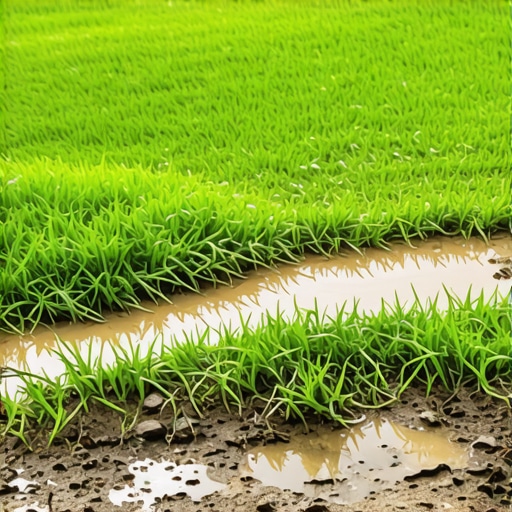
The Olfactory Warning: Why Your Turf Smells Like Sulfur
Fixing water-logged sod requires identifying the saturation point and soil drainage rate. If your 2026 sod install smells like sulfur, you likely have anaerobic conditions caused by poor sub-surface grading or a lack of permeable aggregate layers that allow oxygen to reach the root zone.
You step out onto your new lawn and it doesn’t feel like a carpet; it feels like a sponge. Worse, there is a distinct, metallic, egg-like stench rising from the blades. That is the smell of methane and hydrogen sulfide. It is the smell of a dying investment. I recently got called out to tear up a $30,000 patio and adjacent sod install that was sinking and rotting because the previous contractor ignored the hydrostatic pressure building up behind a poorly vented retaining wall. The water had nowhere to go, so it sat under the sod until the roots literally liquefied. The soil was a black, slimy mess. It didn’t have to be this way. If you ignore the soil physics, the biology will fail every single time. It is that simple.
The Physics of Drainage: Why Soil Grading Trumps Aesthetics
Proper landscaping drainage relies on a minimum 1% to 2% slope away from structures to prevent water logging. Without this topographical grade, water occupies the pore space in the soil, displacing oxygen and suffocating the microbial life necessary for nitrogen uptake.
“A retaining wall doesn’t fail because of the stone; it fails because of the water trapped behind it.” – Hardscape Engineering Axiom
When we talk about sod install, most people think about the green side. I think about the brown side. If your soil has a high bulk density—meaning it is compacted—the water cannot move vertically through the profile. It sits. This creates a perched water table. In heavy clay soils, common in many residential developments, the clay particles are so small and flat that they stack like plates, leaving no room for water to exit. You need macropores. You get those through core aeration and the introduction of organic matter, but if the grade is wrong, even the best soil will eventually saturate.
How do I fix standing water after sod installation?
To fix standing water, you must install sub-surface drainage such as a French drain or catch basin system. You must also verify that the irrigation schedule is not exceeding the infiltration rate of your specific soil type, which is often less than 0.5 inches per hour in clay.
| Solution | Efficiency | Estimated Cost (per linear ft) | Primary Function |
|---|---|---|---|
| French Drain | High | $25 – $50 | Relieving sub-surface hydrostatic pressure |
| Catch Basin | Medium | $15 – $30 | Removing surface pooling quickly |
| Dry Creek Bed | Low/Medium | $40 – $80 | Aesthetic water redirection |
| Soil Amendment | Variable | $5 – $15 | Increasing soil porosity |
The ‘Black Layer’ Syndrome: Diagnosing Anaerobic Soil
The black layer is a physical manifestation of anaerobic respiration where bacteria produce sulfides that react with iron in the soil. This creates a toxic environment that prevents root elongation and leads to turfgrass decline and Pythium blight.
I tell my crew: if you see a black line two inches down, the lawn is drowning. It’s not a mystery. It’s chemistry. When oxygen is depleted, anaerobic bacteria take over. They produce gases that are toxic to the Poa pratensis or Festuca arundinacea roots. You can’t fix this with fertilizer. In fact, adding high-nitrogen fertilizer to a water-logged lawn is like throwing gasoline on a fire; it encourages fungal pathogens to feast on the weakened tissue. Stop the water first. Then fix the soil. Don’t skip this.
Why does my new grass feel spongy?
Spongy grass is usually a sign of excessive thatch or soil saturation where the sod knits have not properly integrated with the sub-base. This prevents capillary action from pulling moisture down into the deeper soil profile, leaving the surface layer perpetually wet.
Remediation: The Professional Restoration Protocol
Remediating rotten sod involves mechanical aeration, the application of calcined clay or gypsum to break up clay bonds, and potentially a full yard cleanup to remove anaerobic organic matter. In extreme cases, the sod must be lifted to correct sub-grade depressions.
- Step 1: Conduct a percolation test to determine the current drainage rate.
- Step 2: Mark all utility lines via 811 before any excavation.
- Step 3: Install 4-inch perforated NDS pipe wrapped in geotextile fabric for drainage.
- Step 4: Use #57 stone as an aggregate base for all drainage trenches.
- Step 5: Apply top-dressing with a 70/30 sand-to-compost ratio to improve surface infiltration.
- Step 6: Adjust irrigation heads to ensure head-to-head coverage without over-saturation.
“Soil saturation for more than 48 hours during the growing season will lead to significant root mortality in most cool-season turfgrasses.” – Penn State Department of Plant Science
Irrigation Calibration and Long-Term Maintenance
Successful landscaping management requires evapotranspiration (ET) based watering. Most homeowners over-water by 300%. You need to water deep and infrequent. You want to force those roots to dive deep into the soil to find moisture. If you keep the top inch constantly wet, you are just inviting root rot. Check your irrigation controller. If it’s raining, turn it off. Better yet, install a smart moisture sensor. It will save your lawn and your wallet. It will rot if you don’t. Period.