
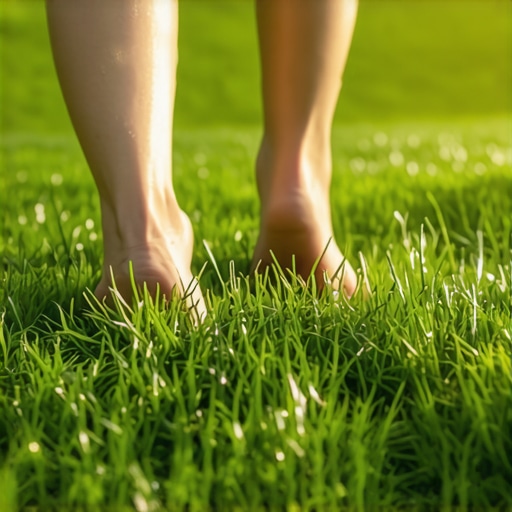
Walking across a newly installed lawn should feel firm, like a well-constructed athletic field, not like a damp marshland. When you feel that characteristic squish or ‘give’ under your boots, it is a physiological signal that the gas exchange within the soil profile has been compromised. Spongy sod is primarily caused by a ‘perched water table’ effect where moisture is trapped at the interface of the new sod and the existing subsoil, often exacerbated by over-irrigation or poor soil grading. This condition prevents roots from anchoring, leading to anaerobic stress and potential root rot. It is a structural failure of the landscaping ecosystem.
The Apprentice Lesson: Why Grading Prevails Over Greenery
I always drill into my new crew members: if you don’t fix the soil grading first, every plant you put in the ground is just expensive compost. Last season, I brought a lead tech out to a site where the homeowner had laid $4,000 worth of premium fescue sod himself. Within ten days, the entire backyard felt like a waterbed. He thought he just needed more fertilizer. I had to show him that the subsoil was compacted to nearly 95 percent proctor density, meaning it was essentially concrete. The water had nowhere to go. We had to lift the sod, which was already smelling of sulfur, and start the site prep from scratch. It was a hard lesson in civil engineering: the grass is just the paint; the soil is the foundation. If the foundation is flat and compacted, the paint will peel.
The Forensic Diagnosis: Soil Texture and Interfacial Tension
To understand why your lawn feels like a sponge, we have to look at the microscopic reality of the soil. When sod is harvested, it comes with a layer of its own soil, often a heavy muck or peat-based medium. If your yard consists of heavy red clay or silty loam, you have two radically different soil textures meeting at a sharp boundary. This creates a physical phenomenon known as a ‘perched water table.’ Surface tension keeps the water in the upper, more porous sod layer because the pore spaces in the clay below are too small to ‘pull’ the water down through capillary action. The water sits at the interface. It saturates the thatch. It fills every macro-pore that should be occupied by oxygen. Oxygen is the catalyst for root respiration. Without it, the roots stop growing and begin to ferment.
“A soil’s infiltration rate is governed by its coarsest layer; when a fine-textured sod is placed over a compacted subsoil, the resulting water barrier can lead to rapid anaerobic decline.” – Agronomy Manual for Professional Turfgrass Managers
The Chemical Nightmare of Over-Irrigation
Most homeowners believe that more water equals more life. In reality, over-irrigation is the leading cause of sod failure in the first 30 days. When you apply 2 inches of water per day to a new install, you are effectively drowning the ecosystem. The sponginess you feel is the physical displacement of air by water. In a healthy soil profile, 50 percent of the volume should be pore space, ideally split equally between water and air. When that ratio shifts to 90 percent water, the soil loses its structural integrity. This is where pathogens like Pythium and Rhizoctonia thrive. These are not just ‘diseases’; they are opportunistic decomposers that eat the very roots trying to establish themselves in your yard.
How much water do I actually need for new sod?
New sod requires approximately 1 inch of water per day for the first 14 days, but this must be split into multiple short cycles. The goal is to keep the sod and the top 0.5 inches of soil moist, not to saturate the ground 6 inches deep. Once the roots begin to knit, you must transition to deep, infrequent watering to force those roots to search for moisture at lower depths. If the ground stays spongy after the first week, you are watering too much. Period.
Does spongy sod mean I have a drainage problem?
Sponginess is often the first symptom of a larger drainage failure. If the water does not dissipate within two hours of irrigation, the sub-grade is likely sloped toward the house or the soil is too compacted to allow vertical percolation. In these cases, no amount of ‘drying out’ will fix the issue long-term. You may need to install a French drain or a series of catch basins to move that hydrostatic pressure away from the root zone.
| Symptom | Probable Cause | Physical Measurement |
|---|---|---|
| Surface Squish | Over-irrigation | Surface moisture > 40% |
| Deep Sinkage | Poor Sub-base Compaction | Penetrometer < 100 PSI |
| Sulfur Smell | Anaerobic Soil | pH drop below 6.0 |
| Yellowing Blades | Nitrogen Leaching / Rot | Low Nitrate levels |
The Remediation Checklist: Fixing the Squish
- Immediately reduce irrigation frequency but maintain short durations to prevent surface desiccation.
- Core aerate the lawn if it is older than 6 months to break up the thatch and improve gas exchange.
- Check the soil pH; anaerobic conditions often lead to acidic spikes that require lime application.
- Top-dress with 0.25 inches of coarse masonry sand to improve surface drainage and fill micro-depressions.
- Apply a preventative fungicide if the soil has been saturated for more than 72 hours in temperatures above 80 degrees.
“Structural stability in turfgrass systems is a function of root mass and soil bulk density. High moisture levels decrease the shear strength of the soil, leading to the ‘spongy’ sensation reported by site inspectors.” – International Construction and Paver Institute (ICPI) Standards
The Long-Term Outlook: Preventing the Thatch Layer
If you ignore a spongy lawn, you are inviting a massive thatch buildup. Thatch is a layer of living and dead organic matter that accumulates between the green vegetation and the soil surface. In a waterlogged environment, the microbes that usually break down this organic matter cannot survive. The thatch thickens. It becomes a hydrophobic barrier during the summer and a sponge during the winter. This cycle will eventually kill the lawn. You must ensure your yard cleanup includes aggressive raking and, eventually, vertical mowing if the thatch layer exceeds 0.5 inches. Don’t be a ‘mow-and-blow’ victim. Understand the biology under your feet. A firm lawn is a healthy lawn. A spongy lawn is a dying one. Get the water out, get the air in, and let the roots do their job.