
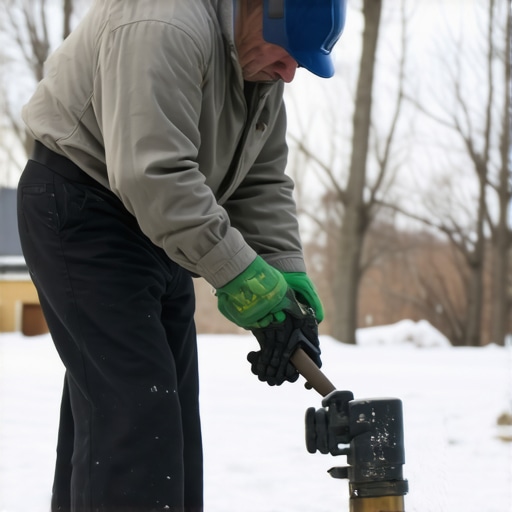
The Engineering Reality of Frozen Irrigation Lines
I always drill into my new crew members: if you don’t fix the soil grading first, every plant you put in the ground is just expensive compost. It is the same with irrigation. I have seen guys think they are done after five minutes of blowing air into a system, only to return in the spring to a mainline that looks like a shattered glass bottle. They forget that water is one of the few substances on Earth that expands as it freezes. That 9% volume increase is not just a statistic; it is a physical force that will shear through Schedule 40 PVC and brass backflow preventers like they were made of paper. If you leave five percent of the water in a low-point elbow, you have left a ticking time bomb for your client’s sod install. My job is to make sure your 2026 season starts with a functioning system, not a $5,000 excavation bill.
The Critical Role of Air Volume in Mainline Evacuation
Winterizing your 2026 sprinkler mainline requires high-volume air flow to displace standing water without exceeding the safe PSI thresholds of your piping. You must prioritize CFM (Cubic Feet per Minute) over pressure to ensure a complete purge of the irrigation system’s low-point drains and backflow assemblies. If you use high pressure with low volume, the air simply rides over the water.
“A retaining wall doesn’t fail because of the stone; it fails because of the water trapped behind it. Similarly, an irrigation system fails not because of the cold, but because of the residual moisture’s inability to escape during the phase transition to ice.” – Hardscape Engineering Axiom
How much air pressure for irrigation blowout?
For most residential and light commercial systems, you should never exceed 50 PSI for PVC systems or 80 PSI for polyethylene tubing. High pressure creates friction, which generates heat. If you run a high-pressure compressor for too long, you can actually melt the internal seals of your zone valves or weaken the glue joints on your mainline. It is the volume of air, measured in CFM, that moves the water. A standard shop compressor usually pushes 4 to 6 CFM. That is a toy. For a 1-inch mainline, you need a minimum of 80 to 100 CFM to create the necessary ‘slug’ of air that pushes water out of the heads rather than just bubbling through it.
The Systematic Process for Mainline Protection
Properly winterizing a 2026 irrigation system involves a five-stage process: water isolation, backflow drainage, zone-by-zone blowout, controller management, and insulation. This sequence ensures that hydrostatic pressure does not build up behind check valves or within the mainline manifold. Skip one step, and you risk a catastrophic failure.
| Component | Material Type | Max Safe PSI | Critical Failure Point |
|---|---|---|---|
| Mainline | Sch 40 PVC | 50 PSI | Bell-and-spigot joints |
| Lateral Lines | Class 200 / Poly | 80 PSI | Insert fittings/Barbs |
| Backflow | Brass / Bronze | N/A (Drain only) | Internal ceramic discs |
| Zone Valves | Nylon/Plastic | 50 PSI | Rubber diaphragms |
When should I winterize my sprinkler system?
You must schedule your blowout at least two weeks before the first hard freeze, typically when soil temperatures drop below 40 degrees Fahrenheit. Waiting until the ground is frozen makes it impossible to drain the system effectively because the heads and swing joints may already be seized. In regions with heavy clay, soil retains moisture longer, leading to heaving that can displace pipes if they are not fully voided of water. Yard cleanup should occur simultaneously to ensure all sprinkler heads are visible and clear of debris before the air hits them.
The Blowout Checklist: No Shortcuts Allowed
- Shut off the main water supply: This is usually located in a basement or a crawlspace. Use a tag to ensure nobody turns it back on.
- Drain the backflow preventer: Open the test cocks at a 45-degree angle. This prevents water from being trapped against the ball valve seats.
- Connect the compressor: Use the blowout port located after the backflow preventer. Never blow air through the backflow device itself.
- Cycle through zones: Start with the zone furthest from the compressor. Run each zone until you see a fine mist, then move on. Do not run dry air for more than two minutes per zone.
- Leave valves partially open: This allows for any residual moisture expansion without cracking the valve body.
“Failure to evacuate water from the backflow assembly accounts for 70% of spring irrigation repairs in northern climates.” – Irrigation Association Technical Manual
The Science of Soil and Sod During the Freeze
When we talk about landscaping, we are talking about managing a living ecosystem. If your mainline leaks over the winter because of a poor winterization job, it creates a subterranean ice pocket. This leads to frost heave. When the ground thaws, that area will be unstable. If you have just invested in a sod install, that heaving will tear the delicate new root structures of your Kentucky Bluegrass or Fescue. You will see yellowing and die-back in the spring that has nothing to do with nutrients and everything to do with the fact that your soil was physically manipulated by ice. Deep, infrequent watering in the fall helps toughen the roots, but once that water is in the pipes, it must come out. It will rot the roots if it pools. Don’t skip the blowout.
The Post-Blowout Yard Cleanup Strategy
Fall yard cleanup is the final line of defense for your irrigation heads. Leaves and organic debris act as sponges, holding moisture directly against the wiper seals of your pop-up heads. When that moisture freezes, it can bond the plastic head to the riser. When the system tries to pop up in the spring, the motor or the pressure will snap the head right off. I tell my clients that a clean yard is a safe yard. Rake the debris away from the irrigation valve boxes. Ensure the lids are seated correctly so they don’t fill with water and freeze the valves into a solid block of ice. This is basic landscaping 101, yet it is where most people fail. Precision matters. Details matter. If you want a 2026 season without headaches, treat your mainline like the engineering feat it is.