
The 20-Year Rule of Groundwork Preparation
I always drill into my new crew members: if you don’t fix the soil grading first, every plant you put in the ground is just expensive compost. Most homeowners see a dead lawn and think they just need a layer of new green on top. That is a $5,000 mistake waiting to happen. You are not just buying grass; you are investing in a biological system that requires a specific ratio of oxygen, mineral content, and drainage to survive the first six months. I have seen hundreds of installs fail because the contractor didn’t understand the difference between surface dirt and a viable seedbed. We do not do ‘mow-and-blow’ shortcuts here. We do engineering.
Why Dirt Preparation Trumps Sod Quality Every Time
Proper dirt preparation involves the complete removal of organic debris, mechanical aeration of the compacted subsoil, and the chemical balancing of soil pH levels to create a receptive environment for new root systems. Without these steps, sod will root-bind and fail within one season. It is about the rhizosphere. If that root-to-soil contact is blocked by a layer of dead thatch or compacted clay, the sod will starve. It will die. Do not skip the prep phase. It is the most critical part of the entire 2026 project.
“A lawn is only as healthy as the six inches of soil beneath it; proper physical and chemical preparation prevents 90 percent of turf failures.” – Penn State Agricultural Extension
How much depth do I need for a sod base?
You need a minimum of four to six inches of loosened, high-quality topsoil to allow for deep root penetration and moisture retention. This depth ensures that the roots can move vertically to escape surface heat during the peak of summer. Shallow soil leads to hydrostatic stress. This causes the grass to go dormant or die when temperatures spike. Dig deep. Check your depths with a probe.
The Mechanical Breakdown: Removing the Old Turf Layer
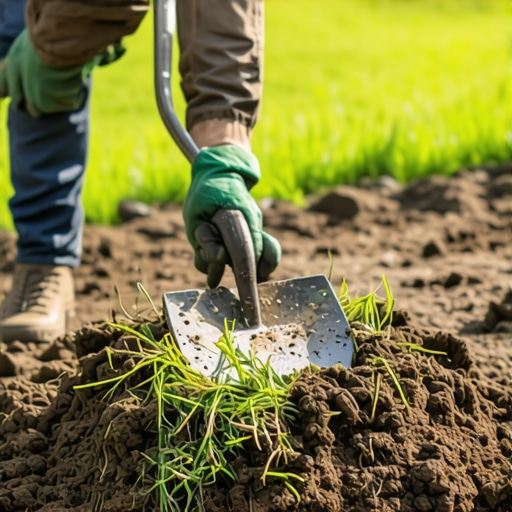
Removing dead grass is not a surface-level cleanup; it requires the mechanical stripping of the thatch layer and the root mat to reveal the mineral soil beneath. Using a vertical sod cutter is the industry standard because it provides a uniform grade that hand-shoveling cannot match. If you leave the dead grass, it creates a hydrophobic barrier. This barrier prevents water from reaching the new roots. You must expose the actual dirt. You must clear the slate entirely.
| Removal Method | Efficiency | Soil Impact | Cost Factor |
|---|---|---|---|
| Manual Stripping | Low | Low Disturbance | High Labor |
| Sod Cutter Machine | High | Perfect Grade | Equipment Rental |
| Chemical Kill & Till | Medium | High (Nutrient Reset) | Low Cost |
| Solarization | Very Low | Sterilizes Microbes | Time Intensive |
Soil Mechanics: Addressing Compaction and pH Balance
Compacted soil lacks the macropores necessary for oxygen exchange, which leads to anaerobic conditions that rot new sod roots before they can establish. We measure compaction in PSI using a penetrometer. If the ground is harder than a packed gravel driveway, your grass cannot breathe. You need to introduce organic amendments like leaf compost or aged manure to break the clay bonds. Use a core aerator if you are not doing a full till. It creates 2.5-inch deep voids for air and water to reach the sub-strata.
“Turfgrasses thrive in a soil pH between 6.0 and 7.0, where nutrient availability for nitrogen, phosphorus, and potassium is maximized.” – Texas A&M Agrilife Extension
Will irrigation systems interfere with sod prep?
Existing irrigation lines must be flagged and mapped before any mechanical digging or tilling begins to avoid line ruptures and costly manifold repairs. You must also check your head-to-head coverage while the ground is bare to ensure no dry spots will occur post-install. This is the time to move heads. This is the time to fix leaks. Don’t dig blindly. Call 811 before you drop a blade into the earth.
Grading and Drainage: Preventing the 2026 Swamp
Grading is the process of creating a 1 to 2 percent slope away from the home’s foundation to prevent standing water and foundation infiltration. Water follows the path of least resistance. If your yard has a ‘bowl’ effect, the new sod will succumb to pythium blight or root rot within weeks. We use laser levels to ensure the pitch is correct. We don’t guess. We measure. If the grade is off, the project is a failure before it starts.
- Step 1: Clear all surface stones larger than 1 inch.
- Step 2: Conduct a 24-hour percolation test to check drainage.
- Step 3: Apply a 10-10-10 starter fertilizer to the bare dirt.
- Step 4: Final-rake to a ‘flour-like’ consistency.
- Step 5: Roll the bare dirt with a water-filled roller to firm the base.
The Information Gain: The One-Inch Water Rule
While the internet tells you to water every day, turf grass actually needs deep, infrequent watering, exactly 1 inch per week, to force roots to chase the water down. If you mist the surface daily, you train the roots to stay shallow. Shallow roots die in the heat. Deep roots survive the drought. Use a tuna can to measure your irrigation output. If it takes 30 minutes to fill the can, that is your weekly run time. It is simple math. It works. Stop over-watering your mud and start watering your soil profile.