
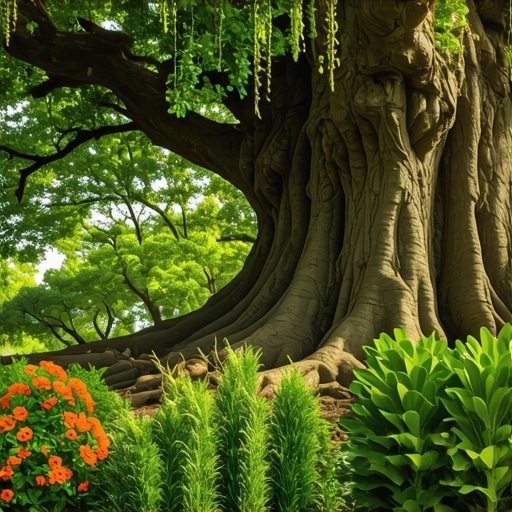
The Reality of Planting Under the Canopy
Planting under giant oaks requires selecting species with low water requirements and high shade tolerance to survive the canopy density and root competition. Success depends on maintaining root flare visibility and avoiding soil compaction during the install to protect the host tree long-term.
I always drill into my new crew members: if you don’t fix the soil grading first, every plant you put in the ground is just expensive compost. I have seen guys spend six figures on nursery stock only to watch it wither because they didn’t understand the hydrostatic competition of a 100-year-old Quercus alba. A mature oak is a biological machine. It moves hundreds of gallons of water a day. If you dig haphazardly into its root zone, you are not just planting a hosta; you are performing surgery on a giant without anesthesia. You have to respect the feeder roots. These roots exist in the top 12 to 18 inches of the soil profile. This is where the gas exchange happens. If you smother them with 6 inches of heavy clay or cheap sod install, you seal the tree’s fate. It will rot. It will die. Maybe not this year, but in five years, that canopy will start thinning, and it is your fault.
“The critical root zone (CRZ) of a tree is an area where the roots are most sensitive to disturbance and compaction; any alteration here can lead to long-term decline.” – Penn State Extension
How much water do plants under oak trees need?
Plants installed under the drip line of a mature oak require supplemental irrigation via pressure-compensating drip emitters to account for the tree’s massive water uptake. Generally, these plants need approximately 1 to 1.5 inches of water per week, delivered slowly to ensure deep soil penetration without causing root rot in the oak.
[image_placeholder_1]
1. Helleborus orientalis (Lenten Rose)
Hellebores are the workhorses of the deep shade world. They are tough. They are evergreen. Most importantly, they don’t care about the allelopathic chemicals some trees produce or the dry shade conditions common under oaks. When we do a high-end landscaping project, I use these because they handle the root competition better than almost anything else. Their root systems are fibrous and can find niches between the oak’s lateral roots. We look for a soil pH between 6.0 and 7.0. If the soil is too acidic from years of leaf litter, we hit it with a light application of pelletized lime. Don’t overdo it. High-end horticulture is about precision, not guesswork. We install these at a density of one plant every 18 inches. This allows for airflow, which is critical. If you pack them in too tight, you invite Botrytis. That is a fungal nightmare you don’t want to manage.
2. Asarum canadense (Wild Ginger)
If you want a native groundcover that actually survives the heavy shade of a giant oak, you go with Wild Ginger. This isn’t the stuff you find at a big-box store. This is a low-growing, rhizomatous perennial that creates a dense mat. This mat serves a dual purpose: it looks clean and it acts as a living mulch, regulated soil temperatures. In our yard cleanup protocols, we leave the leaf litter in the fall because the ginger loves that organic matter breakdown. It feeds the nitrogen cycle. I tell my clients that if they want a manicured look without the high-maintenance water bill of sod, this is the play. It spreads slowly but surely. It won’t choke out the tree. It respects the king.
Can I install sod under a mature oak tree?
Installing sod under a mature oak tree is generally a recipe for failure due to insufficient light levels (less than 4 hours of direct sun) and the risk of root suffocation. The process of grading and tilling for sod installation often severs critical feeder roots, leading to the gradual decline of the tree’s health.
3. Hakonechloa macra (Japanese Forest Grass)
When the client wants movement and light in a dark corner, we specify Japanese Forest Grass. It looks like a waterfall of gold. But from an engineering perspective, its benefit is its non-invasive root system. It won’t compete aggressively with the oak for nutrients. We typically install a 1-inch layer of composted leaf mold before planting these. This jumpstarts the mycorrhizal fungi in the soil. These fungi form a symbiotic relationship with both the grass and the oak. It is a biological handoff of nutrients. Most contractors ignore the soil microbiology. They just want the check. We want the ecosystem to thrive. We use 1/2-inch swing pipe for the irrigation to ensure each clump gets dedicated water during the first two seasons. After that, they are remarkably drought-tolerant. Don’t skip the mulch, but keep it off the crown of the plant. Crowns need to breathe.
“A retaining wall doesn’t fail because of the stone; it fails because of the water trapped behind it, much like a plant fails not because of the shade, but because of the lack of oxygen in the root zone.” – Hardscape Engineering Axiom
| Plant Species | Drought Tolerance | Growth Rate | Root Depth |
|---|---|---|---|
| Hellebore | High | Moderate | Deep Fibrous |
| Wild Ginger | Medium | Slow | Shallow Rhizome |
| Forest Grass | Moderate | Moderate | Shallow Fibrous |
The Engineering of Site Preparation
Yard cleanup is the most underrated part of the process. You have to clear the invasive honeysuckle and the debris without using a heavy skid steer. Compaction is the silent killer. A single pass with a 5,000-pound machine can collapse the pore space in the soil. This stops the oxygen. No oxygen means no ATP production in the roots. The tree suffocates. We use hand tools and air-spades. It takes longer. It costs more. But the tree lives. When we do a sod install elsewhere on the property, we keep the equipment 20 feet away from the drip line of the oak. No exceptions. I’ve fired guys for parking a truck under an oak. It is that serious.
- Step 1: Hand-clear all invasive weeds and debris.
- Step 2: Test soil pH and nutrient levels (NPK).
- Step 3: Layout plants avoiding large structural roots.
- Step 4: Hand-dig small holes, 2x the width of the root ball.
- Step 5: Backfill with native soil mixed with 10% organic compost.
- Step 6: Apply 2 inches of aged wood chips, keeping 6 inches clear of the tree trunk.
Irrigation is the final piece of the puzzle. You cannot use standard spray heads. They hit the trunk of the oak, leading to fungal cankers and rot. We use Netafim drip line or similar pressure-compensating tech. We pin it to the surface and mulch over it. This delivers water directly to the root zone of the new plants without wasting a drop or hurting the tree. It is efficient. It is smart. It is how you do landscaping that lasts decades instead of months.