
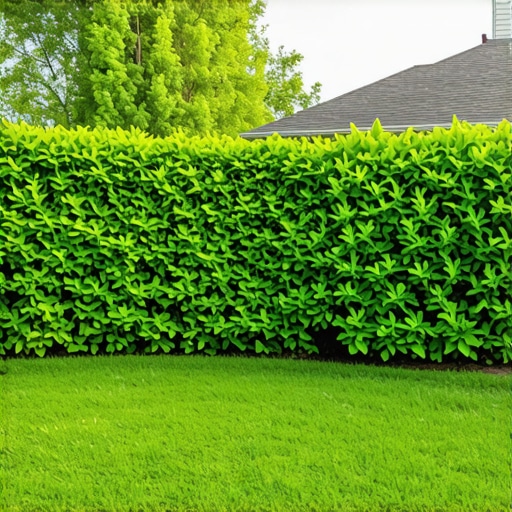
Why Successful Backyard Privacy Starts Below the Surface
Most homeowners rush into planting fast-growing screens without considering root system expansion, soil drainage, or nutrient depletion, leading to diseased specimens that fail within three years of a landscaping project. I always drill into my new crew members: if you don’t fix the soil grading first, every plant you put in the ground is just expensive compost. I have seen countless $10,000 installs go to die because the contractor ignored the clay-to-silt ratio. You cannot just dig a hole, drop a root ball, and walk away. If that hole acts like a bucket in heavy rain, the roots will drown in 48 hours. Proper yard cleanup requires removing any existing debris and testing the soil pH before you even think about a shovel. Most privacy screens need a pH between 6.0 and 7.0 to absorb the nitrogen required for rapid vertical growth. If your soil is sitting at a 5.2, you are just throwing money at a plant that cannot eat.
“The primary cause of failure in newly planted trees is a lack of oxygen in the root zone caused by excessive soil moisture and deep planting.” – Penn State Extension
How much irrigation do new privacy trees need?
For the first year, privacy trees require deep, infrequent watering to force roots to chase moisture deep into the subsoil. A standard irrigation system should be calibrated to deliver 1 inch of water per week, ideally via drip lines to avoid fungal growth on the foliage. Drip irrigation reduces evaporation and targets the root flare directly. Do not rely on overhead sprayers designed for a sod install. They are inefficient for woody ornamentals. You need a flow rate of about 0.5 to 1 gallon per hour per plant depending on the soil’s percolation rate.
1. Thuja Occidentalis ‘Emerald Green’ (American Arborvitae)
The Thuja Occidentalis is a staple for small yards because of its narrow, columnar growth habit that provides dense evergreen coverage without encroaching on limited square footage or interfering with existing irrigation lines. It grows roughly 1-2 feet per year, reaching a peak height of 15 feet while maintaining a 4-foot width. This makes it ideal for tight spaces where the landscaping footprint is a primary concern. However, I often see these planted way too close together. If you space them less than 3 feet apart on center, you limit the airflow. Poor airflow leads to spider mites and Bagworms. Use a 36-inch spacing to allow the foliage to touch without suffocating. Ensure the root flare—the point where the roots expand at the base of the trunk—is at or slightly above the soil grade. Burying it too deep leads to trunk rot and girdling roots.
2. Prunus Caroliniana (Carolina Cherry Laurel)
Known for its 24-inch annual growth rate, Prunus Caroliniana establishes quickly if the irrigation system provides consistent deep-root watering during the first two seasons, preventing the leaf-drop common in stressed transplants. For a broadleaf evergreen option, Prunus Caroliniana offers thick, glossy foliage that acts as a natural sound barrier and windbreak. It thrives in well-drained soil typical of a professional sod install preparation. This plant is a heavy feeder. You need to apply a 10-10-10 slow-release fertilizer in early spring and again in mid-summer. If the leaves start turning yellow between the veins, you have an iron chlorosis issue usually caused by high alkalinity. One thing to watch: the seeds and leaves contain hydrocyanic acid. It is tough as nails, but keep it away from pets that like to chew on sticks.
3. Ilex x Nelms ‘Liberty’ (Liberty Holly)
The Ilex x Nelms ‘Liberty’ adds roughly 12 inches of vertical growth annually and creates a dense, prickly wall that discourages intruders while providing a nesting habitat for birds, outperforming standard sod install borders. The Liberty Holly is a resilient choice for homeowners needing a thorny, impenetrable barrier that responds well to heavy pruning, ensuring the screen stays within the tight boundaries of a managed yard cleanup zone. Unlike many hollies, Liberty is self-pollinating, so you do not need a male and female pair to get the red berries. It is a dense wood. When you prune, use sharp bypass pruners, not hedge trimmers that shred the leaves. Shredded leaves leave the plant vulnerable to fungal spores. A clean cut heals in 72 hours. A jagged tear takes weeks.
“A retaining wall doesn’t fail because of the stone; it fails because of the water trapped behind it.” – Hardscape Engineering Axiom
What is the fastest growing hedge for a small yard?
While the Leyland Cypress is the fastest, growing up to 3 feet per year, it is often too large for small backyards and prone to Seiridium canker; therefore, the Green Giant Arborvitae or Cherry Laurel are better-managed alternatives for tight spaces. You have to balance growth speed with the eventual maintenance load.
| Plant Species | Annual Growth Rate | Mature Width | Maintenance Level |
|---|---|---|---|
| Emerald Green Thuja | 12-24 Inches | 3-4 Feet | Low |
| Cherry Laurel | 24-30 Inches | 6-8 Feet | Moderate |
| Liberty Holly | 10-14 Inches | 5-6 Feet | Moderate |
The Privacy Screen Installation Checklist
- Conduct a soil test to check NPK levels and pH.
- Mark all underground utilities via 811 before digging.
- Excavate holes twice as wide as the root ball but no deeper.
- Install a dedicated drip irrigation zone for the new trees.
- Apply 2-3 inches of organic mulch, keeping it away from the trunk.
- Verify the root flare is visible above the soil line.
The first year after installation is the settling-in period. You will see more root development than top growth. This is normal. The plant is building its hydraulic system. Do not over-fertilize during this phase. Let the roots find the native soil. By year two, the vertical surge begins. Keep your pruners ready. Manage the height early to encourage density. A thin, tall screen is useless. You want a thick, opaque wall of green. Real landscaping is about the long game.