
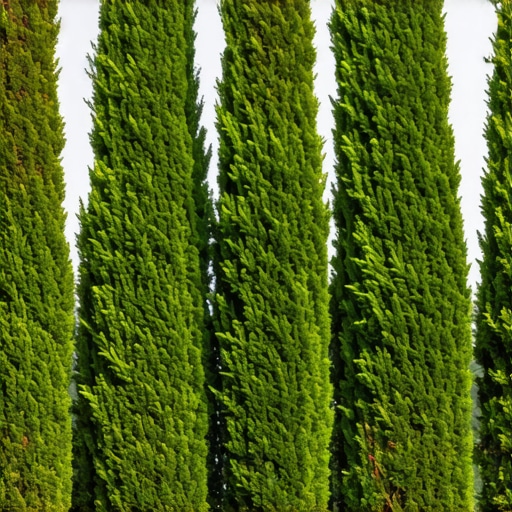
The Foundation of Privacy: Why Soil Grading Beats Plant Selection
Privacy trees that require minimal pruning include species like Cryptomeria japonica ‘Radicans’, Thuja ‘American Pillar’, and Ilex opaca. These selections are chosen for their genetic growth habits that maintain a columnar or pyramidal form without the need for annual shearing or intensive canopy management. Choosing the right species is only 20 percent of the job; the remaining 80 percent is site engineering, specifically managing soil bulk density and hydrostatic drainage to prevent root rot.
I always drill into my new crew members: if you don’t fix the soil grading first, every plant you put in the ground is just expensive compost. I remember an apprentice who thought he could skip the transit level on a 50-foot screen of Green Giants. He dug the holes in a low spot where the hydrostatic pressure from the neighbor’s uphill lot collected. Within three months, those trees were drowning in anaerobic soil. The roots turned black, the needles dropped, and we had to rip out $4,000 worth of stock. We had to go back in, install a French drain with 57 stone and a 4-inch perforated pipe, and regrade the entire line to a 2 percent slope. It was a brutal lesson in why physics always wins over aesthetics. You don’t just plant a tree; you install a biological system that must breathe and drain.
“A soil test is the only way to accurately determine the amount of lime and fertilizer needed for your landscape. Guessing can lead to over-application, which is a waste of money and can damage the environment.” – Penn State Agricultural Extension
The 5 Best Low-Maintenance Privacy Trees for Professional Landscapes
Selecting privacy trees requires an understanding of USDA Hardiness Zones and the specific apical dominance of the species. You want trees that grow up, not out, to avoid the need for constant hedging. Here are the top professional choices for a hands-off screen.
1. Cryptomeria japonica ‘Radicans’ (Japanese Cedar)
The Radicans Cryptomeria is the gold standard for high-density screens that don’t need a haircut. It grows in a tight, pyramidal shape and reaches 30 to 40 feet. Unlike the Leyland Cypress, it is highly resistant to Seiridium canker and Cercospora needle blight. It handles heavy clay better than most conifers, provided the percolation rate isn’t zero. Its feathery texture stays dense even in partial shade, which is rare for a fast-growing conifer. Do not plant this in a wind-tunnel; its branches can be heavy and prone to ice load breakage if not protected from extreme northern exposure.
2. Thuja occidentalis ‘American Pillar’
If you have a narrow space, the American Pillar Arborvitae is the tool for the job. It grows 20 feet tall but only 4 feet wide. It is essentially a faster-growing, more heat-tolerant version of the ‘Emerald Green’. It requires zero pruning to maintain its shape. Its vertical growth rate can exceed 3 feet per year once the root system is established. Use a drip irrigation system with 2-gallon-per-hour emitters to keep the soil moisture consistent during the first two summers. Inconsistent water leads to interior needle browning, which is a stress response, not a disease.
3. Ilex opaca (American Holly)
For a broadleaf evergreen option, the American Holly is an armored wall. It is slow-growing compared to conifers, which means it stays in its lane. It is native to the Eastern US, meaning it has evolved to handle local pest pressure. The spiny leaves act as a physical deterrent for intruders and deer. It thrives in acidic soil (pH 4.5 to 6.0). If your soil test comes back at pH 7.0, you will need to amend with elemental sulfur or use an acid-loving fertilizer like Holly-Tone to prevent iron chlorosis.
4. Juniperus virginiana (Eastern Red Cedar)
This is the ‘indestructible’ option. If you are dealing with alkaline soil, salt spray, or extreme drought, the Eastern Red Cedar is your best bet. It is a pioneer species that grows in the harshest conditions. It doesn’t have the soft look of a Cryptomeria, but it provides a 100 percent opaque screen. It requires zero pruning. One warning: do not plant this near apple trees, as it is an alternate host for Cedar-Apple Rust. It is a workhorse, not a show horse.
5. Magnolia grandiflora ‘Teddy Bear’
The Teddy Bear Magnolia is a dwarf cultivar that stays compact and upright. It gives you the massive, waxy leaves and white flowers of a Southern Magnolia without the 60-foot spread. It is perfect for upscale landscaping where texture matters. It is a heavy feeder. You need a high-nitrogen fertilizer in early spring to support the foliar expansion. It is hardy to Zone 7, so if you are in the North, stick to the Thuja or Juniper.
Engineering the Installation: Beyond the Hole
Professional landscaping is about soil physics. When we perform a sod install or plant large privacy trees, we look at bulk density. If the soil is compacted to more than 1.6 grams per cubic centimeter, roots cannot penetrate the soil. You must scarify the walls of the planting hole. A smooth, ‘glazed’ hole wall created by an auger acts like a clay pot, trapping roots inside and leading to root girdling. [IMAGE_PLACEHOLDER_1] Use a spade to break up those walls. This allows capillary action to move water between the root ball and the native soil. Never bury the root flare. The point where the trunk widens into the roots must be visible at the soil surface. Burying it leads to stem-girdling roots and trunk rot. It will die. Maybe not this year, but in five years, it will fail.
| Tree Species | Growth Rate (Annual) | Mature Width | Soil Preference |
|---|---|---|---|
| Cryptomeria Radicans | 2-3 Feet | 10-12 Feet | Well-drained/Acidic |
| American Pillar | 3+ Feet | 4 Feet | Loamy/Moist |
| American Holly | 1 Foot | 15-20 Feet | Acidic/Deep |
| Eastern Red Cedar | 1-2 Feet | 8-15 Feet | Any/Drought-tolerant |
| Teddy Bear Magnolia | 1 Foot | 10-12 Feet | Rich/Organic |
How much water do new privacy trees need?
New privacy trees require roughly 1 inch of water per week, delivered deeply and infrequently. A drip irrigation setup is superior to overhead spray because it delivers water directly to the root zone, reducing evaporation and preventing foliar fungal diseases. During the first year, check the soil 4 inches deep; if it feels dry, water it.
What is the best spacing for a living fence?
Spacing depends on the mature width of the species. For American Pillar, space them 3 to 4 feet on center. For Cryptomeria, 6 to 8 feet is ideal. Planting too close leads to light competition, causing the lower branches to die off, which ruins the privacy screen you were trying to build. Always calculate for the tree’s size at year ten, not year one.
“Proper drainage is the most overlooked component of plant health. Without oxygen in the root zone, nutrient uptake ceases regardless of fertilizer application.” – International Society of Arboriculture (ISA)
The Professional Planting Checklist
- Call 811 to mark underground utilities before any excavation.
- Perform a percolation test: dig a 12-inch hole, fill with water, and ensure it drains within 12 hours.
- Dig the hole twice as wide as the root ball but no deeper.
- Remove all burlap, twine, and the top two tiers of wire baskets.
- Expose the root flare; ensure it sits 1 inch above the final grade.
- Backfill with native soil; do not over-amend, or the roots will never leave the hole.
- Apply 2 to 3 inches of hardwood mulch, keeping it 4 inches away from the trunk.
- Install irrigation on a dedicated zone for trees.
- Remove any nursery stakes to allow the trunk to develop reaction wood.
- Monitor for bagworms or spider mites monthly during the first growing season.