
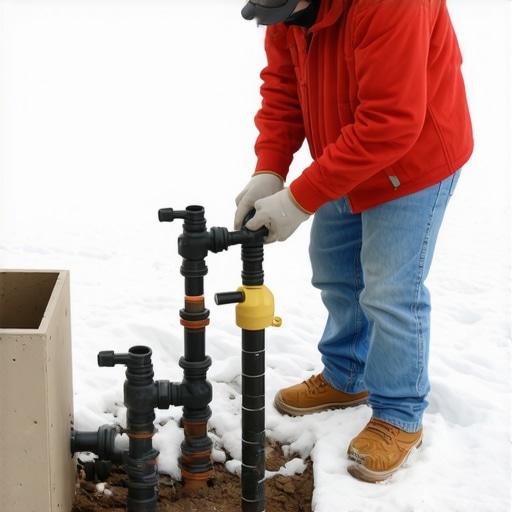
The sound of a burst irrigation pipe in the spring is not a splash; it is the sound of money draining from your bank account into a muddy trench. To winterize your sprinkler system effectively, you must perform a compressed air blowout to evacuate all residual water from PVC or poly pipes and backflow preventers before the first deep freeze hits. This prevents hydrostatic expansion from fracturing valves and underground lines. I have spent twenty years digging up the failures of others, and the physics of ice is undefeated. If you leave water in a confined space and the temperature drops below thirty-two degrees Fahrenheit, that water will expand by approximately nine percent. That expansion exert forces exceeding tens of thousands of pounds per square inch. Your schedule forty PVC does not stand a chance.
The Anatomy of a Frozen Irrigation System
A frozen irrigation system fails because of the specific mechanical properties of water and the structural limitations of thermoplastic piping and brass valves. When water transitions to a solid state, it requires more volume. In a closed loop system, this expansion has nowhere to go. It will find the weakest point in your infrastructure. Usually, this is the valve manifold or the backflow preventer. I always drill into my new crew members: if you do not fix the soil grading and evacuate every drop of water, every plant you put in the ground is just expensive compost. I remember a job in the suburbs where a homeowner used a small tire inflator to try and blow out his lines. He thought because he saw a little mist, he was safe. By April, I had to excavate forty feet of poly pipe that had split like a hot dog on a grill. He did not understand the difference between pressure and volume.
“The primary cause of failure in residential irrigation systems during winter months is the improper evacuation of water from the backflow prevention assembly, which remains most vulnerable to ambient air temperature fluctuations.” – Irrigation Association Technical Manual
Why PSI is the Secondary Metric in Winterization
While most homeowners focus on pressure, professional winterization is actually about CFM (Cubic Feet per Minute), which measures the volume of air moving through the pipes. You need a high volume of air to move the water, but you must keep the pressure low to avoid melting the pipe. High pressure creates friction, and friction creates heat. If you run a small compressor at high PSI for too long, you can actually deform the internal components of your zone valves. We never exceed fifty PSI for systems with poly pipe and eighty PSI for PVC systems. It is a delicate balance. You are not just blowing air; you are managing thermodynamics within a buried environment.
| Pipe Material | Max Recommended PSI | Common Failure Point | Repair Difficulty |
|---|---|---|---|
| Schedule 40 PVC | 80 PSI | Brittle fractures at bell ends | Moderate |
| Polyethylene (Black) | 50 PSI | Linear splits along the wall | Low |
| Brass Backflow (PVB) | N/A (Drain only) | Internal poppet and bonnet | High |
How much air do I need to blow out my sprinklers?
To properly evacuate water, you need a compressor capable of delivering at least 10 to 20 CFM for a standard residential system. Small pancake compressors usually max out at two or three CFM. These are useless for irrigation. They do not provide enough volume to fill the pipe and push the water out as a solid slug. Instead, the air just bubbles over the top of the water. This leaves significant residue in the low spots. When that residue settles and freezes, it creates a localized ice plug that can still crack the pipe. You need a tow-behind compressor or a high-end industrial unit to do this correctly. Do not skimp on the equipment. The tool dictates the outcome.
The Forensic Breakdown: Why Backflow Preventers Explode
The backflow preventer is the most expensive part of your system and the most likely to break. It sits above ground, exposed to the elements. While the ground provides some geothermal insulation for your pipes, the backflow preventer is at the mercy of the wind chill. Even a brief overnight dip below freezing can shatter the internal brass or plastic components. When we do a forensic autopsy on a burst PVB, we often find that the ball valves were left in the fully closed position. This is a rookie mistake. You must leave ball valves at a forty-five degree angle during the winter. This allows any water trapped inside the ball mechanism to escape. If it is closed, the water is trapped against the side of the brass casing. When it freezes, it shears the brass right in half.
“Hydrostatic pressure resulting from ice expansion in a restricted cavity can exceed the tensile strength of cast brass and stainless steel assemblies.” – American Society of Sanitary Engineering (ASSE)
Can I winterize my own sprinkler system?
You can winterize your own system only if you have access to an industrial air compressor and a thorough understanding of backflow preventers and manifold mechanics. Most residential compressors lack the CFM capacity to safely clear the lines. If you attempt this with a small unit, you risk leaving water behind or overheating the lines. Furthermore, if you do not follow the correct sequence of opening and closing zone valves, you can create a pressure spike that will blow the heads right off the risers. It is a technical process that requires precision. One wrong move and you are looking at a four-figure repair bill in the spring. I have seen it happen a hundred times.
The Step-by-Step Evacuation Protocol
This is the standard operating procedure my crews use. We do not deviate. We do not take shortcuts. Following this ensures the system survives the harshest frost cycles. Accuracy is more important than speed.
- Isolate the Water Supply: Shut off the main irrigation valve inside the basement or in the meter pit. Tag it so no one turns it back on.
- Attach the Compressor: Connect the air hose to the blow-out port, usually located just after the backflow preventer. Never blow through the backflow preventer itself.
- Activate Zones Manually: Start with the zone that is furthest away and highest in elevation. This uses the natural gravity of the system to your advantage.
- The Three-Minute Rule: Never run air through a single zone for more than two minutes at a time. The heat will damage the plastic. If a zone is not clear, move to the next one and come back to it after it cools down.
- Fine-Tune the Backflow: Open the test cocks and leave the ball valves at a forty-five degree angle. This is the only way to protect the internal seals.
- Disconnect and Seal: Remove your compressor fittings and cap the blow-out port to prevent debris or insects from entering the system over the winter.
Subsurface Realities: Frost Lines and Soil Types
The depth of your pipes matters, but it is not a guarantee of safety. In many regions, the frost line can reach thirty inches or deeper during a sustained cold snap. Most irrigation lines are buried only eight to twelve inches deep. This puts them directly in the danger zone. If you have heavy clay soil, the risk is even higher. Clay retains more moisture than sandy loam. When that moisture in the soil freezes, it causes the ground to heave. This soil movement can put physical stress on the pipes even if they are empty of water. This is why a proper yard cleanup and grading are essential. If you have standing water over your valve boxes, that water will freeze and crush the plastic box, potentially damaging the wiring or the valves inside. It is a chain reaction of failure.
The Spring Awakening: What Happens If You Fail?
If you fail to winterize, the spring will be a nightmare of sod installs and leak detection. You will turn on the main valve and notice the meter spinning wildly. This indicates a subsurface rupture. Often, these leaks do not surface immediately. They stay underground, eroding the soil base and creating sinkholes. If you have a patio or a walkway nearby, the leaking water can wash out the modified gravel base, leading to structural settling. This is how a simple irrigation failure turns into a massive hardscape renovation. I have seen five-thousand-dollar patios ruined because of a sixty-dollar valve that froze and leaked for two weeks before the homeowner noticed. Do the work now. Protect your investment. Do not be the guy who thinks he is smarter than the laws of physics. Water expands. Pipes break. End of story.