
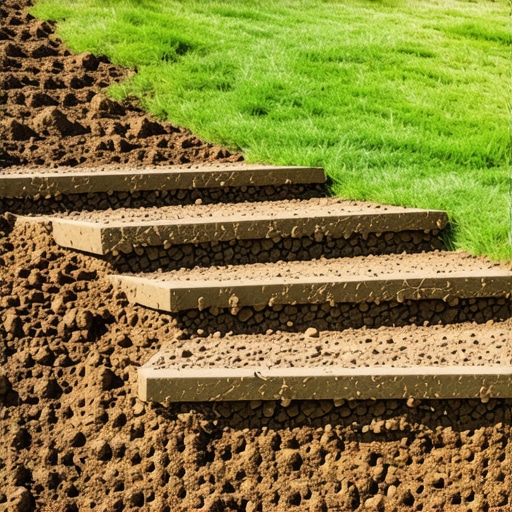
Gravity is the primary enemy of any sod install on a grade. I always drill into my new crew members: if you do not fix the soil grading first, every plant you put in the ground is just expensive compost. Most homeowners and ‘mow-and-blow’ outfits think they can just roll grass out like a carpet on a 30-degree incline and expect it to stay. It will not. Within one heavy rain cycle, that unanchored turf will liquefy at the root zone and slide down the hill in a muddy heap. We approach slope stabilization as a civil engineering challenge, using mechanical fasteners and staggered joints to fight shear stress. If you are not prepared to use 6-inch staples and 12-inch wooden pegs, you are not ready to tackle a hillside.
The Critical Physics of Slope Preparation
Proper slope preparation requires soil grading to ensure hydrostatic pressure does not build up behind the sod, leading to saturation-induced slippage. You cannot skip the yard cleanup phase, which involves removing every rock larger than a nickel and every stick that could create an air pocket. Air is the death of roots. If the soil is compacted like concrete, the roots will never penetrate. We use a power rake to scarify the top 2 inches of the ‘A’ horizon soil. This creates a textured surface that acts like Velcro for the new sod. Without this mechanical keying, the sod sits on a slick surface, waiting for the first irrigation cycle to lubricate its path to the bottom of the hill.
“Root-to-soil contact is the single most important factor in turfgrass establishment, particularly on inclines where the force of gravity works against the surface tension of the root zone.” – Agricultural Extension Agronomy Manual
How much modified gravel do I need for a patio base?
While the question of gravel refers to hardscaping, the base preparation for sod on a slope follows a similar logic: you need well-draining subsoil to prevent water logging. If your slope has heavy clay, you must incorporate expanded shale or coarse sand to improve the infiltration rate. We aim for a bulk density that allows a probe to penetrate easily but remains firm enough to resist surface erosion. For a typical sod install, we ensure the grade is cut at a 2-percent pitch away from structures before we even think about the turf. This prevents basement flooding and ensures the hill manages runoff effectively.
The Engineering of the Running Bond Pattern
Installing sod on a slope requires a running bond pattern where the vertical joints are staggered to prevent rills and gullies from forming between the rows. Think of it like laying bricks. If you align the seams, water will find those channels, pick up speed, and wash out the soil underneath the grass. We lay the sod perpendicular to the direction of the slope. This horizontal orientation acts as a series of mini-speed bumps for rainwater. Each row must be tucked tightly against the previous one without overlapping. Overlapping causes the edges to dry out and die, creating a ‘brown ladder’ effect on your hillside.
| Material Type | Holding Strength | Decomposition Rate | Best Use Case |
|---|---|---|---|
| 6-inch Steel Staples | Moderate | 3-5 Years | Gentle slopes (<15 degrees) |
| 12-inch Wooden Stakes | High | 1-2 Years | Steep embankments (>25 degrees) |
| Biodegradable Plastic Pegs | Moderate | 12-24 Months | Environmentally sensitive zones |
What is the best way to anchor sod on a steep grade?
The best way to anchor sod is to use 12-inch wooden lath stakes driven through the center of each sod roll and at the corners of the seams. These stakes should be driven flush with the soil surface so they do not interfere with future mowing. For extremely steep grades, we use a double-staking method. This involves one stake in the center and two at the top leading edge. This pins the turf mat to the subgrade, forcing the roots to grow directly into the existing soil profile rather than sliding laterally across the surface during a storm event.
Irrigation Strategies for Sloping Turf
Successful irrigation on a slope requires cycle-and-soak programming to prevent runoff and ensure the lower sections do not become a swamp while the top sections desiccate. Water obeys gravity. If you run your sprinklers for 20 minutes straight, the top 5 feet of the hill will get 2 minutes of water, and the bottom 5 feet will get 18 minutes. We set our controllers to run for 5 minutes, wait 30 minutes for the water to infiltrate the pore spaces, and then repeat. This forces the root system to chase moisture deep into the ground. Deep roots are the only thing that will permanently hold that hill in place once the staples rust away.
“A retaining wall doesn’t fail because of the stone; it fails because of the water trapped behind it, much like sod fails when the soil-water interface becomes a slip plane.” – Hardscape Engineering Axiom
The Maintenance Checklist for New Slope Sod
Maintaining newly installed sod on a grade requires a strict fertility schedule and moisture monitoring to ensure the establishment phase is successful. Do not even think about mowing for the first 21 days. You need to wait until you cannot pull the sod up by hand. This indicates that the primary roots have transitioned into secondary anchoring roots. When you do finally mow, do it on a diagonal. Never mow a steep slope when it is wet; you will tear the turf and create a slide risk. Use a high-nitrogen starter fertilizer with a slow-release polymer coating to provide steady nutrients without burning the tender new growth.
- Day 1-7: Water three times daily using the cycle-and-soak method to keep the thatch layer moist.
- Day 8-14: Reduce watering to twice daily: early morning and late afternoon.
- Day 15-21: Check for root attachment: if the sod resists lifting, reduce watering to once daily.
- Day 22+: Perform the first mow at the highest setting: do not remove more than 1/3 of the blade.
How long does it take for sod to root on a hill?
In most climates, sod will root within 14 to 21 days provided the soil temperature is above 55 degrees Fahrenheit and moisture levels are consistent. On a hill, this process may take slightly longer at the top of the slope due to faster evaporation and drainage. We recommend using a rooting stimulant containing mycorrhizae to accelerate the biological bond between the sod and the subsoil. This fungal network acts as an extension of the root system, increasing drought resistance and structural integrity.