
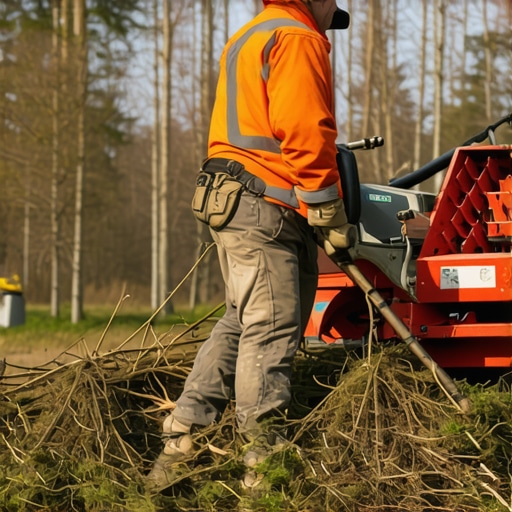
I always drill into my new crew members: if you don’t fix the soil grading first, every plant you put in the ground is just expensive compost. This lesson applies doubly to yard cleanup. I have seen too many rookies try to hide brush piles under a layer of fill dirt, thinking they are being clever. Within three years, that organic matter rots, the soil collapses, and the $15,000 sod install on top of it looks like a topographical map of the moon. Clearing debris is not just about aesthetics; it is about site engineering. If you are staring at a massive mountain of cedar, oak, or invasive scrub in 2026, do not reach for a wood chipper yet. Chippers are high-maintenance, dangerous, and slow for the volume we are talking about. You need a strategy that handles bulk without the mechanical headache.
How to clear brush piles quickly in 2026 without a wood chipper?
To clear 2026 brush piles fast without a wood chipper, utilize mechanical grapple attachments on a skid steer to consolidate mass, employ air curtain burners for high-speed onsite incineration, or implement trench-based biochar production. These professional methods prioritize bulk volume reduction and soil health over individual branch processing.
The Mechanical Advantage: Why the Grapple Wins
Manual labor is a fool’s errand for large-scale landscaping. A standard wood chipper requires you to limb every branch to fit the throat of the machine. That is wasted time. In my firm, we use a 72-inch root grapple on a track loader. The hydraulic 3,000 PSI clamping force crushes the air out of the pile instantly. We are talking about reducing the physical footprint of the brush by 40 percent just by picking it up. When you move mass mechanically, you are protecting your crew’s backs and accelerating the yard cleanup timeline. You are looking for a grapple that features independent tines to grab uneven loads of logs and brush simultaneously.
“Woody debris buried in the soil profile causes localized nitrogen deficiency as microbes consume available N to break down high-carbon cellulose; this immobilization can stunt turf growth for years.” – Agronomy Manual of Soil Management
The Physics of the Air Curtain Burner
If you have the acreage and the permits, the air curtain burner is the king of 2026 debris management. Unlike a standard bonfire which creates thick, black smoke and attracts the fire department, an air curtain burner uses a high-velocity manifold to blow a sheet of air across a containment pit. This traps the particulates and re-circulates them back into the fire. The result is a burn that is 10 times hotter than an open flame and produces virtually no smoke. You can incinerate a whole tree in minutes. It turns 100 cubic yards of brush into a single bucket of ash. This ash is a concentrated source of potassium, which we later test and potentially integrate back into the soil before the sod install. It is efficient engineering at its finest.
Comparison of Brush Management Methods
| Method | Speed Rating | Cost Factor | Soil Impact | Required Equipment |
|---|---|---|---|---|
| Air Curtain Burner | High | Moderate | Low (Ash only) | Blower/Trench |
| Biochar Trench | Medium | Low | High Benefit | Excavator |
| Grapple & Haul | High | High (Dump fees) | Neutral | Skid Steer/Dumpster |
| Manual Chipping | Low | Low | Mulch Cover | Wood Chipper |
How much does it cost to haul brush per cubic yard?
In the current 2026 market, professional haul-off rates for landscaping debris typically range from $45 to $85 per cubic yard depending on your proximity to a green-waste recycling center. This is why onsite processing is the superior financial move. If you are clearing two acres of heavy brush, you could be looking at 200 cubic yards of loose material. Do the math. Processing it into biochar or using an air curtain burner pays for the equipment rental in a single day. Do not let your profit margin get eaten by a roll-off dumpster company.
The Biochar Trench: Turning Waste into Gold
For those who care about long-term soil biology, the biochar method is the secret weapon. We dig a trench exactly 4 feet deep and 3 feet wide. We stack the brush tightly. We light the top. As the fire burns down, the oxygen is restricted at the bottom, creating a pyrolysis reaction. Instead of turning to ash, the wood turns into carbon-stable biochar. We quench it with water from our irrigation setup once the pile glows deep red. This char is a permanent home for microbes. When you later till this into the site before laying sod, you are creating a reservoir for nutrients and water that lasts for centuries. It is the opposite of the “mow-and-blow” philosophy. You are building an ecosystem.
Professional Checklist for Site Clearing
- Identify utility lines via 811 before any mechanical excavation or trenching.
- Check local municipal codes for “Open Burning” vs. “Air Curtain” exemptions.
- Sort materials: Hardwood for biochar, softwood/vines for incineration.
- Assess soil moisture; never run heavy tracks over saturated clay to avoid compaction.
- Plan the irrigation layout before the brush is gone to ensure trenches align with clearing paths.
How do I prepare the ground for sod after clearing brush?
Once the brush is gone, the real work begins. You cannot just throw down grass. The soil is likely compacted and nutrient-depleted. We use a Harley Rake to scarify the top 4 inches. We then check the pH. Most brush-heavy areas are acidic due to decaying tannins. We might add pelletized lime at a rate of 50 pounds per 1,000 square feet. Only after the grade is laser-leveled and the irrigation heads are set to the finished grade do we bring in the sod install crew. If you skip the compaction test, your lawn will be lumpy by next spring. Use a water-filled roller to find the soft spots before the pallets arrive.
“A retaining wall doesn’t fail because of the stone; it fails because of the water trapped behind it, and the same hydrostatic principles apply to buried organic debris causing soil subsidence.” – Hardscape Engineering Axiom
The Dangers of the “Hugelkultur” Misinterpretation
You might hear internet gurus tell you to just bury the logs in a mound and plant on top. They call it hugelkultur. In a residential landscaping context, this is often a disaster. Unless you are in a specific permaculture zone with the right climate, a buried log pile is a termite hotel. It also creates air pockets that lead to root rot in your premium plants. If you want to use the brush for soil health, it must be chipped or charred. Don’t bury whole logs under your yard. It will rot. It will sink. You will regret it. I have spent half my career fixing “sustainable” projects that were really just lazy ways to avoid hauling debris.
PAA: Will brush piles attract snakes and rodents?
Yes, any brush pile left for more than 48 hours becomes a primary habitat for copperheads, rats, and mice. This is why speed is the critical factor in 2026. If you cannot process the pile in one weekend, you are creating a pest pressure problem for the entire neighborhood. Professional yard cleanup means immediate processing. If you must wait, keep the pile as far from the foundation of the home as possible and never tarp it, as the trapped heat and moisture accelerate the arrival of pests. Get it cleared. Get it processed. Get the grass growing.