
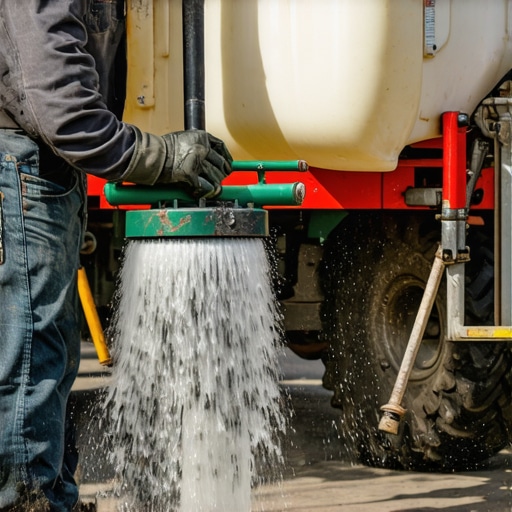
The Chemical Nightmare: A $12,000 Sod Lesson
A homeowner called me in a panic last season after they completely torched their front lawn by applying what they thought was a simple liquid iron supplement. They were staring at three thousand square feet of shriveled, straw-colored TifTuf Bermuda that had been installed just weeks prior. The culprit was not the iron; it was the microscopic residue of 2,4-D herbicide left over from the previous autumn. They hadn’t neutralized the tank. They didn’t scrub the lines. They basically acid-washed their new investment. This is why I tell my crew that a dirty sprayer is a weapon of mass destruction for any professional landscaping project. If you are prepping for the 2026 season, you need to understand that water alone is not a cleaning agent for chemical surfactants. It will fail. You must treat tank maintenance like a forensic operation to ensure your sod install and yard cleanup efforts aren’t sabotaged by your own equipment.
Why Sprayer Maintenance Dictates Your Turf Success
Sprayer maintenance prevents cross-contamination and nozzle clogging by removing hardened chemical residues and biological biofilms that accumulate during storage. Failing to de-gunk your tank leads to uneven NPK distribution, ruined seals, and phytotoxicity that can kill high-value landscaping and sensitive sod in hours. Accuracy is everything in 2026.
How do I remove hardened fertilizer from a sprayer tank?
Removing hardened fertilizer requires a chemical breakdown of the salt crystals that bind to the polyethylene tank walls. You cannot just shake the tank. You need a dedicated tank cleaner or a heavy-duty ammonia solution to increase the pH and dissolve the crust. Use a stiff-bristled brush on a pole to mechanically agitate the corners where the pump intake sits. This prevents the crystals from breaking loose later and clogging your 50-mesh screens mid-job.
“A sprayer that has not been properly triple-rinsed and neutralized becomes a reservoir for unintended herbicide damage, often referred to as ‘chemical ghosting’ in the turf industry.” – Purdue University Extension Agronomy Manual
The Anatomy of a Clogged System: A Forensic Autopsy
When I tear apart a pump that has failed, I usually find a gray, viscous sludge. This is the ‘gunk.’ It is a combination of hard water minerals, undissolved wettable powders, and degraded surfactants. In an irrigation-heavy environment, these residues interact with the minerals in your water. If you have high calcium levels, your chemicals are more likely to flocculate. This means they turn into a jelly-like substance that sits at the bottom of the tank. It destroys diaphragm pumps. It eats through Viton seals. It turns a $500 professional sprayer into a boat anchor. You must inspect the suction strainer first. If it is coated in slime, your entire system is compromised. Don’t skip the hose lines either. Chemicals can permeate the rubber over time, leaching out into your next batch of fertilizer and killing your client’s flowers. This is not a suggestion; it is engineering reality.
| Cleaning Agent | Target Residue | Application Method | ||||||
|---|---|---|---|---|---|---|---|---|
| Household Ammonia | Phenoxy Herbicides (2,4-D, Dicamba) | 1% solution, circulate for 15 mins | Commercial Tank Cleaner | Wettable Powders & Oily Emulsions | Follow label PSI for agitation | Trisodium Phosphate (TSP) | Extreme Fertilizer Scaling | Hot water mix, overnight soak |
The Professional 10-Point Sprayer De-winterization Checklist
- Inspect the Tank Integrity: Look for stress cracks in the plastic. Sunlight degrades poly tanks over time. If it looks chalky, replace it.
- Flush with Warm Water: Start with a 10-gallon flush to move loose debris.
- Clean the Suction Strainer: Remove the mesh and scrub with a toothbrush. If it is frayed, it will let grit into the pump.
- Check the Diaphragm or Piston: Lubricate with a silicone-based grease. Do not use petroleum-based products on rubber seals.
- Test the Pressure Gauge: If the needle bounces, you have air in the lines or a failing pump.
- Calibrate the Nozzles: Catch the output in a measuring cup for 60 seconds. If it varies by more than 10% from the manufacturer’s spec, the orifice is worn.
- Scrub the Tank Walls: Use a long-handled brush. The gunk hides in the shadows of the tank mold.
- Neutralize the Chemical Ghost: Use an ammonia or commercial neutralizing agent.
- Rinse the Booms: Ensure the ends of the spray booms are flushed. Debris settles at the ends.
- Final Flow Test: Run clean water at 40 PSI and check for leaks at every fitting.
What is the best way to clean a commercial backpack sprayer?
For a commercial backpack sprayer, the key is the triple-rinse method combined with a dedicated nozzle soak. First, dump the tank and add clean water, shaking vigorously. Second, add a cleaning solution and pump it through the wand for two minutes. Third, disassemble the nozzle and the handle filter, soaking them in a bucket of detergent. This prevents the small orifices from becoming obstructed by dried chemical flakes that can distort your spray pattern and lead to ‘striping’ on a new sod install.
“Uniformity of application is the cornerstone of professional turf management; even a 5% deviation in nozzle output can lead to localized nutrient deficiencies or toxic over-application.” – ICPI Hardscape and Turf Standards
The Physics of the Spray Pattern and Why Gunk Ruins It
You might think a little bit of residue in the nozzle isn’t a big deal. You are wrong. A standard flat-fan nozzle relies on a precise orifice shape to atomize the liquid into specific micron sizes. When gunk builds up, it creates turbulence. This turbulence creates ‘fines’ or tiny droplets that drift in the wind. These fines end up on the neighbor’s prize roses or your own ornamental shrubs. It also creates heavy droplets that fall straight down, leading to ‘hot spots’ of fertilizer that will burn the roots of fresh sod. I have seen entire yard cleanup projects ruined because the contractor didn’t realize their nozzles were partially occluded. You are looking for a crisp, even fan. Anything else is a failure of professional standards. Check your spray tips every 50 gallons. Use a ceramic tip if you are spraying abrasive powders; they last ten times longer than brass. Don’t be cheap. A $5 nozzle protects a $5,000 landscaping job. It is simple math. Every time you finish a job, flush the system. If you leave chemical in that tank overnight, you are inviting the gunk to take over. It will rot your gaskets. It will ruin your morning. Clean it now or pay for it later.