
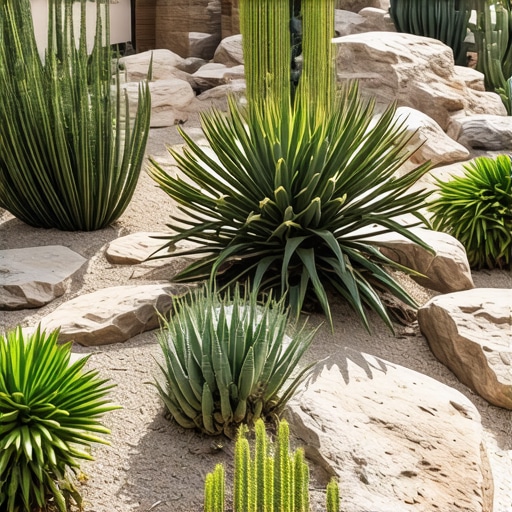
The Engineering Foundation of a High-End Rock Garden
A low-maintenance rock garden in arid zones requires meticulous site grading, porous substrate layers, and geotextile fabrics to prevent weed infiltration and ensure water reaches deep root systems without evaporating or causing surface erosion in rare heavy rains. Most homeowners think you just throw some stones on a hill and call it a day. That is how you end up with a weed-infested pile of hot rocks that kills your plants. I always drill into my new crew members: if you don’t fix the soil grading first, every plant you put in the ground is just expensive compost. It is the physics of the site that dictates the success of the biology. If your grade is off by even two percent in a desert climate, the little rain you do get will either pool and rot the root crowns or wash away your expensive top-dressing. We are building a system, not a decoration.
Material Science: Choosing Aggregates and Boulders
Selecting the right stone for a dry climate rock garden depends on the thermal mass of the material and its specific gravity to ensure long-term stability against wind and water movement. You cannot just grab whatever is cheapest at the big-box store. Those round river rocks from the hardware store? They roll. They do not lock together. You need angular crushed stone or decomposed granite for your base. These materials have a high internal friction angle that prevents shifting. Boulders should be local. Buying exotic stone from three states away is a rookie mistake. Local stone matches the native soil pH and looks natural. When we set a boulder, we bury at least one-third of it. This anchors the stone and provides a cool, moist micro-environment for root systems to tuck under. It mimics the natural geological strata. It prevents shifting during the freeze-thaw cycles that occur even in many dry climates.
“In arid environments, the goal of a rock garden is to minimize evapotranspiration by shielding the soil surface with inorganic mulch while maintaining high macroporosity for gas exchange.” – USDA NRCS Agronomy Technical Note
| Material Type | Drainage Efficiency | Heat Retention | Stability Rating |
|---|---|---|---|
| Decomposed Granite | High | Moderate | Excellent |
| Lava Rock (Scoria) | Exceptional | High | Poor |
| Crushed Limestone | Moderate | Moderate | High |
| River Cobble | Low | Low | Moderate |
How deep should a rock garden base be?
For a standard residential installation, you need a four-to-six inch excavation depth to accommodate the structural layers and the weed barrier. This depth allows for a stable footing for larger boulders and enough room for a two-inch layer of decorative aggregate on top of the structural base. If you go shallower, the soil will eventually mix with your stone through worm activity and erosion. This creates a seedbed for weeds. Don’t skip the depth. It will fail.
The Botany of Arid Landscapes: Plant Selection and Root Flares
Planting in a rock garden requires an understanding of USDA Hardiness Zones and the transpiration rates of specific xerophytic species. You aren’t just looking for something that looks good; you are looking for plants that can handle a 40-degree temperature swing in 24 hours. The most common failure I see is planting too deep. People cover the root flare. The root flare is where the trunk meets the roots. If you bury it under rock or soil, it will rot. I don’t care how dry your climate is. Use native species like Agave, Yucca, or specialized Penstemon. These plants have evolved to seek out the pockets of moisture trapped under stones. [IMAGE_PLACEHOLDER] Always check the root ball for girdling before it goes in the hole. If those roots are circling the pot, they will never break out into the native soil. They will choke the plant to death within three years. Cut them or toss the plant.
What are the best drought-tolerant plants for rocky soil?
The best performers are succulents, woody perennials, and ornamental grasses like Bouteloua gracilis which require minimal supplemental irrigation once established. Choose plants with glaucous foliage or waxy coatings, as these features are biological adaptations designed to reflect sunlight and retain internal moisture during peak UV exposure hours.
Precision Irrigation and Soil Hydrology
Proper irrigation in a rock garden is about targeted delivery to the root zone, avoiding the surface of the stones where water evaporates instantly. Drip irrigation is the only professional choice here. We use Netafim or similar pressure-compensating emitters. We don’t use spray heads. Spraying water on hot rocks is a waste of money. You want 0.5 to 1.0 gallon-per-hour emitters placed directly at the drip line of the plant. As the plant grows, you must move those emitters out. Most contractors set them at the trunk and leave them. That leads to a weak, centralized root system. You want to force the roots to spread. If you are doing a sod install nearby, ensure the runoff from the lawn irrigation does not bleed into the rock garden. The high nitrogen levels in lawn fertilizer will cause a weed explosion in your rocks. Keep them separate.
“A retaining wall or rock terrace doesn’t fail because of the stone; it fails because of the water trapped behind it.” – Hardscape Engineering Axiom
The Installation Checklist
- Call 811 to mark underground utilities before any excavation.
- Grade the sub-base at a minimum 2% slope away from any structures.
- Install a heavy-duty non-woven geotextile fabric (not the cheap plastic stuff).
- Place largest boulders first, burying the bottom third for stability.
- Install the drip irrigation mainlines and lateral tubes.
- Set plants at the correct height, ensuring the root flare is visible.
- Apply a 2-3 inch layer of decorative aggregate or decomposed granite.
- Perform a system pressure test to check for leaks in the irrigation line.
Maintaining the Arid System
A low-maintenance garden is not a no-maintenance garden. You will need a thorough yard cleanup twice a year. Blow out the organic debris like fallen leaves. If leaves sit on the rocks, they break down into compost. That compost becomes soil. That soil grows weeds. Use a high-powered blower, not a rake. Raking disturbs the locking mechanism of the stones. Check your irrigation emitters for calcium buildup, especially if you have hard water. A clogged emitter is a death sentence for a plant in July. This is a scientific approach to landscaping. It is about managing the mechanical and biological realities of the site. Do it right the first time. Or don’t do it at all.