
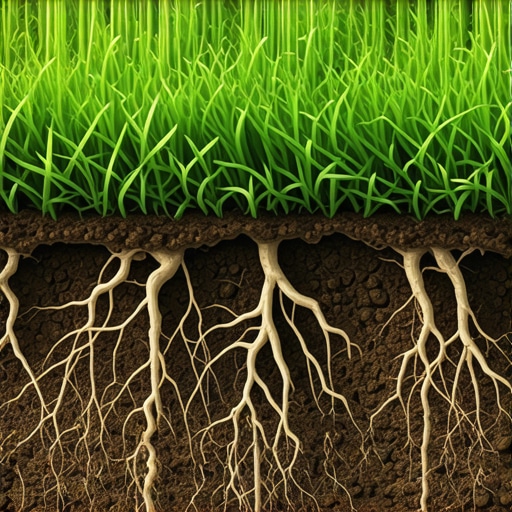
The Chemical Nightmare: A $15,000 Lesson in Soil Burn
Last spring, I walked onto a property that looked like a scorched-earth tactical exercise. The homeowner, a DIY enthusiast who spent too much time on YouTube and not enough time reading labels, had completely torched 8,000 square feet of expensive Kentucky Bluegrass. He had applied a triple-dose of high-nitrogen synthetic fertilizer in 90-degree heat, thinking more was better. The grass wasn’t just dead; the soil was functionally sterile. The salt index had skyrocketed, and the microbial life was obliterated. This is the reality of the ‘mow-and-blow’ culture that relies on chemical spikes rather than biological foundations. To fix it, we didn’t just throw down more seed. We had to perform a total soil autopsy, excavating the history of neglect and restarting the carbon cycle using humic acid. If you want a lawn that survives the climate shifts of 2026, you stop feeding the plant and start feeding the dirt.
What is Humic Acid and Why Does Your Lawn Require It?
Humic acid is a highly concentrated organic soil conditioner derived from oxidized lignite, often called leonardite, which drastically improves nutrient uptake, soil structure, and microbial activity. In the 2026 landscaping landscape, it acts as a chelator, binding to insoluble minerals and making them bio-available to grass roots, ensuring deep-vein hydration and structural resilience. Without it, your fertilizers simply leach into the groundwater.
“Humic substances are the most chemically active compounds in soils, dictating the availability of nutrients and the health of the rhizosphere.” – Agronomy Manual 10th Ed.
The Forensic Autopsy: Why Synthetic Programs are Failing
Traditional turf management is failing because it treats soil like a dead medium. When you apply standard N-P-K (Nitrogen, Phosphorus, Potassium) fertilizers, only about 40% of that nutrition actually reaches the plant. The rest is lost to volatilization or runoff. This creates a weak, ‘lazy’ root system that stays in the top two inches of the soil. When July heat hits, that shallow-rooted turf wilts immediately. Humic acid changes the electrical charge of the soil particles. It increases the Cation Exchange Capacity (CEC). Think of CEC as the soil’s battery capacity. A high CEC means the soil can hold onto nutrients and water longer. This is critical for irrigation efficiency. If your soil can’t hold water, your irrigation system is just an expensive way to wash away your topsoil. We see this constantly during yard cleanup sessions; we pull out dead thatch and find bone-dry dirt just three inches down despite heavy watering. It is a structural failure of the soil chemistry.
How Much Humic Acid Do You Actually Need?
Precision is everything in high-end landscaping. You don’t just ‘spread some around.’ You calculate based on your soil’s organic matter percentage. Most residential yards are sitting at less than 2% organic matter. You want to aim for 5%. To move the needle, we apply granular humic acid at a rate of 1 to 2 pounds per 1,000 square feet, twice a year. If we are doing a fresh sod install, we apply it directly to the graded soil before the rolls go down. This ensures the new roots don’t hit a wall of hard-pan clay. They chase the humic-rich moisture deep into the sub-base. It will rot if you don’t have that drainage and biological bridge. Do not skip this step.
How often should I apply humic acid to my lawn?
For optimal root depth, professional-grade humic acid should be applied twice annually: once in early spring during the first flush of root growth, and again in early fall to prepare the turf for winter dormancy. This schedule maximizes the chelation of micronutrients like iron and magnesium, which are essential for chlorophyll production and cold-hardiness.
Can humic acid replace traditional fertilizer?
No. Humic acid is a soil conditioner, not a primary nutrient source. However, it makes your existing fertilizer 50% more effective. By integrating humic acid, you can actually reduce your total nitrogen input, which prevents the ‘surge growth’ that leads to frequent mowing and fungal outbreaks. It is about efficiency, not just volume. This is a core tenet of modern landscaping engineering.
The Technical Specs: Humic vs. Fulvic Acid
You need to understand the difference between humic and fulvic fractions. Humic acid is the heavy hitter; it stays in the soil for years, building structure. Fulvic acid is the delivery truck; it’s a smaller molecule that enters the plant leaf directly. For a 2026 lawn strategy focused on root depth, you want a product that is at least 70% humic acid by weight. Check the label. If it doesn’t list the leonardite source, it’s garbage. Avoid the cheap liquids at big-box stores that are mostly water and black dye.
| Metric | Traditional Synthetic Only | Humic-Integrated Program |
|---|---|---|
| Root Depth (Inches) | 2-4 inches | 8-12 inches |
| Water Consumption | High (Daily watering) | Low (Deep/Infrequent) |
| Nitrogen Leaching | Significant (30%+) | Minimal (<10%) |
| Soil Compaction | High (Requires annual aeration) | Low (Biological loosening) |
Blueprint for Root Depth: The Step-by-Step Remediation
If your lawn is currently struggling, follow this professional protocol. It’s what I charge my high-end clients thousands for, but the logic is simple: fix the biology, and the biology fixes the grass. [IMAGE_PLACEHOLDER]
- Step 1: Core Aeration. Pull 3-inch plugs to break up surface tension. This is the only way to get carbon into the root zone.
- Step 2: Soil Testing. Verify your pH. If you are above 7.2 or below 6.0, your humic acid will struggle to mobilize nutrients.
- Step 3: Granular Application. Spread a high-quality leonardite-based humic product. Do this during your yard cleanup phase.
- Step 4: Irrigation Calibration. Set your irrigation to deliver 0.5 inches of water immediately after application to wash the humic particles into the aeration holes.
- Step 5: Follow-up. Repeat in 6 months. Soil health is a marathon, not a sprint.
“A lawn’s drought tolerance is directly proportional to its root depth, which is governed by soil porosity and organic carbon levels.” – Texas A&M AgriLife Extension.
The 2026 Mandate: Why Carbon is King
We are entering an era where water costs and chemical regulations are making old-school landscaping methods obsolete. In 2026, a ‘green lawn’ won’t be enough; it will have to be a ‘resilient lawn.’ This means building a soil profile that can withstand three weeks without rain. Humic acid is the primary tool for this. It builds the rhizosphere. It creates the 12-inch root systems that survive when the irrigation restrictions kick in. If you are still just throwing ‘weed and feed’ at your problems, you are wasting money and killing your soil. Get a shovel. Dig a hole. If you don’t see dark, crumbly soil and deep white roots, you’re failing the engineering test of your yard. Fix the carbon, and the rest follows.