
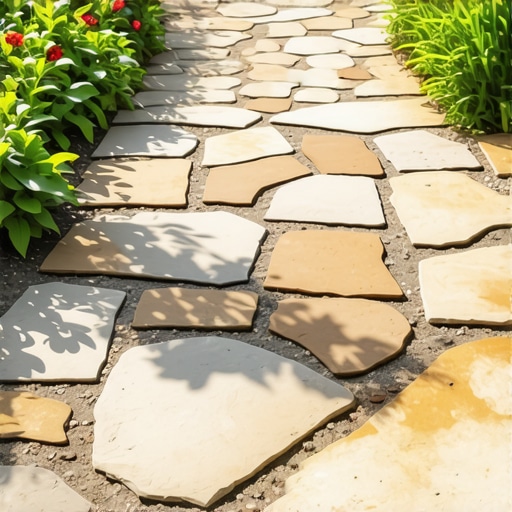
The Engineering of a Weed-Free Hardscape: Why 2026 Requires a New Standard
Establishing a permanent barrier against weed growth in flagstone joints requires more than just a bag of sand and a broom. To achieve weed suppression in flagstone joints, you must integrate high-performance polymeric sand with a stabilized base layer that prevents hydrostatic pressure from forcing moisture and organic matter into the crevices of your landscaping. Most failures occur because the substrate cannot handle the freeze-thaw cycles that will inevitably occur between now and 2026. Stop thinking about the surface. Start thinking about the chemistry of the void.
The Hardscape Autopsy: Lessons from a $30,000 Failure
I recently got called out to tear up a $30,000 patio that was sinking because the previous contractor decided that a simple stone dust base was sufficient for heavy Pennsylvania flagstone. Within two seasons, the stone dust had washed out into the subsoil because they skipped the geotextile fabric. The flagstones were literally floating on mud. As the stones shifted, the joints cracked, creating a perfect nursery for crabgrass and dandelion seeds. It was a structural autopsy of incompetence. If you do not fix the soil grading and the base compaction first, every dollar you spend on high-end sealant is just wasted capital. We had to excavate 8 inches of material, install a 2A modified gravel base compacted in 2-inch lifts, and then reset the entire field. The homeowner paid twice for one patio. Don’t be that person. Compaction matters. Drainage matters more.
“A retaining wall doesn’t fail because of the stone; it fails because of the water trapped behind it. The same logic applies to your patio joints; moisture is the carrier of failure.” – Hardscape Engineering Axiom
The Science of Joint Failure: Why Weeds Actually Grow
To stop weeds, you must understand that 90 percent of weed growth in flagstone comes from the top down, not the bottom up. Wind-blown seeds land in the microscopic cracks of degraded joint material. When irrigation systems or rainfall provide moisture, these seeds germinate in the accumulated organic silt. To prevent this, you need a material that achieves 95 percent Proctor density and remains flexible enough to resist micro-cracking.
How deep should flagstone joints be for polymeric sand?
For a successful polymeric sand installation in flagstone joints, the depth must be a minimum of 1.5 inches to ensure structural cohesion and prevent the material from delaminating or popping out during heavy rain or yard cleanup. Shallow joints lack the mass to stay anchored. If your flagstone is thin, you are already at a disadvantage. Deep joints allow the polymers to cross-link effectively, creating a semi-rigid plug that resists the physical penetration of taproots.
| Material Type | Longevity (Years) | Weed Resistance Rating | Flexibility Index |
|---|---|---|---|
| Standard Masonry Sand | 0.5 | Low | Zero |
| Stone Dust / Screenings | 1.0 | Moderate-Low | Poor |
| Polymeric Sand (G2 Technology) | 5-8 | High | Excellent |
| Permeable Resin Mortar | 10+ | Superior | High |
The 2026 Protocol: Step-by-Step Joint Stabilization
Preparation is 80 percent of the job. You cannot seal a dirty joint. Use a pressure washer with a turbo nozzle to excavated old, failed material to a depth of at least 1.5 inches. Let it dry completely. Not ‘looks dry,’ but bone dry. If there is moisture in the stone, the polymers will activate prematurely and leave a white haze on the surface. This haze is a nightmare to remove. It is a chemical bond you do not want on the face of your stone.
- Step 1: Joint Excavation. Remove all organic matter and old sand using a shop-vac or high-pressure air.
- Step 2: Substrate Inspection. Ensure the irrigation heads are not spraying directly onto the joints, which leads to erosion.
- Step 3: Sand Application. Sweep the polymeric sand into joints in stages. Do not dump it all at once.
- Step 4: Mechanical Compaction. Use a plate compactor with a protective mat to vibrate the sand into the full depth of the joint.
- Step 5: The Finger Test. The sand should be firm and 1/8 inch below the stone edge.
- Step 6: Controlled Hydration. Use a fine mist. Do not flood it. You are triggering a chemical reaction, not washing the patio.
“The selection of jointing sand must meet ASTM C144 standards to ensure the gradation of particles allows for maximum interlocking and capillary break functionality.” – ICPI Technical Specification No. 2
The Relationship Between Sod Install and Hardscape Integrity
If you are planning a sod install adjacent to your flagstone, you must account for the soil pH and drainage. High-nitrogen runoff from new sod can accelerate the breakdown of certain cheap sealants. Furthermore, if your yard cleanup involves heavy power blowing, poorly compacted joints will fail. You need a landscaping plan that directs water away from the hardscape using a 1-inch drop for every 4 feet of run. This is basic civil engineering, but most ‘mow-and-blow’ crews ignore it. They leave the homeowner with a beautiful lawn and a rotting patio. Avoid this. Ensure your irrigation zones are calibrated to avoid ‘puddling’ at the edge of the stone work. Standing water is the enemy of polymer longevity.
How much modified gravel do I need for a patio base?
To calculate modified gravel base volume, multiply the total square footage of the patio by the depth (standard 6 inches for walkways, 8-12 inches for patios) and divide by 27 to get cubic yards. For a 400 square foot flagstone area, you will need approximately 7.5 cubic yards of 2A modified stone to ensure a stable foundation that prevents joint cracking. Do not skip the compaction of the sub-base. If the dirt is soft, the stone will fail. Use a vibratory rammer for the edges and a plate compactor for the field.
Maintenance for the 2026 Lifecycle
Hardscapes are not ‘zero maintenance.’ They are ‘low maintenance.’ Every spring, perform a visual inspection. Look for hair-line cracks. If you see them, do not ignore them. A small application of joint stabilizer can save you from a full re-do in five years. Avoid using harsh acids for cleaning; they eat the polymers. Use a pH-neutral cleaner. Keep the organic debris off the stone. Leaf tannins can stain flagstone permanently if left to rot in the rain. Your patio is an investment. Treat it like one. Don’t skip the details. It will rot if you do.