
The Anatomy of a Dying Ecosystem: Why Your Pond Looks Like Pea Soup
Pond algae control using barley straw is a biological mitigation strategy that relies on the aerobic decomposition of organic lignins to release low-level hydrogen peroxide, which inhibits the cellular division of various filamentous algae and planktonic species without destroying the broader aquatic microbiome. It is not a quick-kill chemical; it is a systemic preventative measure that requires precise timing, surface area calculations, and an understanding of water chemistry to be effective for the 2026 growing season.
I recently got called out to a site where a homeowner had completely torched their aquatic ecosystem. They had a beautiful 1/4-acre pond that turned slightly murky after a heavy spring rain. Instead of checking the irrigation runoff or testing the water, they dumped five gallons of high-concentration copper sulfate into the basin. By the time I arrived, the water was a ghostly, milky blue, every frog was dead, and the rotting algae at the bottom was off-gassing enough methane to make your eyes water. They traded a minor aesthetic nuisance for a biological dead zone. This is the ‘chemical nightmare’ scenario I see too often when people look for shortcuts instead of understanding the biological load of their landscaping.
“Algae control in small impoundments is more effectively managed through nutrient limitation and biological competition rather than repeated chemical intervention, which often leads to resistant strains and oxygen depletion.” – Penn State College of Agricultural Sciences
The Science of the Barley Straw Decomposition Cycle
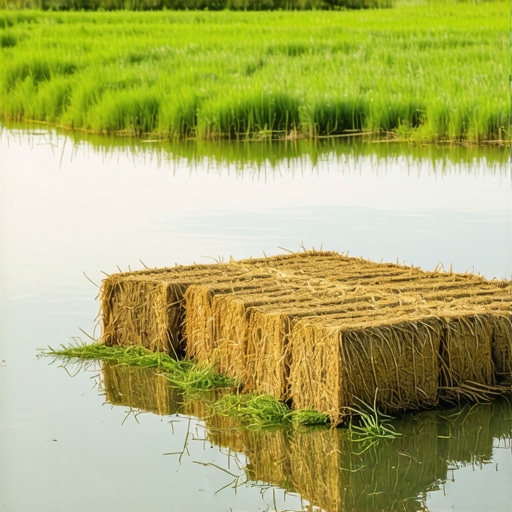
When you toss a barley bale into a pond, you aren’t just adding mulch; you are starting a chemical reactor. As the Hordeum vulgare (barley) straw begins to rot in the presence of oxygen and sunlight, it undergoes a complex breakdown of its cellular structure. This process requires aerobic conditions. If the straw sinks into the anaerobic muck at the bottom, it stops working and simply becomes more sludge. The goal is to keep it in the top 12 inches of the water column where the sunlight hit is highest. The fungi and bacteria that eat the straw release compounds that, when oxidized, create a sustained, microscopic concentration of hydrogen peroxide. This concentration is too low to harm fish or vascular plants like lilies, but it is devastating to the single-celled structures of pond algae. You must plan for 2026 now because this reaction takes 30 to 60 days to reach peak efficacy. If you wait until the water is already green, you have already lost the battle.
The Impact of Yard Maintenance on Pond Health
Your yard cleanup habits directly dictate the phosphorus levels in your water. If your crew is blowing grass clippings, leaf litter, or debris into the pond during a routine sod install or maintenance cycle, they are essentially spoon-feeding the algae. Organic matter that settles at the bottom becomes the ‘muck layer.’ During the heat of summer, this muck releases nitrogen and phosphorus back into the water column. Even the best barley straw application cannot overcome a massive nutrient spike caused by poor landscaping practices. I tell my guys: if the blower nozzle is pointed toward the water, you’re fired. We keep a 20-foot buffer zone of native, un-mowed grasses to act as a bio-filter for any runoff.
| Treatment Method | Active Mechanism | Longevity | Environmental Impact |
|---|---|---|---|
| Barley Straw | Biological/Peroxide Release | 4-6 Months | Minimal/Beneficial |
| Copper Sulfate | Heavy Metal Toxicity | 7-10 Days | High/Residual Accumulation |
| UV Clarifiers | DNA Damage via Radiation | Continuous | None (Requires Power) |
| Dyes (Blue/Black) | Light Limitation | 30 Days | Low (Inhibits Photosynthesis) |
How Much Barley Straw Do I Need?
The general rule of thumb for a typical pond is roughly 2 to 3 bales per acre of surface area, or approximately 0.025 pounds of straw per square foot of water surface. For smaller residential ponds, you are looking at roughly 10 to 25 grams per square meter. Do not over-apply. Excess straw that cannot decompose properly will actually contribute to the nutrient loading problem you are trying to solve. You must secure the bales in mesh bags and buoy them so they remain floating. It is a game of surface area contact. I prefer breaking the bales up into smaller ‘pillows’ and distributing them around the pond perimeter where the water is shallow and warm, as this is where the irrigation runoff usually enters and where algae blooms typically ignite.
“Effective pond management requires a multi-pronged approach: reducing nutrient input, increasing aeration, and utilizing biological inhibitors to maintain a state of dynamic equilibrium.” – Southern Regional Aquaculture Center (SRAC)
How long does barley straw take to work in a pond?
Barley straw typically takes 4 to 6 weeks to begin releasing sufficient levels of hydrogen peroxide to inhibit algae growth, depending on water temperature. In colder water (below 50°F), the decomposition is much slower, which is why early spring application is critical for 2026 control. It works best as a preventative, not a curative. Once the algae is already thick and matted, the straw will struggle to catch up. Don’t wait. Apply when the water begins to warm in late March or early April.
Will barley straw kill existing pond weeds?
No. Barley straw is an algistat, not an herbicide. It will not kill rooted aquatic plants like cattails, water lilies, or pondweed. In fact, by reducing the algae canopy, it often allows your desirable aquatic plants to thrive by increasing light penetration. This is a key distinction. If you have a weed problem, you need to look at manual harvesting or specific herbicides; barley straw is strictly for the green slime and planktonic blooms. If your landscaping plan includes a water feature, you need to understand this distinction before you start planting.
Professional Checklist for 2026 Pond Preparation
- Test water for high phosphate levels before the spring thaw.
- Clear all leaf litter from the pond perimeter during autumn yard cleanup.
- Check irrigation head angles to ensure no fertilizer-heavy water is hitting the pond basin.
- Calculate surface area: Length x Width = Total Square Footage.
- Order certified weed-free barley straw by February to ensure availability.
- Anchor straw ‘pillows’ in the upper 12 inches of water using floats.
- Monitor water clarity bi-weekly; if the straw turns black and smells of sulfur, remove it immediately.
It is important to remember that pond management is an exercise in patience. You are dealing with a living, breathing system. If you try to force it into submission with heavy chemicals, it will bite back. I have seen sod install projects where the installers used high-phosphorus ‘starter’ fert right next to a pond edge, and within three days, the water was a thick, green sludge. That is a failure of engineering. Proper landscaping means thinking three steps ahead. Use the barley. Watch the oxygen levels. Let the biology do the heavy lifting. Your fish, and your wallet, will thank you in 2026.