
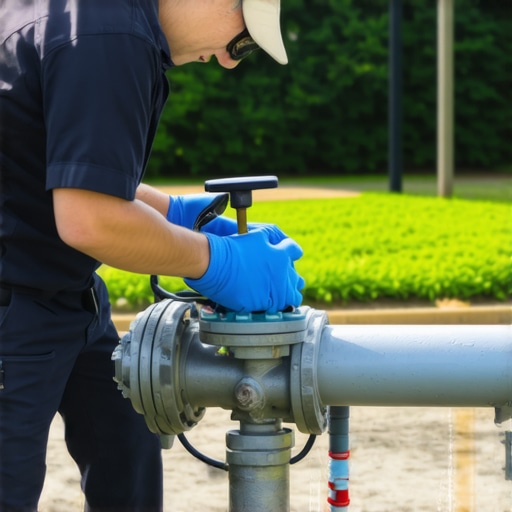
The Forensic Autopsy of a Failing Irrigation System
You walk out to the yard and see the symptoms before you even hear the system kick on. The turf is showing that tell-tale grayish-blue tint. The blades are folded. In some spots, your expensive sod install from last spring is turning into expensive compost. When the zone finally fires, the sprinkler heads don’t pop. They just weep. A pathetic puddle forms around the base of the head while the rest of the zone stays bone dry. Most guys will tell you it’s a broken pipe or a clogged nozzle. They’re usually wrong. If the entire system is dragging, you aren’t looking at a single head issue; you’re looking at a systemic failure of the pressure regulation, most likely at the Reduced Pressure Zone (RPZ) assembly.
The Narrative Matrix: The Case of the Whistling Backflow
I recently got called out to a property where the homeowner had spent five figures on a custom landscape design. Within three months, the backyard was a dust bowl. The previous contractor had already replaced the irrigation controller twice and ‘flushed’ the lines three times. I walked straight to the RPZ assembly—that brass contraption usually hidden in a fake rock or a cage. It was whistling. A high-pitched, metallic scream that indicated the internal relief valve was stuck in a perpetual state of ‘dumping.’ The system was losing 30 PSI before the water even hit the first manifold. We didn’t need more water; we needed to stop the water from fighting itself. I tore the RPZ apart and found a single pebble the size of a pea lodged in the first check valve. Thirty thousand dollars of landscaping held hostage by a five-cent rock.
“A backflow prevention assembly is not a ‘set and forget’ component; it is a precision mechanical device subject to the laws of fluid dynamics and mechanical fatigue.” – Irrigation Association Technical Manual
Why Your RPZ Is Killing Your Irrigation Pressure
An RPZ (Reduced Pressure Zone) assembly causes irrigation pressure loss when internal components like check valves, relief springs, or rubber diaphragms fail or become fouled by debris. This failure causes a drop in PSI (Pounds per Square Inch) because the device is designed to dump water out of the relief port if it senses a pressure imbalance, effectively robbing the downstream zones of the energy required to lift sprinkler heads.
Comparing Backflow Devices and Pressure Impacts
| Device Type | Typical PSI Loss | Protection Level | Common Failure Point |
|---|---|---|---|
| RPZ (Reduced Pressure Zone) | 8 – 15 PSI | High (Health Hazard) | Relief valve fouling / Spring fatigue |
| PVB (Pressure Vacuum Breaker) | 2 – 5 PSI | Moderate | Internal float sticking |
| DCV (Double Check Valve) | 3 – 5 PSI | Low (Non-Health) | Check valve seat leakage |
The RPZ is the gold standard for safety, but it is also the most sensitive. It operates on a differential pressure principle. There is a zone between two check valves that is kept at a lower pressure than the supply. If that differential is compromised, the relief valve opens. This is physics, not magic. If your supply line is 70 PSI and your RPZ is malfunctioning, you might only be sending 35 PSI to your rotors. Rotors need at least 40-45 PSI just to rotate. Anything less and you just have a very expensive leak.
How much pressure do I need for my irrigation system?
Most residential irrigation systems require a minimum of 40 to 50 PSI at the furthest head to operate efficiently. When you factor in friction loss through the PVC pipes and the mandatory 10-12 PSI drop across a healthy RPZ, your street pressure needs to be at least 65 PSI. If the RPZ is fouled, that drop can double, leaving your system paralyzed. Don’t guess. Use a pressure gauge on the test cocks of the RPZ to see exactly where the energy is disappearing. It’s the difference between engineering and guesswork.
The 2026 Irrigation Diagnostic Checklist
- Check the Relief Port: If water is constantly dripping or spitting from the bottom of the RPZ, the relief valve is unseated.
- Verify Street PSI: Use the first test cock (upstream) to measure incoming pressure. If the street is low, the RPZ isn’t your only problem.
- Test Check Valve #1: Shut off the downstream ball valve. If the relief valve starts dumping, your first check valve isn’t sealing.
- Inspect for Debris: Turn off the water, bleed the pressure, and open the sensing line. Look for PVC shavings or sand. It doesn’t take much.
- Spring Tension: Over time, the stainless steel springs in the check valves lose their ‘K-factor.’ Replace them every 5 years.
What are the signs of a failing backflow preventer?
The most common signs of a failing backflow preventer include visible water discharge from the relief port, a vibrating or humming sound during operation, and a significant drop in sprinkler head height. If you notice your heads are ‘bubbling’ instead of spraying, the RPZ is the first place to look. Do not adjust the controller settings to compensate for a mechanical pressure drop. You’ll just waste water and drown your soil microbiology while the grass stays thirsty.
The Engineering of Soil Grading and Water Management
You cannot talk about irrigation without talking about grading. In my two decades in the dirt, I’ve seen more ‘irrigation problems’ that were actually drainage problems. If your yard is flat or, worse, sloped toward the foundation, that RPZ discharge will create a swamp. The water must go somewhere. I drill this into my crew: we don’t just install pipes; we manage hydrostatic pressure. If the RPZ is dumping because of a pressure spike in the city main, and your grading is off, you’re looking at a flooded basement. Fix the grade first. Then fix the tech.
“Hydrostatic pressure is the silent killer of hardscapes; if you don’t provide a path for water, it will carve its own path through your foundation or your retaining wall.” – Hardscape Engineering Axiom
When we do a yard cleanup or a full sod install, we verify the irrigation coverage under load. That means we don’t just ‘turn it on.’ We measure the GPM (Gallons Per Minute) at the meter. If the RPZ is 15 years old and pitted with calcium deposits, we replace it. No exceptions. Putting new sod on top of a compromised irrigation system is like putting a Ferrari engine in a car with a clogged fuel line. It’s a waste of everyone’s time and money.
The Maintenance Mandate
Irrigation is a mechanical system, not a static utility. In 2026, with shifting municipal water pressures and more frequent ‘boil water’ advisories, your RPZ is the only thing standing between your family’s drinking water and the chemicals you put on your lawn. Don’t bypass it. Don’t ‘gut’ the internals because you’re frustrated with the pressure loss. Rebuild it. Use a high-quality rebuild kit with silicone seals that resist chloramines. It isn’t hard. It just takes a wrench and some respect for the engineering.