
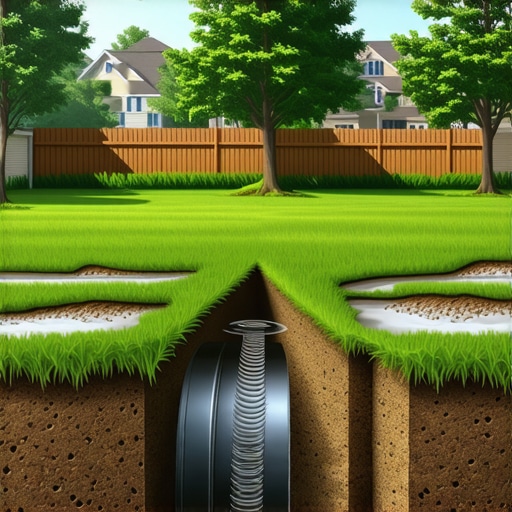
What is a French Drain and Why Does Your Yard Need One?
A French drain is a sub-surface drainage system consisting of a perforated pipe surrounded by clean stone and wrapped in geotextile fabric. It prevents yard flooding by intercepting groundwater and redirecting it to a safe discharge point before it saturates the soil profile, damages your sod install, or undermines your home foundation. I recently got called out to tear up a $30,000 patio that was sinking because the previous contractor ignored the 2% grade toward the foundation. The pavers were literally floating on a soup of saturated clay. This wasn’t a product failure; it was a civil engineering failure. If you don’t manage the water, the water manages you. I see it every week: homeowners spend thousands on a new landscaping package only to watch their expensive plants rot because the yard has the drainage capacity of a concrete bowl. You can buy the best irrigation system on the market, but if that water has nowhere to go, you are just building a swamp. Water follows the path of least resistance. Your job is to build that path before the water carves its own through your basement. Most yard cleanup crews will just blow the leaves off a puddle; a real professional finds out why the puddle is there in the first place.
The Forensic Autopsy: Why Your Lawn is a Swamp
The primary cause of standing water is soil compaction and poor hydrostatic pressure management. When soil becomes saturated, the pore spaces between soil particles fill completely with water, leaving no room for oxygen. This is how you kill a lawn. Root rot isn’t just about water; it is about suffocation. Most residential lots are stripped of topsoil during construction, leaving behind heavy subsoil that doesn’t drain. If you have standing water for more than 24 hours after a rain, your soil grading is failing. I always drill into my new crew members: if you don’t fix the soil grading first, every plant you put in the ground is just expensive compost. You cannot solve a drainage issue with sod install alone. In fact, laying new sod over a swampy area just hides the problem for six months until the roots hit the hardpan and die. You need a French drain to act as a relief valve for the entire yard.
“A retaining wall doesn’t fail because of the stone; it fails because of the water trapped behind it.” – Hardscape Engineering Axiom
How much modified gravel do I need for a patio base?
For a standard hardscape installation, you need a minimum of 6 inches of modified gravel (2A or 21A) compacted in 2-inch lifts. This creates a stable structural base that allows for hydrostatic pressure relief. Calculate your volume by multiplying the square footage by the depth in feet, then dividing by 27 to get cubic yards. Do not guess. If the base is thin, the patio will heave. Water always wins if you don’t give it a way out.
Engineering a French Drain: The Professional Standard
A professional French drain is not just a pipe in a hole. It is a multi-layered filter system. First, the trench must be excavated with a minimum 1% slope (one inch of drop for every eight feet of run). We use Schedule 40 PVC with pre-drilled holes, not that flimsy black corrugated pipe that you find at big-box stores. That thin stuff crushes under the weight of the soil. We line the trench with a non-woven geotextile fabric. This is critical. It allows water through but keeps the fine silt out. If silt gets into your stone, the drain will clog in three years. We use #57 washed stone as the aggregate. It has a high void ratio which allows for maximum water flow. The pipe is placed holes-down. Yes, holes-down. This allows the water table to rise into the pipe and be carried away. We wrap the entire stone and pipe assembly in the fabric, creating a “burrito” that will last 30 years. Anything less is just a temporary fix.
Can I install a French drain under my new sod install?
Yes, but you must ensure the soil profile above the drain is permeable. You cannot put 6 inches of heavy clay over a French drain and expect it to work. We typically use a sandy loam mix or a root zone soil to cover the drain before laying the sod. This ensures that surface water can actually reach the drainage aggregate. If you are doing a full landscaping overhaul, time the drain installation after the heavy grading but before the final irrigation lines are set. This prevents your crew from accidentally cutting through your new drainage system while trenching for sprinklers.
The Interaction of Landscaping and Irrigation
Poorly designed irrigation is the silent killer of many yards. Many contractors set zones to run for 20 minutes every morning regardless of the weather. This leads to anaerobic soil conditions. When you combine over-watering with poor drainage, you get a pathogen playground. Pythium and Rhizoctonia thrive in these conditions. A French drain mitigates the damage of over-irrigation by removing the excess gravitational water. However, the best solution is a smart controller with a rain sensor combined with proper yard cleanup to keep drains clear. If your gutters are dumping 500 gallons of water into a corner of your yard every time it rains, no amount of irrigation adjustment will save your lawn. You must pipe those downspouts directly into your drainage system.
“Surface drainage must be managed to prevent saturation of the subgrade, which reduces the load-bearing capacity of the soil.” – ICPI Tech Spec Number 2
Drainage Solution Comparison
| System Type | Primary Function | Material Requirement | Typical Lifespan |
|---|---|---|---|
| French Drain | Groundwater removal | Sch 40 PVC, #57 Stone, Fabric | 20-30 Years |
| Catch Basin | Surface runoff capture | Polyethylene Box, Solid Pipe | 15-20 Years |
| Dry Well | On-site infiltration | Structural Crate, Clean Stone | 15-25 Years |
| Swale | Surface redirection | Graded Soil, Turf/Rock | 50+ Years |
The Professional Drainage Checklist
- Call 811 to mark all underground utilities before digging.
- Confirm a 1 percent minimum slope using a laser level or transit.
- Use non-woven 4oz geotextile fabric to prevent siltation.
- Select Schedule 40 perforated PVC for longevity and crush resistance.
- Backfill with 1 to 2 inch clean, washed angular stone.
- Direct discharge to a safe daylight point or dry well.
- Document the location of the drain for future yard work.
Maintenance and Long-Term Results
Once a French drain is installed and the sod install is complete, the maintenance is minimal but vital. You need to keep the discharge point clear. If the end of the pipe is buried in mulch or leaves from a lazy yard cleanup, the whole system backs up. I recommend a pop-up emitter at the end of the line. It stays closed to keep out rodents but pops up under water pressure to let the flow out. Check your irrigation heads twice a year to ensure they aren’t spraying directly onto the drain line, which can cause localized soil erosion. If you follow these engineering standards, your yard will stay firm even during a three-inch downpour. It is the difference between having a yard you can use and a yard you can only look at from the porch. Don’t be the homeowner who pays for the same landscaping twice because they skipped the drainage the first time. Science doesn’t care about your budget; water will go where gravity takes it. Plan accordingly.