
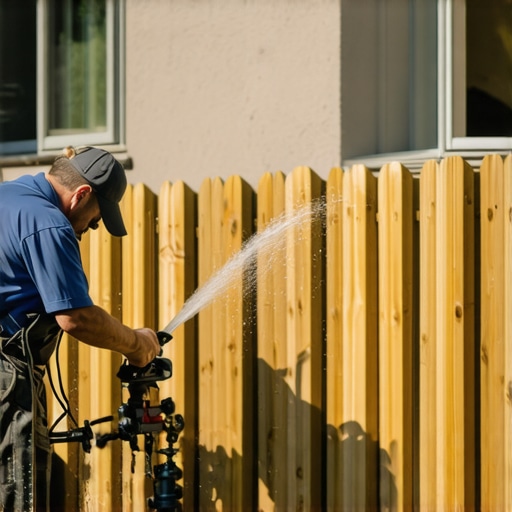
The Forensic Autopsy of a Saturated Property
The rhythmic clicking of a misaligned impact rotor is the sound of money dissolving your property. I see it every week: a homeowner spends $15,000 on a high-end cedar fence or $50,000 on custom windows, only to let a $5 sprinkler head destroy the investment. The symptom starts as a faint white haze on the glass or a dark, damp stain at the base of the fence. Within eighteen months, that haze becomes etched calcium carbonate that no vinegar solution will touch, and that damp stain becomes a localized colony of Basidiomycota fungi eating the cellulose out of your pickets. It is a slow-motion wrecking ball. When we go in for a yard cleanup, we aren’t just raking leaves; we are often performing a post-mortem on structural materials that failed because someone didn’t understand nozzle trajectory or arc adjustment.
I always drill into my new crew members: if you don’t fix the soil grading and irrigation alignment first, every plant you put in the ground is just expensive compost. I remember an apprentice, eager to finish a sod install, who ignored a tilted head near a customer’s mahogany deck. Six months later, I was back there with a moisture meter. The deck joists were at 35% moisture content—effectively rotting from the inside out. I made him help me pull the deck boards to see the white rot. It was a $4,000 lesson in precision. Irrigation is not a ‘set it and forget it’ utility. It is a hydraulic system that requires millimetric accuracy to avoid catastrophic property damage.
Why Sprinkler Overspray Destroys Your Property
Sprinkler overspray triggers rapid degradation of building materials through mineral calcification and fungal rot. Constant moisture on fence pickets or window panes leads to hydrostatic pressure issues and etched glass, requiring expensive landscaping remediation or hardscape replacement to maintain structural integrity. This is not merely an aesthetic issue; it is a structural liability. When water hits a vertical surface, it doesn’t just disappear. It tracks down to the foundation or the fence post footer. On a window, the solar heat bakes the minerals into the silica, creating a permanent bond. On a fence, the water forces the wood fibers to expand and contract daily, shearing the fasteners and leading to warped boards. This cycle of wetting and drying is more damaging than constant submersion because it accelerates the physical breakdown of the material’s cellular structure.
“Water applied to building envelopes via irrigation systems is a leading cause of premature cladding failure and mold growth in residential structures.” – Building Science Institute
Identifying the Root Cause of Irrigation Misalignment
To stop sprinkler overspray, you must first diagnose whether the issue is nozzle radius, arc adjustment, or high dynamic pressure. Most residential systems suffer from misting caused by excessive PSI, which allows the wind to carry water onto fences and windows regardless of where the head is pointed. You need a pressure gauge to ensure your heads are operating at their rated PSI—usually 30 for sprays and 45 for rotors. If your system is screaming at 70 PSI, your yard cleanup will eventually involve hauling away dead plants that were never actually watered because the water turned into a fog and drifted into your neighbor’s yard or against your siding. If the pressure is correct, then we look at the physical mechanics: the tilt of the head, the grit in the nozzle, and the internal seal of the pop-up body.
How do I stop my sprinklers from hitting the fence?
The most effective way to stop sprinklers from hitting the fence is to replace standard high-trajectory nozzles with short-radius nozzles or MP Rotators that feature a lower angle of discharge. By reducing the trajectory, the water remains below the fence line. Additionally, adjusting the arc of the sprinkler using a specialized adjustment tool ensures the spray stops exactly 2 inches before the fence. If the head is located too close to the structure, you may need to trench and move the head back 12 inches to allow for a proper spray pattern. Don’t just screw down the radius screw; that disrupts the precipitation rate and causes puddling. Use a nozzle designed for the specific distance you need.
“Proper irrigation design requires head-to-head coverage to ensure uniformity, but must never allow direct impingement on non-target structural elements.” – ASABE Standards
Adjusting Sprinkler Heads for Precision Spray Patterns
Precision irrigation adjustment involves balancing the nozzle arc and the radius of throw while accounting for wind drift and head tilt. A head that is even five degrees off-level will throw water 20% further on the downhill side, often hitting windows or fences that were meant to be dry. Use a 6-inch level to verify every head near a structure is perfectly vertical. For rotors, you must set the left and right stops. Most Hunter or Rain Bird rotors have a fixed left stop; you have to physically turn the entire body to align the left side, then use the key to adjust the right arc. If you are doing a sod install, do this before the grass goes down. Trying to fix a tilted head once the sod is rooted is twice the work and half as effective. Check your nozzles for calcium buildup. A partially blocked nozzle will ‘finger,’ sending a rogue stream of water directly at your house.
Markdown Comparison of Irrigation Nozzles
| Nozzle Type | Typical Trajectory | Best Use Case | Risk to Structures | | :— | :— | :— | :— | | Standard Spray | 25 – 30 Degrees | Small Turf Areas | High (Wind Drift) | | Low Angle Spray | 10 – 15 Degrees | Under Wind/Fences | Moderate | | MP Rotator | Multi-Stream | Slopes/Uniformity | Low (Heavy Droplets) | | Bubbler | 0 Degrees | Tree Rings/Beds | Zero (Flood Only) |
Structural Remediation: Repairing Fence and Window Damage
If you have already suffered sprinkler damage, the remediation process requires removing mineral deposits and sealing the affected surfaces to prevent further hydrostatic intrusion. For windows, use a phosphoric acid-based cleaner to dissolve the calcium carbonate, but be careful not to etch the glass further. For fences, the wood must be allowed to dry to below 12% moisture before applying a penetrating oil-based stain. Do not use a film-forming sealer; it will trap the moisture inside and accelerate the rot. If the fence posts are already leaning, your irrigation has likely saturated the soil to the point of liquefaction, and you will need to reset those posts with gravel for better drainage. This is why landscaping is as much about water management as it is about aesthetics.
How to clean hard water stains off windows from sprinklers?
To remove hard water stains, apply a mixture of distilled vinegar and citric acid or a commercial calcium-lime-rust remover to the glass with a non-abrasive pad. For heavy mineralization, use a specialized cerium oxide glass polishing compound with a dual-action polisher. Once clean, apply a hydrophobic coating or wax to the window; this forces water to bead off quickly, preventing the minerals from bonding to the surface during future overspray incidents. However, the only permanent solution is to redirect the sprinkler nozzles away from the glass entirely. Cleaning is just a temporary fix for a mechanical failure.
The Monthly Irrigation Audit Checklist
Irrigation systems are dynamic. Soil shifts, heads get bumped by mowers, and nozzles wear out. Follow this protocol once a month to ensure your landscaping doesn’t destroy your home. 1. Manually fire every zone and check for ‘misting’ (indicator of high pressure). 2. Walk the perimeter of the house and fences—if you see water hitting a vertical surface, adjust the arc immediately. 3. Inspect for low head drainage where water leaks out of the lowest head after the cycle ends. 4. Clear any overgrown turf from around the heads; grass creates a ‘splash-back’ effect that sends water everywhere. 5. Check the rain sensor to ensure the system isn’t running during storms, which adds unnecessary hydrostatic load to your foundation. Don’t skip this. A ten-minute walk can save you a ten-thousand-dollar repair bill later. Physics doesn’t care about your schedule.