
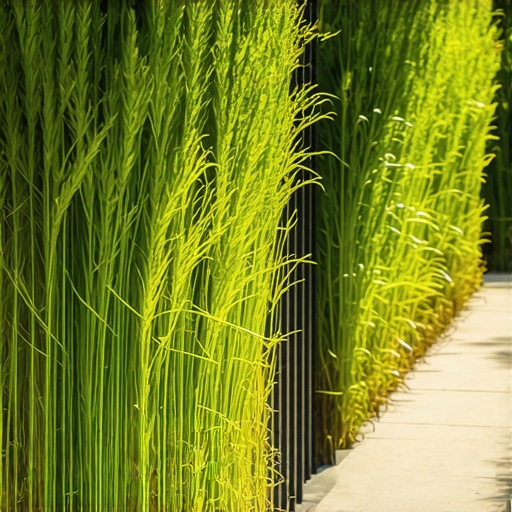
I always drill into my new crew members: if you don’t fix the soil grading first, every plant you put in the ground is just expensive compost. You can buy the most expensive 7 gallon pots of Miscanthus in the county, but if they are sitting in a low spot where water pools, those roots will rot before the first season ends. High-end landscaping isn’t about the aesthetic; it is about the biology and the engineering of the site. When we talk about privacy screen ideas using tall grasses, we are talking about creating a vertical biomass wall that can withstand 40 mph wind gusts while maintaining enough porosity to prevent a wind-tunnel effect on your patio.
The Engineering of Living Screens
Building a privacy screen with tall grasses requires a calculated approach to site preparation and plant spacing to ensure total coverage without overcrowding the root zones. You must account for the mature spread of the species, typically 3 to 5 feet, to prevent air circulation issues that lead to fungal pathogens like rust or powdery mildew. A successful sod install or replacement around these beds ensures that invasive turf grass doesn’t compete for the nitrogen and micronutrients required for the grasses to reach their full vertical potential.
“A retaining wall doesn’t fail because of the stone; it fails because of the water trapped behind it.” – Hardscape Engineering Axiom
How much space do tall grasses need for a privacy screen?
To achieve a dense visual barrier, most tall grasses should be spaced at 75% of their mature width, ensuring the culms overlap at maturity. For example, a grass with a 4-foot spread should be planted on 3-foot centers to eliminate gaps while allowing enough soil volume for the root systems to thrive.
Selecting Grasses for Structural Integrity
The selection of tall grasses for landscaping depends heavily on the USDA hardiness zone and the hydrostatic pressure of the soil in the planting area. You cannot simply pick a grass because it looks good in a catalog; you must match the CEC (Cation Exchange Capacity) of your soil to the nutrient demands of the species. Switchgrass (Panicum virgatum) is a workhorse for erosion control and privacy due to its deep fibrous root system, while Miscanthus varieties provide a much denser biomass for sound dampening and visual blocking. [IMAGE_PLACEHOLDER_1]
| Species | Height | Spread | USDA Zone | Growth Habit |
|---|---|---|---|---|
| Miscanthus x giganteus | 10-12 ft | 4-5 ft | 4-9 | Clumping |
| Panicum virgatum ‘Northwind’ | 5-6 ft | 2-3 ft | 4-9 | Upright/Stiff |
| Calamagrostis ‘Karl Foerster’ | 3-5 ft | 2 ft | 5-9 | Early Bloomer |
| Saccharum ravennae | 8-10 ft | 4 ft | 5-9 | Large Plumes |
The Installation Process: From Yard Cleanup to Planting
A professional landscaping project begins with a yard cleanup that strips the sod and removes all organic debris that could harbor pathogens or pests. You must excavate the planting trench to a depth of at least 12 inches, breaking up any hardpan clay to ensure vertical drainage. If the soil is heavy clay, common in many residential developments, you must amend it with 1/4 inch minus crushed stone or coarse sand to increase pore space. Don’t skip the utility marking; call 811 before you drive a spade into the ground. A single severed irrigation line or fiber optic cable will ruin your budget and your schedule.
- Step 1: Clear all existing turf and weeds from a 4-foot wide strip.
- Step 2: Amend soil with organic compost to achieve a pH between 6.0 and 7.0.
- Step 3: Install a drip irrigation system with emitters spaced every 12 inches.
- Step 4: Plant grasses at the same depth they were in the nursery pot.
- Step 5: Apply 3 inches of double-ground hardwood mulch, keeping it away from the crown.
Which tall grasses grow the fastest for privacy?
Miscanthus x giganteus is the fastest-growing ornamental grass, capable of reaching its full 10 to 12-foot height in a single growing season once established. For homeowners needing immediate screening, installing 5-gallon or 7-gallon containers provides the necessary biomass density within the first few months of planting.
Irrigation and Nutrient Management
While the internet tells you to water every day, turf grass and ornamental grasses actually need deep, infrequent watering exactly 1 inch per week to force roots to chase the water down. This deep rooting is what makes the grass stable during high winds. If you use a standard irrigation clock, set it for long durations at 3:00 AM to minimize evapotranspiration. Over-watering leads to lodging, where the grass stalks become weak and flop over, destroying the privacy screen effect. Use a slow-release nitrogen fertilizer in early spring, but avoid high-nitrogen formulas in late summer, as this encourages soft growth that will succumb to early frosts.
“Soil compaction is the silent killer of urban landscapes, reducing oxygen availability to the rhizosphere and inducing anaerobic stress.” – Penn State Agricultural Extension
The longevity of your privacy screen depends on the maintenance of the rhizosphere. Every 3 to 4 years, you may need to divide clumping grasses to prevent the center of the plant from dying out. This is a labor-intensive process requiring a sharp spade or an axe, but it results in free plant material that can be used to extend your landscaping elsewhere. Proper yard cleanup in late winter, cutting the dead stalks back to 4 inches above the ground, is vital to allow new culms to emerge without obstruction.