
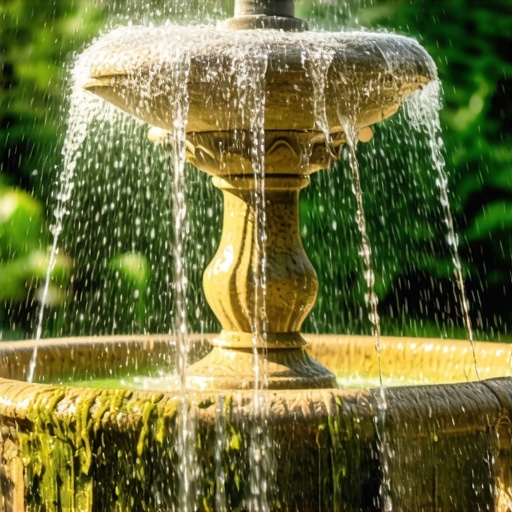
Why Your Stone Fountain Keeps Turning Green
To remove algae from stone without scrubbing, apply a sodium percarbonate solution or concentrated enzymes directly to the fountain basin. These professional-grade oxidizers and biological catalysts break down the extracellular polymeric substances that bind algae to porous stone surfaces, allowing organic debris to be rinsed away without mechanical abrasion.
I recently got called out to tear up a $30,000 patio that was sinking because the previous contractor failed to manage the hydrostatic pressure from an adjacent fountain. The homeowners were so focused on the ‘look’ that they ignored the fact that the fountain was leaking and the water was constantly green, attracting pests and destabilizing the modified gravel base of the entire hardscape. This is a common story in this industry. People buy a high-end cast stone feature and then treat it like a cheap plastic birdbath. They hit it with stiff wire brushes or high-pressure washers, not realizing they are literally grinding the lifespan out of the material. When you scrub stone, you create micro-fissures. These microscopic cracks are like five-star hotels for algae spores. You think you are cleaning it, but you are actually preparing the bed for the next, even more aggressive bloom. As a professional who has spent decades managing soil grading and hardscape longevity, I can tell you that the secret to a clean fountain is not elbow grease; it is chemistry and physics. If your sod install is graded toward the fountain, or if your irrigation heads are constantly splashing tap water into the basin, you are fighting a losing battle against nitrates and minerals.
“Algal blooms in closed-loop water features are primarily driven by phosphate accumulation and insufficient dissolved oxygen levels. Manual removal of surface biomass does not address the underlying biological load within the stone’s pore structure.” – Agricultural Extension Agronomy Manual
The Science of Biological Biofilms in Masonry
The green slime you see is not just a surface stain. It is a complex colony known as a biofilm. These organisms secrete a sticky carbohydrate matrix that anchors them into the pores of your limestone or cast stone. When you attempt to scrub this away, you are merely decapitating the colony. The ‘root’ remains protected deep within the stone. To achieve a no-scrub clean, you must use a surfactant that can penetrate the surface tension of the water and deliver an oxidizing agent directly to that matrix. I prefer using sodium percarbonate. Unlike liquid bleach, which is highly acidic and can dissolve the calcium carbonate binder in cast stone, sodium percarbonate breaks down into oxygen, water, and soda ash. The rapid release of oxygen molecules creates a mechanical lifting action at the molecular level. It literally pushes the algae out of the pores from the inside out. It is the difference between trying to pull a weed and just killing the soil it lives in.
How much enzyme cleaner do I need for a 50-gallon fountain?
For a standard 50-gallon feature, a professional loading dose of 1 ounce of concentrated enzyme cleaner is required, followed by weekly maintenance doses of 0.25 ounces. This dosage ensures that the biological catalysts remain at a high enough concentration to digest organic debris before it can form a visible biofilm on the stone surface.
| Treatment Method | Mechanism of Action | Surface Impact | Duration of Results |
|---|---|---|---|
| Manual Scrubbing | Mechanical Abrasion | High (Pitting) | 7 to 14 Days |
| Pressure Washing | Hydraulic Force | Severe (Erosion) | 10 to 20 Days |
| Sodium Percarbonate | Oxygen Oxidation | Zero (Safe) | 30 to 60 Days |
| Biological Enzymes | Organic Digestion | Zero (Safe) | 90+ Days |
The Role of Irrigation and Yard Cleanup in Algae Prevention
Most fountain owners do not realize that their landscaping habits are the primary cause of their algae problems. If you have a professional irrigation system, check the spray patterns. If your sprinklers are hitting the stone, you are introducing phosphates and chlorine directly into the feature. Furthermore, your yard cleanup routine is critical. A single handful of grass clippings that finds its way into the water is a massive nitrogen bomb. In my firm, we always install a 3-foot buffer zone of decorative river rock or a non-organic mulch around fountains to prevent mower discharge from contaminating the water. If you just finished a new sod install, be especially careful. The high-phosphorus fertilizer used to establish new roots is the ultimate fuel for an algae bloom. Keep your yard cleanup tight and your water chemistry balanced, and the need for any cleaning, scrubbing or otherwise, drops by eighty percent.
“A stone feature is a living part of the landscape ecosystem. Failure to account for nutrient runoff from adjacent turf grass will result in perpetual biological imbalance.” – Hardscape Engineering Axiom
What is the safest way to prevent algae in a stone fountain?
The safest prevention method is the installation of a UV-C clarifier combined with phosphate binders. These tools disrupt the DNA of floating algae spores and sequester the nutrients that the algae need to survive, effectively starving the biofilm without the use of harsh, stone-damaging chemicals.
- Check water pH weekly: Aim for a neutral 7.0 to 7.5 to prevent stone scaling.
- Remove leaf litter daily: Decaying organic matter is the primary food source for algae.
- Monitor pump flow: Stagnant water is an invitation for cyanobacteria.
- Use distilled water for top-offs: This prevents the buildup of calcium and minerals.
- Apply a stone sealer: A high-quality breathable sealer fills pores so algae cannot anchor.
The No-Scrub Professional Protocol
If your fountain is already green, do not reach for the brush. First, turn off the pump. Apply your sodium percarbonate or oxygen-based cleaner evenly over the surface. Let it sit for twenty minutes. You will see it begin to foam. This is the oxygen working. After the foam subsides, simply rinse the stone with a garden hose. The algae will slough off in sheets. For the internal water, we use a biological flocculant. This is a chemical that grabs floating particles and clumps them together so they sink to the bottom where the pump filter can grab them. Once the water is clear, introduce a maintenance dose of enzymes. These enzymes live in the water and ‘eat’ any new organic matter that falls in. It is self-cleaning technology at its finest. Don’t skip the sealer afterward. A porous stone is a vulnerable stone. Seal it. Use a professional-grade silane-siloxane sealer that allows the stone to breathe but prevents water and organisms from getting a foothold. It is the only way to protect your investment long term. Stop scrubbing. Start thinking like a chemist.