
The High-Performance Logic of Modern Yard Cleanup
Successful yard cleanup is a logistical exercise in volume management and soil health preservation, requiring a deep understanding of organic matter decomposition and mechanical leverage. Most homeowners approach leaf removal as a cosmetic chore, but to a professional, it is the critical removal of potential anaerobic layers that can suffocate 100% of your sod install investment. If you leave a three-inch mat of wet maple leaves on your turf over winter, you aren’t just ‘leaving it natural’; you are creating a petri dish for Snow Mold (Typhula spp.) and destroying the soil’s oxygen exchange capacity.
I always drill into my new crew members: if you don’t fix the soil grading and clear the debris first, every plant you put in the ground is just expensive compost. I remember a job in late October where a client wanted a full landscaping overhaul, but the site was buried under a foot of oak leaves. My lead apprentice thought he could just rake as he went. Two hours later, he was exhausted and hadn’t cleared twenty square feet. I had to stop the clock and teach him the physics of the tarp. If you aren’t moving five hundred pounds of debris per drag, you’re losing money. The soil underneath those leaves was already starting to sour, smelling of sulfur because the lack of airflow had turned the surface soil anaerobic. That’s the cost of being slow.
“Effective leaf management prevents the formation of an impermeable layer that blocks moisture infiltration and gas exchange in the root zone of cool-season grasses.” – Penn State Center for Turfgrass Science
The Physics of the Tarp: Moving Piles Solo
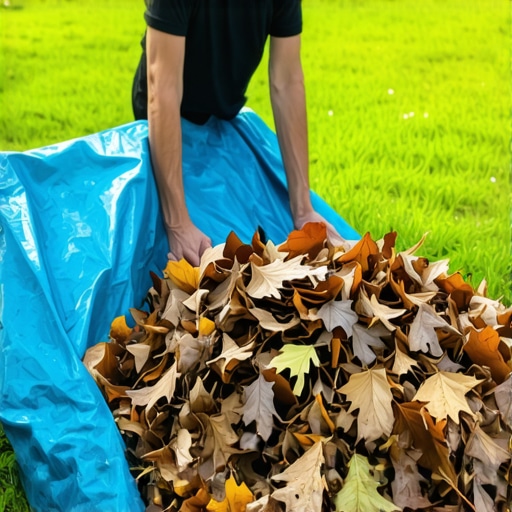
To move massive volumes of organic debris solo, use a heavy-duty polyethylene tarp as a mechanical sled to minimize friction and maximize the load-per-trip ratio. Yard cleanup efficiency is determined by how many times you touch the material; the goal is to touch it twice: once to get it on the tarp, and once to dump it. Use a 10×12 or 12×16 tarp. Anything larger becomes unmanageable when wet; anything smaller requires too many trips.
Position the tarp downwind of your work area. Use a high-quality aluminum-tine rake or a backpack blower with a minimum of 700 CFM to move leaves into the center of the tarp. Do not overfill the edges. Fold the front corners inward to create a ‘prow’—this prevents the tarp from catching on irrigation heads or uneven turf. Hook the tarp to a drag rope or a specialized ‘tarp puller’ handle. This allows you to keep your spine neutral and use your glutes and hamstrings to pull, rather than your lower back. It’s basic physics: reducing the coefficient of friction against the grass allows a single person to move 50 to 100 pounds of dry leaves with minimal aerobic strain.
Why Cleanup Precedes a Sod Install
Installing new turf requires a pristine, compacted, and leveled soil base that is entirely free of decomposing organic ‘fluff’ which causes settling and nitrogen immobilization. Sod install projects fail most frequently because the installer left organic debris beneath the roots. As that material decomposes, it creates air pockets. Air pockets kill roots. Period. If you are planning a spring install, your fall cleanup must be surgical. You need to expose the actual soil mineral layer to ensure proper soil-to-root contact once the pallets arrive.
| Debris Type | Weight (Wet/lbs) | Disposal Method | Impact on Soil pH |
|---|---|---|---|
| Oak Leaves | Heavy | Mulch/Haul | Acidifying |
| Pine Needles | Light | Compost | High Acidity |
| Maple/Poplar | Medium | Mulch | Neutral |
| Green Grass | Very Heavy | Immediate Haul | Nitrogen Spike |
How much modified gravel do I need for a patio base?
For a standard residential patio, you need 6 inches of compacted 21A or CR-6 modified gravel to ensure structural integrity and proper drainage. To calculate the volume, multiply the total square footage by 0.5 (for a 6-inch depth), then divide by 27 to get cubic yards; always add 10% for compaction loss. Don’t eyeball this. If your base is thin, your pavers will shift within two freeze-thaw cycles. It’s math, not a guess.
The Interaction Between Debris and Irrigation
Neglected leaves often migrate into irrigation valve boxes and around spray heads, leading to mechanical failure and localized flooding during the spring startup. During your yard cleanup, you must clear a 6-inch radius around every single pop-up head. Debris trapped in the wiper seal of a head will prevent it from retracting, leading to it being sheared off by a mower. Furthermore, decomposing leaves create a ‘sludge’ that can clog the fine mesh filters inside the nozzles. Clean the heads now or replace them in May. Your choice.
“Surface drainage and sub-surface moisture management are the two most critical factors in preventing hardscape heaving and turfgrass fungal pathogens.” – ICPI Tech Spec No. 2
Landscaping Preparation Checklist
- Clear the Crown: Ensure no leaves are piled against the root flare of trees to prevent cambium rot.
- Scalp the Edges: Use a string trimmer to clear debris from the transition between turf and hardscape.
- Inspect 811 Marks: Ensure any flags from utility marking are visible before using heavy equipment.
- Soil Test: Take samples after cleanup but before sod install to check NPK levels.
- Blower Maintenance: Clean air filters and check spark plugs before the 20-hour cleanup push.
How do I stop my yard from flooding after a heavy rain?
To stop yard flooding, you must restore the positive grade away from the foundation and install a French drain system with a dedicated discharge point. Use a 4-inch perforated NDS pipe wrapped in a geotextile sock, buried in a trench filled with clean 1-inch river stone. Simply ‘adding dirt’ usually just moves the puddle three feet to the left; you need a managed hydraulic exit. It’s about hydrostatic pressure. Give the water a path of least resistance that isn’t your basement.
Technical Management of Nitrogen Ratios
The Carbon-to-Nitrogen (C:N) ratio of brown leaves is roughly 60:1, meaning they require a massive amount of nitrogen to break down. If you mulch these leaves into your turf without adding a high-nitrogen fertilizer, the microbes will ‘steal’ the nitrogen from your grass to process the carbon. This leads to yellowing, stunted turf in the spring. If you aren’t removing the leaves via the tarp method, you must apply a 46-0-0 Urea or a high-nitrogen slow-release product to balance the chemistry. Don’t guess on the rates. One pound of actual N per 1,000 square feet is the standard. Use a spreader. Don’t skip this. It will rot if you don’t manage the chemistry. Modern landscaping is as much about chemistry as it is about aesthetics.