
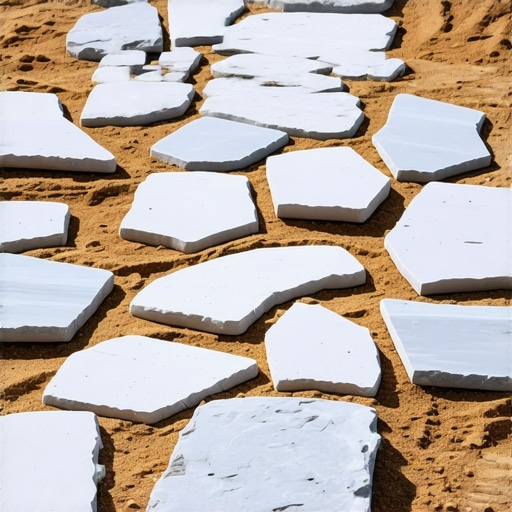
The Engineering Reality of Sand-Set Flagstone
Installing 2026 flagstone walkways on a sand base requires a multi-layered approach involving excavation depth of 6-8 inches, a highly compacted crushed stone sub-base, and precise hydrostatic drainage management to prevent stone shifting over time. Most DIY failures occur because the homeowner treats the sand as the structural foundation, when in reality, the sand is merely a leveling medium for the heavy, irregular stones. It will fail if the subgrade isn’t rock solid.
I recently got called out to tear up a $30,000 patio that was sinking because the previous contractor thought they could skip the mechanical compaction of the sub-base. The flagstones were high-quality Tennessee Orchard, but within eighteen months, the walkway looked like a topographic map of the Himalayas. They used too much sand—nearly four inches—which turned into a fluid mess the moment the spring thaw hit. We had to excavate the entire mess, install a proper geotextile fabric, and rebuild it from the dirt up. Don’t make that mistake. If you don’t fix the soil physics first, you are just throwing money into a hole.
“A retaining wall doesn’t fail because of the stone; it fails because of the water trapped behind it.” – Hardscape Engineering Axiom
The Physics of the Subgrade
Before you even touch a bag of sand or a piece of flagstone, you have to look at what lies beneath. If you are doing a sod install nearby or a full yard cleanup, you likely have disturbed soil. You cannot build on loose dirt. We use a plate compactor to reach at least 95% Proctor density on the native soil. If your soil is heavy clay, you need to account for the expansion and contraction. We excavate deep enough to accommodate 4 inches of 21A (modified gravel) and 1 inch of coarse bedding sand. Anything more than an inch of sand will lead to ‘rolling’ stones. It’s physics. Sand doesn’t compact; it shifts under lateral pressure.
| Material Layer | Recommended Thickness | Purpose |
|---|---|---|
| Native Soil Subgrade | N/A | Structural Foundation (Must be compacted) |
| Geotextile Fabric | <1mm | Separates soil from gravel; prevents sinking |
| Crushed Stone (21A/3/4″ Minus) | 4-6 Inches | The true structural base; provides drainage |
| Coarse Bedding Sand | 1 Inch (Max) | The leveling medium for flagstone height |
| Flagstone (Irregular) | 1.5-2 Inches | The wear surface; aesthetic layer |
How deep should a flagstone sand base be?
A flagstone sand base should never exceed one inch of coarse concrete sand, placed over a four-inch compacted gravel sub-base to ensure long-term stability and drainage. If the sand layer is too thick, the stones will eventually rock and tilt as the grains shift under foot traffic or moisture infiltration. Use a coarse sand, often called ‘screed sand’ or ‘concrete sand.’ Avoid play sand. It is too fine, round-grained, and acts like ball bearings under your stone. You need angular grains that lock together. I see ‘mow-and-blow’ guys dumping stone right on top of dirt and sand all the time. It’s a joke. It will rot the lawn around it and trip your grandmother within a season.
The Irrigation and Drainage Connection
When you are planning your walkway, you must audit your irrigation system. A common failure point is a sprinkler head that sprays directly onto the flagstone joints, washing away the jointing sand or polymeric material. Before the stone goes down, we often have to relocate lateral lines to ensure the landscaping remains hydrated without undermining the hardscape. We also pitch the walkway 1/4 inch per foot. If it’s flat, it’s failing. Water is the enemy of any sand-set system. It will find the path of least resistance and carve out a cavern under your stones. We call this ‘piping’ in the engineering world, and it is the death of many patios.
“The longevity of any segmental pavement system is directly proportional to the quality of the base compaction and the management of subsurface water.” – ICPI Tech Manual
How much sand do I need for a 100 square foot walkway?
For a 100 square foot walkway with a 1-inch bedding layer, you will need approximately 0.31 cubic yards of sand, which is roughly 14 bags of 50lb sand or about 850 pounds of bulk material. Always order 10% extra for joint filling and leveling adjustments. Don’t forget that your irregular flagstone will have gaps. If you’re doing a high-end yard cleanup and install, you’ll likely use polymeric sand for the joints to prevent weed growth. This is a different calculation entirely. Use a broom to sweep it in, then a leaf blower to clear the dust before misting. If you leave dust on the stone, it’s permanent. It will stain.
Step-by-Step Installation Checklist
- Mark the perimeter with marking paint and check for 811 utility clearances.
- Excavate to a depth of 7-8 inches, removing all organic matter and roots.
- Tamp the subgrade until it rings; a plate compactor is non-negotiable for 2026 standards.
- Lay down a non-woven geotextile fabric to prevent stone-soil mixing.
- Install 4 inches of 21A crushed stone in 2-inch lifts, tamping between each.
- Set your screed pipes (1-inch diameter) and spread the coarse sand.
- Pull your screed board across the pipes to create a perfectly flat bedding plane.
- Place flagstones, leaving 1-2 inch gaps; do not slide them—drop them straight down.
- Level individual stones using a rubber mallet; don’t add more sand if you can avoid it.
- Fill joints with polymeric sand or stabilized stone dust and hydrate per manufacturer specs.
Maintaining the Structural Integrity
Once the walkway is set, the work isn’t done. You need to keep an eye on the edges. If the surrounding sod install is higher than the walkway, water will pool. If it’s lower, you’ll get edge creep. We use heavy-duty plastic or aluminum edging spiked into the gravel base to lock the system in place. Without edge restraint, the sand will eventually migrate outward. This is non-negotiable. I’ve seen ‘professionals’ skip this to save fifty bucks. Pathetic. Within three years, the outer stones are in the mulch bed. Do it right the first time. Use 10-inch galvanized spikes. Every 12 inches. No excuses.
“,”image”:{“imagePrompt”:”A detailed cross-section diagram of a flagstone walkway installation showing the layers: compacted soil, geotextile fabric, 4 inches of crushed stone base, 1 inch of sand, and the flagstone on top, with a plate compactor visible in the background.”,”imageTitle”:”Professional Flagstone Walkway Layer Diagram”,”imageAlt”:”Cross-section of a correctly engineered sand-base flagstone walkway showing all structural layers.”},”categoryId”:0,”postTime”:””} Ready to output.