
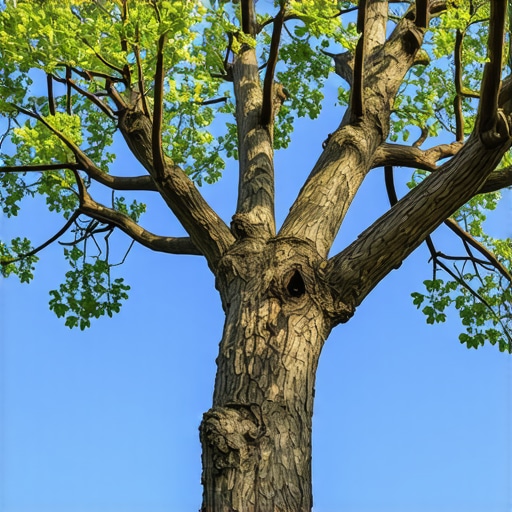
Why You Should Never Top Your Trees: The Arboreal Death Sentence of Spring
I always drill into my new crew members: if you do not fix the soil grading first, every plant you put in the ground is just expensive compost. I was standing on a job site last week in a neighborhood where every silver maple looked like a hat rack. I told my youngest apprentice to look at the trunk of a mature oak that had been topped three years ago. It was a horticultural autopsy in real time. The tree was not growing; it was screaming in slow motion. Topping is the most expensive mistake a homeowner can make in their landscaping plan. It is not pruning. It is a biological assault that triggers a cascade of structural and chemical failures that usually ends with a chainsaw and a stump grinder five years down the road. High-end landscaping requires an understanding of tree physiology, not just the ability to swing a pole saw. When you hack the top off a tree, you are not controlling its size. You are destroying its ability to feed itself.
The Physiological Catastrophe of Tree Topping
Tree topping is the practice of drastically cutting back major branches to stubs, which triggers starvation and structural failure. This intervention removes the photosynthetic factory during the critical spring growth surge, forcing the tree to deplete its starch reserves to produce weak, dangerous epicormic shoots. When you remove 50 percent to 100 percent of a tree’s leaf-bearing crown, you are removing its primary source of energy. Trees do not just grow; they manage a complex budget of carbon and nitrogen. In the spring, they have already invested their savings into the initial bud break. If you top them now, they have no bank account left to draw from for a second set of leaves.
Will a topped tree grow back?
Technically, yes, but the growth is a panic response. The tree activates dormant buds just beneath the bark to create sprouts known as water sprouts or epicormic shoots. These grow at an accelerated rate, sometimes 20 feet in a single season, as the tree tries to replace its lost canopy. However, these shoots are weakly attached to the outer layer of the wood rather than being integrated into the structural core of the branch. They are prone to snapping in even mild wind loads. It is a cycle of failure. You top the tree to make it smaller, it responds by growing faster and weaker, and now you have a 40-foot hazard instead of a 30-foot shade tree.
“Topping is the most harmful pruning practice known. It creates large wounds that the tree cannot easily close, leading to decay and structural instability.” – International Society of Arboriculture (ISA) Standards
The Physics of Decay and Sunscald
Trees are engineered to handle the sun. The canopy provides shade not just for your lawn, but for the tree’s own bark. When you top a tree, you expose the sensitive inner tissues of the remaining limbs to direct ultraviolet radiation. This leads to sunscald, which kills the cambium layer. The cambium is the vascular system of the tree. If that dies, the branch dies. Furthermore, trees use a process called CODIT (Compartmentalization of Decay in Trees). When you make a proper thinning cut at a branch collar, the tree can seal that wound. A topping cut is a jagged stub that the tree cannot seal. It remains an open door for fungal pathogens and wood-boring insects. This is why we see heart rot in almost every topped tree we are called to remove. The rot travels down the center of the limb, creating a hollow tube that looks fine on the outside but has zero structural integrity.
| Feature | Proper Crown Reduction | Tree Topping (The Hack Job) |
|---|---|---|
| Cut Location | At a lateral branch 1/3 diameter of parent | Randomly between nodes (stubs) |
| Tree Health | Preserves energy reserves and CODIT | Triggers starvation and sunscald |
| Regrowth | Natural, strong branch attachments | Weak, rapid epicormic sprouts |
| Long-term Cost | Low maintenance, high property value | High removal costs, liability risk |
Integrating Tree Health with Sod Install and Irrigation
If you are planning a sod install or a massive yard cleanup this spring, you must consider the critical root zone of your trees. Many contractors will scalp the ground to level it for new turf, slicing through the feeder roots that live in the top 6 inches of soil. This is just as deadly as topping. When we perform landscaping renovations, we map the drip line. If you are installing an irrigation system, do not let the installers trench through the root system of a 50-year-old oak. It will die. We see it every season: a beautiful new lawn is installed, the irrigation is set to run every morning, and the trees start showing dieback because their roots are drowning or were severed during the sod install. Proper yard management requires a holistic approach where the trees, the turf, and the water systems work in a biological balance.
How much does it cost to fix a topped tree?
Remediation is expensive and often impossible. If the damage is recent, a certified arborist can perform crown restoration over 3 to 5 years. This involves selecting the strongest epicormic shoots and pruning the others to encourage a new, stable leader. However, in most cases, the internal decay has already begun. The cost of yearly structural pruning for a damaged tree often exceeds the cost of removing it and planting a proper replacement. A typical removal for a large, hazardous topped tree can range from $2,500 to $7,000 depending on the proximity to structures. Do not spend money on a yard cleanup just to have a dead tree sitting in the middle of it.
“Large pruning wounds caused by topping do not heal, allowing wood-rotting fungi to enter the tree and cause internal decay that leads to trunk and limb failure.” – Purdue University Cooperative Extension Service
- Inspect for stubs: If your previous contractor left stubs, they are not a pro.
- Check the root flare: During landscaping, ensure the flare where the trunk meets the roots is visible.
- Monitor irrigation: Trees need deep, infrequent watering, not the daily 10-minute spray used for new sod install projects.
- Avoid mulch volcanoes: Never pile mulch against the bark; it holds moisture and rots the tree from the outside in.
The Myth of Height Control
Homeowners often ask for topping because they are afraid a tall tree will fall on their house. This is a fundamental misunderstanding of biomechanics. A healthy, untopped tree is a flexible structure designed to shed wind. A topped tree is a rigid sail. Because the growth is so dense and the attachments are so weak, topped trees are significantly more likely to fail in a storm. If you are worried about height, use crown reduction pruning. This involves cutting branches back to a lateral that is at least one-third the diameter of the branch being removed. This preserves the tree’s health while reducing its profile. Do not let a guy with a truck and a chainsaw tell you otherwise. He is looking for a quick buck; I am looking at the next twenty years of your property value. Real landscaping is about stewardship, not destruction.