
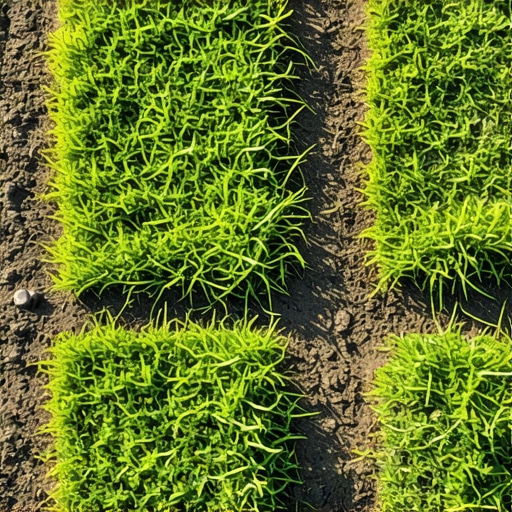
The Forensic Reality of Dying Sod Perimeters
Your new lawn looks like a green carpet in the center, but the edges are crisping into a brittle, tan straw. This is not bad luck; it is a failure of physics or chemistry. New sod turns brown at the edges primarily due to rapid desiccation caused by radiant heat from adjacent hardscapes, air pockets preventing root-to-soil contact, or localized nitrogen burn from improper pre-installation fertilization. To stop the decay, you must identify if the root system is actually knitting into the native soil or if it is sitting in a dry void. Stop guessing and start measuring the soil moisture at the seams.
The Chemical Nightmare: A Case Study in Amateur Ambition
I recall a homeowner in early July who spent $4,800 on premium Kentucky Bluegrass. Three days later, every seam looked like it had been hit with a blowtorch. They had applied a high-nitrogen ‘starter’ fertilizer at double the recommended rate on top of dry soil before the sod was even delivered. This created a high-salt environment that pulled moisture out of the new roots through osmotic pressure. By the time I arrived, the rhizosphere was a toxic zone. We had to flush the soil with three inches of water just to lower the EC (electrical conductivity) levels to a point where the grass wouldn’t perish. It was a $5,000 lesson in soil chemistry: more is not better; correct is better.
The Edge Effect: Why Perimeters Fail First
The perimeter of a sodded area is the most vulnerable point because it lacks the thermal mass and moisture protection of the interior lawn. Edges dry out faster because they are exposed to air on the sides and often sit adjacent to concrete or asphalt, which act as heat sinks that cook the soil. This radiant heat increases the evapotranspiration (ET) rate of the grass blades beyond what the severed root system can handle.
When we talk about the ‘edge effect,’ we are discussing the physics of moisture migration. Water moves from high concentration to low concentration. At the edge of a sod roll, the moisture evaporates into the surrounding dry soil or the air. If the installer didn’t ‘tuck’ the edges or use a garden roller to eliminate the air gaps, the roots at the seam simply hang in a void. They don’t just dry out; they die from exposure. Check your seams. If you can stick your finger under the edge of the sod, your installer failed you. Every gap is a chimney for moisture to escape. It must be flush. It must be compacted. Use a 200-pound water-filled roller. Don’t skip it.
“Turfgrass quality and vigor are directly related to the depth and mass of the root system, which is inhibited by high soil strength and low oxygen levels.” – Penn State Center for Turfgrass Science
Soil-to-Root Contact: The 811 of Sod Install
You can dump a thousand gallons of water on your yard, but if the bottom of the sod isn’t touching the dirt, the plant will die of thirst. Proper root-to-soil contact requires a prepared seedbed that is friable—meaning it is loose enough for roots to penetrate but firm enough to support weight without deep ruts. If the soil is compacted like concrete, the roots will grow sideways instead of down, leading to a shallow, weak lawn that browns the moment the sun hits 85 degrees.
How much modified gravel do I need for a patio base?
While this is a hardscape question, it relates to sod because drainage is king. For a standard patio, you need 4-6 inches of compacted 21A or 3/4-inch modified gravel. If this base is not properly contained, the gravel will leach into your sod zones, creating high-pH pockets that turn your grass yellow and then brown. Soil prep for sod involves tilling to a 4-inch depth and amending with organic compost to improve cation exchange capacity. I don’t care how good the sod looks on the pallet; if you lay it on hard-packed clay, it’s just expensive compost. You need to break that surface tension. If a spade won’t slide into the ground with ease, your grass roots won’t either.
Irrigation Inefficiency and Hydrophobic Soil
Most homeowners think they are watering enough when they are actually just wetting the surface. Effective irrigation for new sod requires ‘head-to-head’ coverage, ensuring every square inch receives direct spray, particularly the edges which are often missed by oscillating sprinklers. If the soil becomes hydrophobic—meaning it repels water—the moisture will simply run off the surface and pool in low spots, leaving the edges bone dry despite the water running.
| Week Post-Install | Watering Frequency | Watering Depth | Objective |
|---|---|---|---|
| Week 1 | 3-4 times daily | Top 1 inch | Keep roots moist, never dry |
| Week 2 | 2 times daily | Top 2 inches | Encourage root elongation |
| Week 3 | 1 time daily | 3 inches deep | Force roots to chase moisture |
| Week 4+ | 3 times weekly | 4-6 inches deep | Establish drought resistance |
Can you overwater new sod?
Yes. If you see mushrooms or the ground feels ‘squishy’ like a sponge three hours after watering, you are drowning the roots. Anaerobic conditions—where water replaces oxygen in the soil—cause root rot. The grass will turn a sickly yellow-brown and pull up easily with a foul smell. You want moist soil, not a swamp. It is a delicate balance of keeping the blades cool without suffocating the rhizosphere. If you can see your footprint in the sod ten minutes after walking on it, it’s too wet.
“A retaining wall doesn’t fail because of the stone; it fails because of the water trapped behind it, much like a lawn fails because of the water trapped on the surface rather than in the root zone.” – Hardscape Engineering Axiom
The Maintenance Schedule for Recovery
If your edges are already brown, you have a 48-hour window to save them. First, take a hand-held hose and drench the brown perimeters specifically. This is ‘spot-watering.’ Second, check the height of your mower. If you scalped the edges because your mower wheel dipped off the curb, you’ve removed the plant’s ability to photosynthesize. Raise the deck. Never take off more than one-third of the blade height.
- Check for ‘Tucking’: Use a hand tool to press the edges of the sod into the soil.
- Monitor the Heat Sinks: Water the areas near sidewalks and driveways 20% more than the rest of the yard.
- Probe the Soil: Use a screwdriver. If it won’t go 6 inches deep, the soil is too dry or too hard.
- Avoid Top-Dressing: Do not put sand or soil on top of the brown edges yet; you will only smother the remaining green tissue.
The reality of landscaping is that nature wants to revert to its mean. If you want a monoculture of high-performance turf, you have to be more disciplined than the weeds. It takes 21 days for a sod roll to establish a primary root system. During those three weeks, you are the life-support system. Don’t fail the edges just because they are at the end of the line. Watch the soil, not the clock. Your irrigation timer is a tool, not a solution. Real landscapers use their hands to feel the dirt. Do the same.