
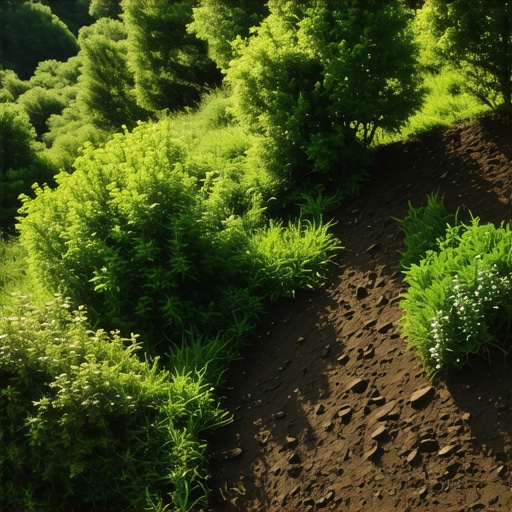
Understanding the Physics of Slope Stabilization
Erosion control on a steep grade is not about aesthetics; it is a battle against gravity and hydraulic shear. When you are staring down a 2:1 slope, the goal is to stabilize the soil profile using a combination of vegetative armoring and mechanical anchoring. Most homeowners make the mistake of thinking a quick sod install will fix a sliding hill. It will not. In fact, heavy sod on a steep incline often acts as a lubricated blanket that eventually slides off the subsoil once the interface becomes saturated. To stop erosion, you must understand how root architecture interacts with the soil structure to mitigate the energy of falling water and the pull of gravity.
I always drill into my new crew members: if you don’t fix the soil grading first, every plant you put in the ground is just expensive compost. I remember an apprentice years ago who spent three days planting daylilies on a 35 degree incline without checking the compaction or the runoff patterns from the neighbor’s driveway. The first spring rain didn’t just wash the mulch away; it carved a three foot deep gully right through the center of his work. He learned the hard way that you cannot fight water; you have to lead it. We ended up having to excavate the entire face, install a series of French drains, and start the landscaping from scratch. The lesson is simple: plants are the skin, but the soil and drainage are the skeleton. If the skeleton is broken, the skin will fail.
The Answer Capsule: What are the best plants for erosion control?
The most effective plants for erosion control on steep slopes are deep-rooted native shrubs, fibrous-rooted groundcovers, and clumping ornamental grasses that provide multi-layer stabilization. Specifically, species like Creeping Juniper, Fragrant Sumac, and Little Bluestem are superior because they anchor the soil at varying depths while their foliage breaks the impact of rainfall. These plants prevent surface runoff and deep-seated soil failure simultaneously.
“A vegetative cover on a slope reduces the erosive force of raindrop impact and increases the infiltration rate of the soil, thereby reducing the volume and velocity of surface runoff.” – USDA Natural Resources Conservation Service
The Mechanics of Root Tensile Strength
Not all roots are created equal. To stabilize a slope, you need a mix of ‘rebar’ and ‘mesh.’ Taproots act like deep anchors (rebar), while fibrous root systems act like a fine mesh that holds the top four to six inches of soil together. When selecting plants, you must look for high root tensile strength. This is the root’s ability to resist being pulled apart under the weight of wet soil. Landscaping on a hill requires a dense canopy to intercept raindrops, which can hit the ground at speeds of 20 miles per hour, dislodging soil particles on impact. By using a tiered planting approach, you create a hydraulic buffer. This is far more effective than any yard cleanup or simple mulch application.
| Plant Category | Soil Binding Depth | Primary Function | Recommended Species |
|---|---|---|---|
| Groundcovers | 4-8 inches | Surface Armoring | Vinca Minor, Creeping Phlox |
| Ornamental Grasses | 12-30 inches | Shear Resistance | Switchgrass, Little Bluestem |
| Shrubs | 3-6 feet | Deep Anchoring | Fragrant Sumac, Forsythia |
How much irrigation do I need for a slope?
Irrigation on a slope must be delivered via drip emitters or micro-spray heads to ensure the water penetrates the soil rather than running off the surface. Overhead irrigation on a hill is a primary cause of localized erosion and soil saturation leading to slope failure. Aim for deep, infrequent cycles that force roots to dive deeper into the soil profile. Shallow watering creates a lazy root system that will fail during a drought or a heavy storm surge. You want to deliver exactly 1 inch of water per week, but broken into two sessions to allow for full absorption into the sub-base.
What is the fastest way to stop dirt from washing away on a hill?
The fastest way to stop immediate erosion is the installation of erosion control blankets (jute or coconut fiber) paired with a sod install that is pinned with six-inch U-shaped landscape staples. However, this is a temporary fix. For long-term stability, you must inter-plant through the blankets with woody perennials. The blankets provide immediate protection for 12-24 months while the permanent root systems establish. Skip the cheap plastic netting; it kills wildlife and doesn’t biodegrade. Use heavy-duty coir logs at the toe of the slope to prevent the base from washing out, which is where most slope failures begin.
- Step 1: Clear invasive weeds and perform a thorough yard cleanup to expose the true grade.
- Step 2: Install temporary silt fencing at the base to catch runoff during construction.
- Step 3: Divert upslope water using a berm or a buried 4-inch N-12 corrugated pipe.
- Step 4: Apply a 2-inch layer of compost to provide nutrients, but do not till it in; tilling loosens the soil and invites erosion.
- Step 5: Layout your plants in a staggered, triangular pattern rather than straight rows.
- Step 6: Install drip irrigation lines before mulching.
- Step 7: Cover the entire area with shredded hardwood mulch. Do not use nuggets; they float away.
“Soil bioengineering uses live plant parts as the main structural components for slope stabilization and erosion control.” – Penn State Agricultural Extension
The Problem with Turf Grass on Slopes
I hate seeing people try to grow a manicured lawn on a 30 degree hill. It is a maintenance nightmare and a biological failure. Standard turf grass has a root system that rarely exceeds 3 inches in depth. It offers zero structural support for the soil mass. Furthermore, the weight of a commercial mower on a wet slope creates ruts that turn into erosion channels. If you want green cover, go with a native No-Mow fescue blend. It grows longer, has deeper roots, and requires zero chemicals to maintain. If you insist on a sod install, make sure you are using a netting-free sod and pinning every square foot. Even then, you are just delaying the inevitable if the grade is too steep.
Hardscape Integration and Hydrostatic Pressure
Sometimes plants aren’t enough. If the slope exceeds a 2:1 ratio (50% grade), you are entering the realm of civil engineering. You may need to incorporate boulder outcroppings or small tiered retaining walls. The biggest mistake here is ignoring hydrostatic pressure. Water builds up behind any solid barrier. If you don’t provide a path for that water to exit via weep holes or a gravel-filled trench, the wall will bulge and eventually explode. Use 3/4-inch clean crushed stone for your backfill. Never use dirt. The stone allows the water to drop straight down to your perforated drain pipe and exit the system safely. This keeps the soil above the wall from becoming a liquid slurry.
Long-Term Maintenance and the Settling Period
The first year is the most critical. You need to monitor the site after every major rain event. Look for ‘piping’—small holes where water is starting to tunnel under your plants. Plug these immediately with a mix of bentonite clay and topsoil. As the plants grow, their canopy will begin to overlap, creating a continuous shield. By year three, the root matrix should be self-sustaining. At this point, your landscaping isn’t just a garden; it is a living retaining wall. Don’t get lazy with the yard cleanup; removing dead leaf litter is fine, but leave some organic matter to feed the soil microbes. Healthy soil has a natural glue called glomalin that helps stick soil particles together. You want that glue. It is the difference between a hill that stays put and one that ends up in the street.