
The Anatomy of Pressure Loss: Why Your Sprinklers Are Choking
Low sprinkler pressure is typically caused by debris accumulation in the valve filter or nozzle screens, which restricts the flow of water (GPM) despite having adequate static pressure. By cleaning the internal filter assembly, you restore the required operating PSI for head pop-up and uniform distribution, preventing turf stress and uneven watering cycles across your landscape zones.
I always drill into my new crew members: if you don’t fix the soil grading and the irrigation flow first, every plant you put in the ground is just expensive compost. I remember a job in a new subdivision where the homeowner was ready to sue the developer because their three-week-old sod install was turning straw-brown. They thought the well had run dry. I walked over to the valve box, pulled the solenoid, and found a handful of construction sand and PVC shavings clogging the internal screen. It took five minutes to fix, but that’s five minutes of technical wisdom that saved $10,000 in Kentucky Bluegrass. Most ‘mow-and-blow’ outfits would have just turned up the timer, drowning the roots and inviting Pythium blight. We don’t do that. We look at the engineering of the flow.
“A properly functioning irrigation system depends on the balance between static pressure and dynamic flow; even a minor obstruction at the valve can lead to a 50% reduction in nozzle throw distance.” – Agricultural Irrigation Manual
The Physics of the Clog: GPM vs. PSI
When we talk about irrigation, you have to distinguish between static pressure (the water sitting in the pipe) and dynamic pressure (the water moving through the heads). You might have 60 PSI at the street, but if a grain of sand is lodged in the valve’s metering orifice, your dynamic pressure drops to 10 PSI at the head. The result? Heads that don’t pop up, or worse, ‘weeping’ heads that create swampy patches while the rest of the landscaping dies of thirst. This isn’t just about water; it’s about the hydraulic integrity of the entire system. When a yard cleanup crew isn’t careful, they knock debris into the valve boxes, or worse, hit a head and allow soil to enter the lateral lines. That soil travels straight to the next bottleneck: the filter.
The 5-Minute Valve Filter Cleanout Process
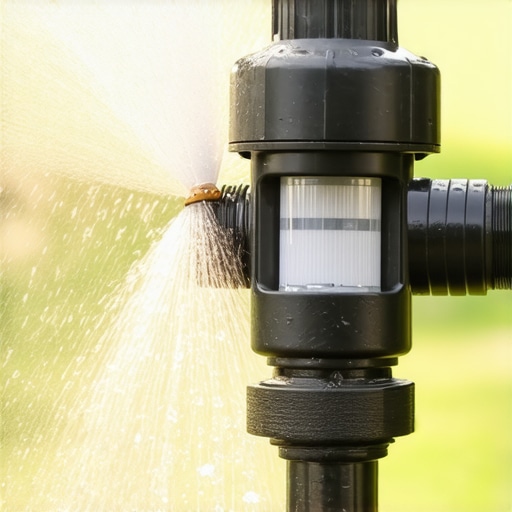
Don’t call a contractor yet. Follow this diagnostic path to clear the system. First, locate your valve box. This is usually green and buried flush with the turf. Remove the lid and find the valve for the zone that is struggling. [image_placeholder_1] Before you touch anything, shut off the main water supply to the irrigation system. Relieve the pressure by manually turning the bleed screw on the valve. You’ll hear a hiss of air and water—that’s the system depressurizing. Once it’s quiet, unscrew the solenoid (the part with the wires) or the jar-top ring, depending on your valve model. Look for a small plastic screen or a narrow port. This is the filter. If it’s covered in a grey film or grit, you’ve found the culprit. Use an old toothbrush and clean water to scrub it. Don’t use chemicals; they degrade the EPDM rubber diaphragms. Reassemble carefully, ensuring the diaphragm spring is seated perfectly. If that spring is crooked, the valve won’t close, and you’ll have a permanent leak. It must be precise.
| Pressure Issue | Physical Symptom | Primary Solution |
|---|---|---|
| Clogged Valve Filter | All heads in one zone are low | Clean internal valve screen |
| Nozzle Screen Obstruction | Only one head is low or misting | Pull head and clean nozzle filter |
| Main Line Leak | Water pooling near valve box | Excavate and repair PVC section |
| Lateral Pipe Pinch | Low pressure after a specific head | Check for root intrusion or soil shift |
How much water pressure does a standard sprinkler head need?
Most rotary heads require a minimum of 30 to 35 PSI at the base to rotate properly, while spray heads need about 20 to 30 PSI. If your system is delivering less than this, the water droplets will be too large or too small, leading to poor distribution uniformity. This causes ‘doughnut’ patterns where the grass near the head is wet but the grass 10 feet away is parched. You aren’t just watering grass; you are managing a biological nitrogen cycle that requires consistent moisture to process nutrients. Without that 30 PSI, the biology fails.
Can a dirty filter cause zone failure?
Yes, a severely clogged filter can prevent the valve from opening at all. Most modern valves are ‘normally closed’ and use a pressure differential to lift the diaphragm. If the metering port is blocked, the pressure cannot equalize, and the valve stays shut. This is a common point of failure after a major yard cleanup or when a new sod install has been recently completed, as soil disturbance often introduces particulates into the main lines. It won’t clear itself. You have to intervene physically.
“Irrigation valves are hydraulic computers; they rely on minute pressure changes to function. Any deviation in the pilot flow path results in catastrophic mechanical failure.” – ICPI Hardscape & Irrigation Standards
The Long-Term Impact on Turf Vigor
If you ignore low pressure, you aren’t just dealing with a brown lawn. You are inviting opportunistic weeds like crabgrass and nutsedge that thrive in stressed environments. When landscaping isn’t getting its 1 inch of water per week—delivered in deep, infrequent sessions—the root systems stay shallow. Shallow roots cannot survive a summer heatwave. By spending five minutes cleaning a valve filter, you are effectively training your turf to chase water deeper into the soil profile. It is the difference between a lawn that survives and a lawn that thrives. Don’t skip the maintenance. Do the work. Check your filters every spring before the heat hits. It is the most cost-effective thing you can do for your property value.
Comments are closed.