
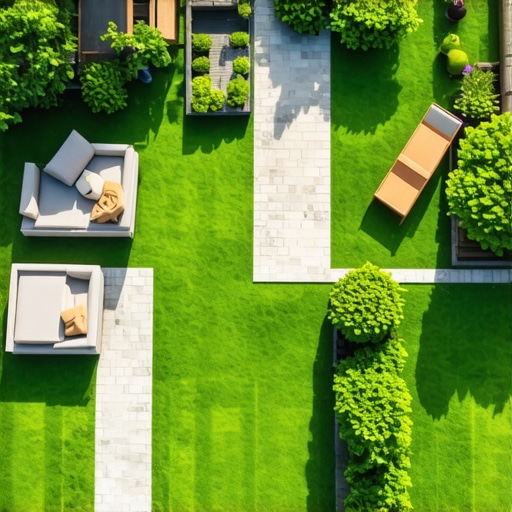
Backyard 2026 Layouts: Precision Zoning with Sod and Irrigation
I always drill into my new crew members: if you don’t fix the soil grading first, every plant you put in the ground is just expensive compost. It is a harsh lesson that most apprentices learn only after watching a four-figure planting budget wither because they ignored the hydrostatic pressure of the site or failed to test the soil pH levels. In the landscape industry of 2026, we are moving away from the messy, overgrown aesthetics of the past and toward precision zoning. This involves using sod install techniques and irrigation systems to create sharp, functional borders between living areas. You cannot achieve this with a simple lawnmower and a bag of cheap seed. It requires engineering.
The Science of Zoning: Using Grass as a Biological Border
Backyard 2026 Layouts rely on the landscaping principle of compartmentalization, where high-performance sod install acts as a living carpet that defines separate functional zones like outdoor kitchens and fire pits. By utilizing specific turfgrass cultivars and rigid edging, we prevent the biological creep that typically ruins high-end designs.
“The successful establishment of turfgrass sod depends heavily on the interface between the sod root zone and the underlying soil profile; poor contact leads to rapid desiccation.” – Penn State Center for Turfgrass Science
This biological border is not just for show. It serves as a natural filtration system for runoff. It catches sediment. It cools the micro-climate of the patio. If you treat your grass like an afterthought, your entire layout will fail within two seasons. Precision is non-negotiable.
Soil Preparation: The Subsurface Engineering of a 2026 Layout
The foundation of any yard cleanup or new installation is the soil chemistry and structure, specifically focusing on nitrogen cycles and soil microbiology. Before a single roll of sod is laid, we examine the compaction levels. If your soil is at a high PSI (pounds per square inch) from construction traffic, the roots will never penetrate. They will hit the dirt like it is concrete and then die. We aim for a bulk density that allows for oxygen exchange. Soil pH must be balanced between 6.0 and 7.0 for optimal nutrient uptake. If the soil is too acidic, your expensive fertilizer is chemically locked away from the plant. We use 4-inch core aeration to break up compaction before the sod install. We do not guess. We test. A site without a soil report is a site destined for failure. Don’t skip this.
How much modified gravel do I need for a patio base?
For a standard residential patio base, you typically need 4 to 6 inches of modified gravel (often called 21A or CR-6) compacted in 2-inch lifts. To calculate volume, multiply the square footage by the decimal depth (e.g., 0.33 feet for 4 inches) and divide by 27 to get cubic yards. Proper compaction is critical to prevent settling.
The Irrigation Infrastructure: Beyond the Sprinkler Head
Modern irrigation is about volumetric water control and smart zoning, ensuring that landscaping elements receive exactly the 1 inch of water required per week without wastage. In 2026 layouts, we use sub-surface drip lines for garden beds and high-efficiency rotary nozzles for turf zones.
“An irrigation system’s efficiency is determined by the uniformity of the water distribution, not just the volume delivered to the zone.” – Irrigation Association Technical Manual
We avoid the old-fashioned ‘spray and pray’ method. We install flow sensors that shut the system down if a pipe leaks. This protects your hardscape from erosion. Water is a tool, but it is also a solvent. Controlled application prevents the heaving of pavers and the rotting of root flares. Every drop must have a purpose.
Does professional sod installation require a drainage plan?
Yes, every professional sod install must include a drainage plan to manage surface runoff and prevent standing water. This involves checking the soil grading to ensure a minimum 2 percent slope away from structures and potentially installing French drains or catch basins in low-lying areas to protect the turf roots.
Comparing Turf Species for Zonal Layouts
| Grass Type | Drought Resistance | Traffic Tolerance | Sunlight Requirement | Recommended Use |
|---|---|---|---|---|
| Kentucky Bluegrass | Moderate | High | Full Sun | Active play zones, luxury lawns |
| Tall Fescue | High | Moderate | Partial Shade/Sun | General landscaping, borders |
| Bermuda Grass | Excellent | Very High | Full Sun | High-traffic paths, southern zones |
| Zoysia | High | High | Full Sun/Light Shade | Precision edges, low maintenance |
The Installation Phase: From Rough Grade to Finished Edge
The sod install process is a race against time and biology. Once the sod is cut at the farm, the clock is ticking on the nitrogen levels and moisture content. We do not allow pallets to sit in the sun for more than four hours. The rough grade must be smoothed to remove ‘birdbaths’ or depressions where water will pool and drown the roots. We use a 100-pound water roller after laying the pieces to ensure the root-to-soil contact is absolute. Air pockets are the enemy. If there is air under the sod, the roots will dry out and the grass will turn brown in 48 hours. It will rot if the water can’t drain, but it will toast if the air can’t be pushed out. Balance is key.
- Mark all utility lines by calling 811 before any excavation begins.
- Clear all debris, rocks, and old vegetation during the yard cleanup phase.
- Apply a high-phosphorus starter fertilizer to encourage rapid root expansion.
- Lay sod in a staggered, brick-like pattern to minimize visible seams.
- Roll the entire area with a weighted roller to eliminate air pockets.
- Initiate a deep watering cycle immediately following the installation.
Maintenance Cycles for High-Performance Yards
While the internet tells you to water every day, turf grass actually needs deep, infrequent watering exactly 1 inch per week to force roots to chase the water down. If you mist the lawn every morning, the roots stay in the top half-inch of soil. When the first heatwave hits, that lawn is dead. You want deep roots for a resilient landscaping layout. Mowing height is equally important. Never remove more than one-third of the grass blade in a single pass. Scalping the lawn shocks the system and invites invasive species to take hold. Keep your blades sharp. Dull blades tear the grass, leaving it open to fungal infections. This is not just cutting grass; it is managing a biological system. Do it right or don’t do it at all.