
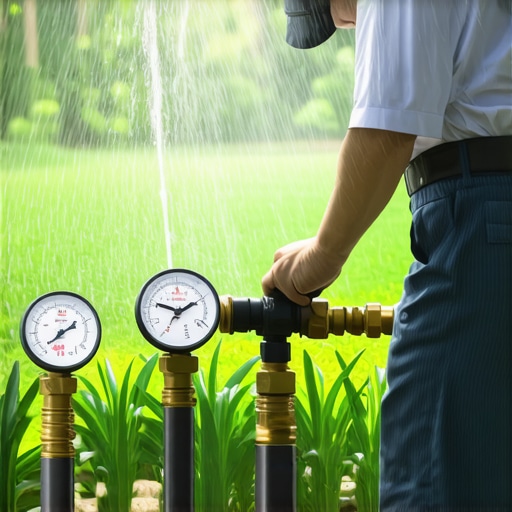
The Symptom of a Starving Landscape
You see it before you hear it: that pathetic, bubbling sputter from a rotor head that should be throwing a thirty-foot stream. Instead of a uniform curtain of water, you get a sad puddle around the head and a yard full of browning, stressed turf. Low water pressure in specific sprinkler zones isn’t just a nuisance; it is a slow-motion execution for your landscaping. When a zone loses its punch, the precipitation rate drops below the point of effectiveness, leaving your root zones bone-dry while your water bill remains high. This is the forensic reality of a failing system. It is rarely a single catastrophic event but rather a series of micro-failures in the hydraulics of your yard. To fix it, you have to stop thinking like a gardener and start thinking like a civil engineer.
The Foreman’s Autopsy: Why Pressure Fails
To fix low water pressure in sprinkler zones, you must systematically isolate leaking lateral lines, clogged nozzle filters, or malfunctioning zone valves. Check the main shut-off valve first to ensure it is fully open before calculating friction loss across the PVC network. I always drill into my new crew members: if you don’t fix the soil grading first, every plant you put in the ground is just expensive compost. The same logic applies to irrigation. If you have a pressure drop, you are fighting physics. You cannot outrun a bad hydraulic design with more run-time. I remember a job where a homeowner spent four thousand dollars on a premium sod install only to watch it turn into straw within three weeks. They blamed the sod farm. I dug up their main line and found a root from a silver maple had squeezed their 1-inch PVC down to the diameter of a drinking straw. That is the reality of the dirt. It is unforgiving.
“Irrigation systems must be designed to deliver water at a rate that does not exceed the soil’s infiltration capacity, while maintaining a minimum operating pressure for uniform distribution.” – Texas A&M AgriLife Extension
How much pressure does a standard rotor head need?
Most residential rotor heads require a dynamic pressure between 35 and 50 PSI to operate effectively and achieve the advertised throw distance. If your pressure at the head drops below 30 PSI, the internal gears may fail to rotate, and the nozzle will ‘weep’ rather than spray. This leads to localized flooding and widespread drought stress in the rest of the zone. You must measure this while the zone is running, not at the static source. Static pressure is a lie; dynamic pressure is the only metric that matters in the field.
The Engineering of Flow: GPM vs PSI
People confuse pressure and flow constantly. Pressure (PSI) is the force that pushes the water; Flow (GPM) is the volume of water moving. If you have high pressure but low flow, your pipes are too small or obstructed. If you have high flow but low pressure, you have too many heads on one circuit. This is a common mistake during a DIY yard cleanup or expansion. You cannot just keep tapping into a zone line and expect the physics to hold up. Every foot of pipe and every elbow fitting adds friction loss. Schedule 40 PVC has different flow characteristics than SDR 21 or funny pipe. If your crew used 1/2-inch swing pipe for a 50-foot run, you have already lost the battle against friction.
| Pipe Diameter (PVC Sch 40) | Max Recommended GPM | Pressure Loss per 100ft (at max GPM) |
|---|---|---|
| 1/2 Inch | 4 GPM | 6.3 PSI |
| 3/4 Inch | 8 GPM | 3.8 PSI |
| 1 Inch | 13 GPM | 2.4 PSI |
| 1.25 Inch | 22 GPM | 1.9 PSI |
The Sod Connection: Why New Turf Cannot Wait
When performing a sod install, your irrigation system is the life support machine. New sod has no deep root system to tap into subsoil moisture. It relies entirely on the top two inches of soil staying consistently damp. Low pressure in a zone means that the ‘overlap’ (head-to-head coverage) fails. In the irrigation world, we call these ‘dry hearts.’ These are the patches where the spray from one head fails to reach the base of the next. Within 48 hours of high heat, those dry spots will go into permanent wilting point. Once the cellular structure of the grass blade collapses, you are not just watering; you are irrigating a corpse. A proper yard cleanup should always include a full system wet-test to ensure every square inch of the new investment is covered.
Can a dirty filter cause low pressure in only one zone?
Yes, a clogged nozzle filter or a partially blocked internal screen in a rotor is the most common cause of localized pressure issues. If one head is spitting while the others in the same zone are firing perfectly, the issue is at the head. If the entire zone is weak, the problem is further upstream at the valve or the main. Pull the guts of the head, rinse the screen in a bucket of clean water, and flush the riser before re-installing. It is a five-minute fix that saves a fifty-dollar plant.
Step-by-Step Recovery Protocol
If your entire zone is sluggish, start at the valve box. Look for weeping valves. A torn diaphragm inside a solenoid valve can prevent the valve from opening fully, or it can allow water to bypass the seal, killing your pressure. Turn the solenoid a quarter-turn to bleed it manually. If the pressure jumps up, your solenoid or your controller’s voltage is the culprit. If the pressure stays low, you have a physical obstruction or a leak. Digging is the only solution. Look for the ‘green spot’ or the ‘soft spot’ in the yard. Water follows the path of least resistance. If you have a lateral line break, the water is going into the subsoil instead of out the nozzle. Find it. Fix it. Use a pro-grade slip-fix or a double-union setup. No cheap compression fittings. They will fail by next season.
“A system that operates below its design pressure will never achieve the distribution uniformity required for high-quality turf maintenance.” – Irrigation Association Standards
The 10-Point Irrigation Audit Checklist
- Verify the main water meter or pump shut-off is 100% open.
- Inspect the backflow preventer for leaks or partially closed ball valves.
- Test the static pressure at an outside hose bib to establish a baseline.
- Activate the problem zone and check for ‘bubbling’ at the base of every head.
- Unscrew and clean the filters on the two lowest-performing heads.
- Check the valve box for standing water or a humming solenoid.
- Walk the line between heads looking for unusually lush or muddy soil.
- Check for ‘geysers’ which indicate a snapped riser or missing nozzle.
- Adjust the arc and radius screws to ensure no water is being wasted on the pavement.
- Check the controller for any ‘sensor’ bypasses that might be throttling flow.
Landscape maintenance is not a set-it-and-forget-it endeavor. Gravity, soil movement, and root growth are constantly working against your PVC. If you ignore a pressure drop, you are inviting pests and fungi that thrive on stressed plants. Turf grass needs deep, infrequent watering, exactly 1 inch per week, to force roots to chase the water down. You cannot achieve that 1-inch depth with a system that is barely misting. Fix the hydraulics. Protect the sod. Do the work right the first time or do not do it at all. The soil does not care about your excuses.