
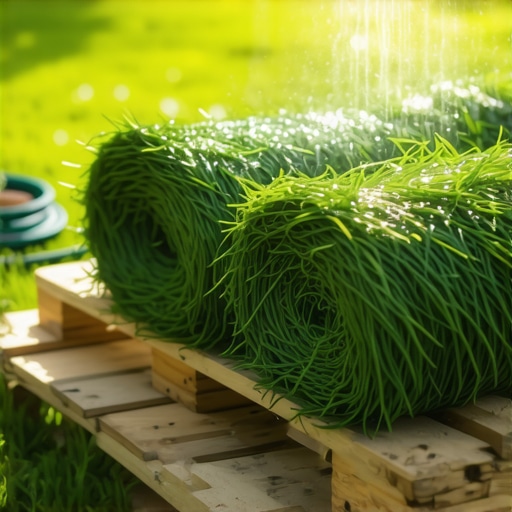
You spent thousands on high-quality turf, but the delivery truck showed up and your crew is MIA or a storm just blew in. Now you have ten pallets of living, breathing organism sitting on your driveway, and the clock is ticking. Most homeowners—and frankly, most ‘mow-and-blow’ hacks—make the fatal mistake of grabbing a garden hose and soaking the pallets. That is the fastest way to kill your investment. You aren’t watering a plant; you are accidentally starting a compost pile. I have seen $8,000 worth of premium Fescue turn into a slimy, fermented mess in under twelve hours because the owner thought a tarp and a sprinkler would save it. It didn’t. It cooked it.
The Critical Reality of Sod Respiration
To keep sod fresh if you cannot lay it today, you must immediately unroll the individual slabs in a shaded area and keep the soil moist, not saturated. Never leave sod rolled on a pallet for more than 24 hours, as the internal temperature will spike due to anaerobic respiration and microbial activity, leading to irreversible root death.
I remember a chemical nightmare back in ’14. A homeowner called me in a panic after they completely torched their front lawn by applying a high-nitrogen ‘starter’ fertilizer on a 95-degree day, then left the sod on the pallets for two days waiting for a ‘better time’ to install. By the time I arrived, the center of those pallets was over 130 degrees Fahrenheit. You could smell the rot from the sidewalk. We had to haul the whole mess to the landfill. It was a total loss because they didn’t understand the biology of what they were holding. Sod is a living system. When it is cut, the roots are severed, and the plant goes into a state of extreme stress. In the roll, it cannot ‘breathe,’ and the heat generated by the grass’s own metabolism becomes its executioner.
“Sod is a perishable product. Internal pallet temperatures can rise to lethal levels (above 105°F) within 12 to 24 hours of harvest depending on ambient temperature and nitrogen content.” – Turfgrass Extension Service
How much time do you actually have?
The window of survival depends entirely on the ambient temperature and the moisture level of the soil at the time of harvest. In the heat of summer, you have roughly 12 to 18 hours before the center rolls begin to ‘cook.’ In the cool of autumn, you might get 36 hours. But ‘might’ is a word I don’t use in professional landscaping. We work on certainties. If that sod isn’t going in the ground immediately, you have to break the pallet. No exceptions.
The Emergency Preservation Checklist
- Break the Pallet: Remove the plastic wrap immediately to allow gas exchange.
- Find the Shade: Move rolls to the north side of a building or under a dense tree canopy.
- Unroll and Spread: Lay the sod out flat on a cool surface (soil is best, concrete is a last resort).
- Hydrate the Soil, Not the Blade: Use a fine mist to keep the soil backing damp. Avoid heavy soaking which leads to crown rot.
- Check Internal Temp: Stick your hand into the center of a roll. If it feels hot to the touch, it is already dying.
The Physics of Heat Transfer in Turf
Why does it get so hot? It is called the ‘Heat of Respiration.’ Even though the grass is cut, it is still performing metabolic functions. In a tight roll, the surface area is minimized, and the heat cannot escape. This is compounded by the nitrogen-rich fertilizers often used by sod farms to get that deep green color. Nitrogen fuels microbial growth, and those microbes generate heat as they break down organic matter. It’s the same principle as a mulch fire. You have to increase the surface area to let the heat dissipate. This is why we unroll it. You are effectively ‘cooling’ the plant by allowing air to circulate around the blades and the root zone.
| Condition | Maximum Pallet Time | Survival Rate (24hr Delay) | Survival Rate (48hr Delay) |
|---|---|---|---|
| Above 85°F | 12 Hours | 40% | 5% |
| 65°F – 80°F | 24 Hours | 85% | 30% |
| Below 60°F | 48 Hours | 98% | 75% |
How to keep sod fresh if you can’t lay it today?
The primary goal is to stop the internal fermentation. If you have a large area of bare soil nearby, lay the sod there temporarily. Do not worry about a perfect fit; just get the roots in contact with the earth. This allows the sod to draw some moisture from the ground and prevents the root hairs from desiccating. If you are forced to keep it on a driveway, you are in a race against time. Concrete acts as a heat sink, radiating warmth back into the sod. In this scenario, you must keep the concrete wet to lower the surface temperature before laying the sod out.
What about irrigation and yard cleanup?
Before you even think about laying that sod—whether it’s today or tomorrow—your yard cleanup must be surgical. I’m talking about removing every weed, every rock larger than a marble, and ensuring your soil grading is perfect. I tell my apprentices: if you don’t fix the soil grading first, every plant you put in the ground is just expensive compost. You need a 1% to 2% slope away from the foundation to prevent hydrostatic pressure from ruining your basement or creating boggy spots in the lawn. Check your irrigation system now. Don’t wait until the sod is down to realize a zone valve is stuck or a head is buried. You need 100% head-to-head coverage. Any ‘dry spot’ in the first 72 hours will result in a dead square of turf.
How much water does fresh sod need?
For the first 14 days, your goal is to keep the soil under the sod consistently moist. This usually means watering 2 to 3 times a day for short durations. You aren’t looking for deep saturation yet; you are looking to prevent the ‘gap’ between the sod and the subsoil from drying out. Once the roots knit into the ground—when you can’t easily lift a corner of the sod—then you transition to deep, infrequent watering. This forces the roots to chase the water down into the soil profile, creating a drought-tolerant lawn. Most homeowners over-water the surface and under-water the root zone. Don’t be that person.
“A retaining wall doesn’t fail because of the stone; it fails because of the water trapped behind it. Similarly, a lawn doesn’t fail because of the grass; it fails because of the soil preparation beneath it.” – Hardscape Engineering Axiom
Common Mistakes in Delayed Installs
One of the biggest blunders is tarping the sod. People think they are protecting it from the sun. In reality, they are creating a greenhouse. The temperature under a dark tarp can jump 20 degrees in minutes. Another mistake is watering the pallet while it is still stacked. The water hits the top, runs down the sides, and never reaches the middle. Worse, the water that does get in becomes trapped and heats up, ‘steaming’ the grass. If you can’t lay it, unroll it. Period.