
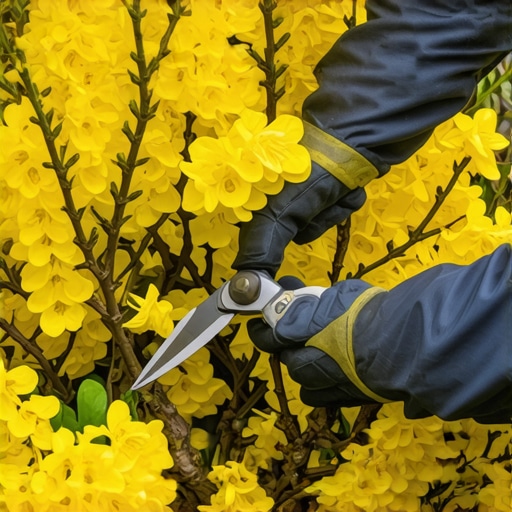
The Biology of the Bloom: Why Timing is Everything
To prune overgrown forsythia without losing blooms, you must perform thinning cuts immediately after the spring flowering cycle concludes, before the plant sets new flower buds for the following year. This window usually lasts about 4 to 6 weeks, allowing the shrub to focus its metabolic energy on vascular growth rather than maintaining ancient, unproductive wood. I always drill into my new crew members: if you don’t fix the soil grading first, every plant you put in the ground is just expensive compost, and if you prune a forsythia in winter, you are literally cutting off next year’s paycheck. I remember a client in the suburbs who spent three years wondering why her hedge never turned yellow. It turns out a local mow-and-blow hack was shearing it into a tight box every October. They were essentially lobotomizing the plant’s reproductive cycle. We had to go in, perform a forensic cleanup, and wait two years for the canopy to recover from that level of chemical and physical stress.
“A pruning cut is a wound that the plant must compartmentalize; the success of this process depends entirely on the location of the cut and the health of the parent branch.” – Horticultural Science Manual
The Anatomy of an Overgrown Shrub
Forsythia is a vigorous grower that operates on a renewal system. It sends up thick canes from the base that remain productive for about three to five years before the bark thickens and the flowering nodes become sparse. If you look closely at an old forsythia, you will see gray, fissured bark at the base. This is the old wood. The younger, more productive wood is smoother and more tan in color. When a shrub becomes overgrown, the interior becomes a tangled mess of dead wood and crossing branches that block sunlight, leading to fungal pathogens like Botryosphaeria canker. This is why a simple yard cleanup isn’t enough; you need a surgical approach to the plant’s structural engineering.
| Pruning Method | Impact on Next Year’s Blooms | Long-Term Plant Health |
|---|---|---|
| Heading Back (Shearing) | Loss of up to 90% | Creates dense, weak “witches brooms” at the tips. |
| Thinning (1/3 Rule) | Zero loss on remaining wood | Encourages fresh growth from the root crown. |
| Hard Rejuvenation | Total loss for 1 season | Resets a neglected plant entirely. |
Tools of the Trade: Beyond the Big-Box Basics
If you show up to a job with dull, bypass pruners from a bargain bin, you are doing more harm than good. You need high-carbon steel blades that make a clean, anatomical cut. I require my foremen to carry bypass pruners for anything under 1/2-inch, loppers for canes up to 1.5 inches, and a folding pull-saw for the heavy basal work. Dull blades crush the vascular cambium, the thin layer of living tissue between the bark and the wood. This prevents the plant from sealing the wound, leaving it open to boring insects. Also, if you’re dealing with a large estate, you should consider the impact of your equipment on the surrounding turf. If we just finished a high-end sod install, I won’t let my crew drag heavy brush across the new lawn. We use tarps and lightweight sleds to ensure the soil structure isn’t compacted during the yard cleanup phase.
How much can I cut off a forsythia at once?
For an overgrown forsythia, you should never remove more than one-third of the total biomass in a single season unless you are performing a total rejuvenation. By removing the oldest 1/3 of the canes at the soil level, you maintain the plant’s height while allowing sunlight to reach the crown. This stimulates the dormant buds at the base to push new, vigorous growth. This 1/3 rule is a standard in professional landscaping because it prevents the plant from going into a shock-induced state of leaf-drop. If you take too much, the plant cannot photosynthesize enough energy to support its root system, and you’ll see dieback in the following summer heat.
The Three-Year Rejuvenation Strategy
Restoring a giant forsythia is a marathon, not a sprint. In Year One, focus entirely on the interior. Remove any wood that is thicker than a broom handle and shows signs of bark splitting. Cut these canes exactly 2 inches above the soil line. Do not leave long stubs. Stubs are an invitation for rot. In Year Two, you address the crossing branches and anything growing toward the center of the shrub. In Year Three, you thin the remaining old wood. By the end of this cycle, you have a completely renewed plant without ever having a “bare” spring. This is where many DIYers fail; they want instant results and end up with a hacked-up mess that takes years to fix. Don’t forget that after such heavy pruning, your irrigation schedule needs to be dialed in. The plant is working hard to rebuild its canopy, and it needs deep, infrequent watering to support that new growth.
“Flowering shrubs that bloom on old wood should be pruned within weeks of flowering to maximize the vegetative growth period before the next floral induction.” – Agricultural Extension Service Bulletin
Can you prune forsythia in the fall?
You can, but you shouldn’t if you want flowers. Pruning in late summer or fall removes the apical buds that have already formed for the next spring. Furthermore, late-season pruning can stimulate a flush of new growth that won’t have time to harden off before the first hard freeze. In colder USDA zones, this tender growth will turn black and die, providing an entry point for disease. Stick to the spring window. It’s the only way to ensure the plant remains a structural asset rather than a maintenance liability. If you’re doing a general yard cleanup in the fall, focus on removing leaf litter from the base of the shrub to prevent moisture-related crown rot, but keep the shears in the truck.
- Check the pH: Forsythia prefers slightly acidic to neutral soil (6.0 to 7.0).
- Sterilize: Wipe your blades with 70% isopropyl alcohol between plants.
- Hydrate: Water the root zone deeply 24 hours before pruning.
- Mulch: Apply a 2-inch layer of organic compost after pruning, but keep it away from the stems.
Avoiding the Mulch Volcano and Root Girdling
One of the biggest mistakes I see after a major pruning job is the homeowner or a cheap contractor piling mulch up against the base of the plant. We call this a mulch volcano. It traps moisture against the bark, causing the very tissue we’re trying to protect to soften and rot. It also encourages adventitious roots to grow into the mulch rather than down into the soil. When those roots encounter the edge of the mulch bed, they often circle the trunk, eventually girdling and killing the plant. When we do a yard cleanup or a fresh sod install near ornamentals, we always leave a 3-inch gap of bare soil around the crown. This allows for proper gas exchange and keeps the root flare visible. Remember: the root flare is where the trunk transitions into the roots. It must breathe. If you bury it, you’re killing the plant slowly from the bottom up. It’s basic civil engineering for biology. Don’t skip this step or your pruning efforts will be for nothing.