
How to Spot Termite Activity in Your Wooden Retaining Walls (and Why It Matters)
For many homeowners in the Tri-State area, a wooden retaining wall is a charming, rustic addition to the landscape. It levels out a sloped yard, creates tiered garden beds, and adds a natural aesthetic that stone often fails to capture. However, as an expert in the field with decades of experience as one of the leading nassau county exterminators, I have seen these beautiful structures turn into a “Trojan Horse” for property destruction. While you are admiring your hostas and hydrangeas, a silent army could be using your retaining wall as a direct highway into the structural timber of your home.
My name is John Kinslow, and I’ve spent my career providing expert extermination services, servicing Nassau and Suffolk Counties in Long Island, NY. I have safely eliminated ants, crickets, spiders, and, most critically, termites for thousands of residents. Identifying termite activity early is the difference between a simple landscaping repair and a $20,000 structural renovation. In this guide, we will dive deep into why wooden retaining walls are so vulnerable and how you can spot the warning signs before the damage spreads from your garden to your foundation.
Why Wooden Retaining Walls Are termites new york Magnets
Retaining walls are uniquely susceptible to termite infestations because they provide the three things subterranean termites crave most: constant moisture, direct soil contact, and an endless supply of cellulose. Subterranean termites, the most common threat in the New York and Long Island area, live underground and require a high-moisture environment to survive. A retaining wall, by its very design, holds back a massive volume of soil that retains water every time it rains or the sprinklers run.
When you have wood-to-soil contact, you are essentially inviting termites to dinner. Even if the wood was originally pressure-treated, that protection fades over time. Cracks, checks, and drill holes from construction allow termites to bypass the chemical outer layer and reach the soft, untreated heartwood inside. This is a common issue when Building 2026 Timber Retaining Walls That Don’t Lean; while the focus is often on structural integrity and drainage, the biological vulnerability of the material is frequently overlooked.
Furthermore, retaining walls often hide the termites’ entry points. Because one side of the wall is completely buried, the insects can enter the timber directly from the earth without ever showing themselves to the sun. This “bridge” allows them to build massive colonies right in your backyard, using the wall as a staging ground for a future assault on your home’s sill plates and floor joists.
5 Visual Signs of pest control termite Activity in Your Landscaping
Detecting termites requires a keen eye and a bit of “detective work.” Because these pests are cryptic, they rarely walk across the surface of the wood. Instead, look for these five tell-tale signs:
1. Mud Shelter Tubes
Subterranean termites are soft-bodied and prone to dehydration. To travel across non-wood surfaces (like the concrete base of a wall or a stone transition), they build pencil-sized tubes made of mud, saliva, and fecal matter. If you see these earthen veins climbing up the side of your wooden timbers, you have an active infestation. These tubes protect them from predators and maintain the humidity they need to thrive.
2. Swarmers and Discarded Wings
In the late spring, usually after a warm rain, termite colonies produce “swarmers” – winged reproductive termites looking to start new colonies. If you notice a cloud of insects or, more commonly, piles of small, iridescent wings near the base of your retaining wall, a mature colony is nearby. Do not mistake these for flying ants; termite wings are all the same length, whereas ant wings have different sizes.
3. BB-Sized Spots of Dried Mud
One of the most overlooked signs is the presence of tiny, BB-sized spots of dried mud on the exterior of the wood. Termites use mud to plug up any holes they accidentally make to the outside world. If you see these small “patches” on your retaining wall, it indicates that the interior of the timber is likely riddled with galleries.
4. Narrow Sunken Lines in the Wood
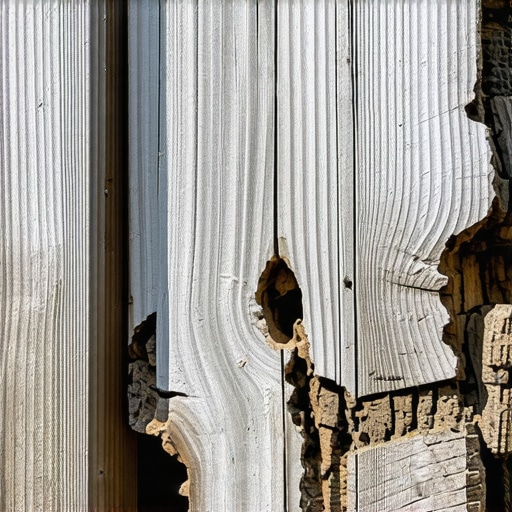
As termites consume the wood from the inside, they often follow the softer grain. This can eventually cause the exterior “veneer” of the wood to sag or sink inward, creating narrow, winding lines that look like ripples in the timber. If you see the wood grain looking distorted or “depressed,” it’s time for a professional inspection.
5. Frass (Termite Droppings)
While subterranean termites don’t always leave piles of frass like drywood termites do, you may still find a “sawdust-like” material in the crevices of the wall. This is often a mixture of wood particles and termite waste. However, if the “sawdust” looks more like clean wood shavings, you might actually be looking for carpenter ant pest control solutions instead, as ants excavate wood rather than eating it.
The “Tap and Feel” Test: Identifying Hollow Timber
Since termites eat wood from the inside out, a retaining wall can look perfectly solid on the exterior while being completely hollowed out on the inside. To determine the health of your wall, I recommend the “Tap and Feel” test. This is a standard procedure used by nyc pest control companies during initial site assessments.
Take a large screwdriver or a rubber mallet and move along the length of the wall, tapping the wood every few feet. A healthy timber will produce a solid, sharp “thud.” If you hit a section that sounds hollow, papery, or echoing, there is significant internal damage. In severe cases, you may even be able to push the screwdriver right through the surface of the wood with very little effort. If the wood gives way easily and reveals a series of layered galleries filled with bits of mud, you have confirmed a termite presence.
Remember, termites prefer the softer “springwood” and leave the harder “summerwood” intact, which creates a honeycomb or layered appearance inside the timber. If you find this pattern, the structural integrity of your wall is compromised, and you must act quickly before the weight of the soil causes a collapse.
Termite Damage vs. Wood Rot: How to Tell the Difference
It is common for homeowners to confuse termite damage with simple wood rot. Both are common in New York landscapes, but they require very different treatments. Wood rot is a fungal infection caused by excessive moisture. Rotted wood typically feels “spongy” or “stringy” and may crumble into cubes (dry rot) or feel slimy (wet rot). While rotted wood is a problem, it doesn’t move or spread to your house in the same way an insect colony does.
Termite damage, conversely, is characterized by the presence of mud. Termites bring soil into the wood to maintain humidity. If you break open a piece of damaged wood and see “mud galleries,” it is definitely termites. Furthermore, you should keep an eye out for other wood-destroying organisms. For instance, carpenter ant pest control is often necessary for walls that have both rot and insect activity, as carpenter ants prefer to nest in damp, decaying wood. While they don’t eat the wood like termites, their tunneling can be just as destructive to a retaining wall’s stability.
Distinguishing between these two is vital. Treating for rot won’t kill termites, and termite baiting won’t stop a fungal rot issue. A comprehensive inspection from a professional who understands biotech pest control methods can help you identify exactly which threat you are facing.
Beyond the Wall: The Risk to Your New York Home
The greatest danger of an infested retaining wall isn’t the wall itself – it’s the proximity to your home. Termites are relentless foragers. Once they have exhausted the food source in your landscaping, they will follow moisture gradients and underground pheromone trails toward your foundation. If your retaining wall is within 10 to 20 feet of your home, it acts as a “launchpad” for an infestation of your main structure.
When we perform inspections for termites new york, we look at the “big picture.” A property is an ecosystem. If you have termites in the yard, you likely have or will soon have them in the house. This is why bio-tech pest control focuses on perimeter protection. We don’t just treat the wall; we create a chemical or bait barrier between the landscaping and the home.
Homeowners should also realize that a yard conducive to termites is often attractive to other pests. A high-moisture environment with plenty of hiding spots can lead to a need for mice pest control or even cockroach pest control. In fact, many of our clients who call for a mice exterminator are surprised to find that the same gaps in their retaining walls and foundations that let in rodents are also serving as entry points for termites and ants. A holistic approach to rodent control pest control and insect management is the only way to truly secure a New York property.
Prevention and Professional Solutions
If you are planning a new project, consider 5 Budget Hardscaping Ideas for Sloped Yards [2026] that utilize non-organic materials. If you must use wood, ensure it is rated for “ground contact” and implement proper drainage to keep the area as dry as possible. For those with existing walls, regular inspections are mandatory. Look for the signs mentioned above at least twice a year – once in the spring and once in the autumn.
If you suspect an infestation, DIY “bug sprays” from the hardware store will not work. These often only kill the termites on the surface, causing the rest of the colony to retreat deeper into the soil or move to a different part of your yard. Professional biotech pest management involves using specialized termiticides or baiting systems that the workers carry back to the queen, effectively neutralizing the entire colony at its source.
Whether you need exterminators bronx residents trust or a specialist in the heart of Nassau County, getting a professional on-site is the first step. We also provide specialized services for other urban pests, including bed bugs treatment nyc and general ant pest control. Don’t let your landscaping become a liability. If you see the signs of termites, or if you simply haven’t had an inspection in years, reach out to bio-tech pest control today. If you’re looking for more robust landscaping alternatives, learn How to Build a Branson Rock Wall That Actually Handles Heavy Rain to avoid the pitfalls of wood altogether.
Your home is your biggest investment. Protecting it starts from the outside in. By keeping a close watch on your wooden retaining walls and partnering with experienced biotech pest control specialists, you can ensure your yard remains a place of beauty rather than a source of stress.