
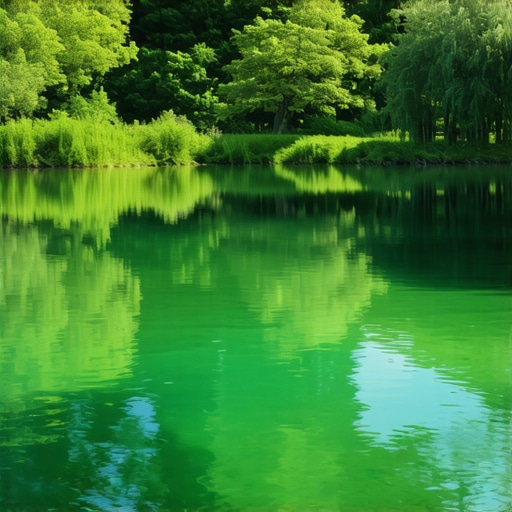
The Forensic Autopsy of a Dying Ecosystem
I recently walked onto a job site where the homeowner had spent three years and nearly four thousand dollars on ‘quick-fix’ chemicals trying to clear a backyard pond that looked like thick pea soup. He was dumping in copper-based algicides every weekend, which killed the algae momentarily, but the dead organic matter just sank to the bottom, rotted, and released a massive spike of phosphorus. This created a ‘rebound loop’ where the next bloom was twice as aggressive as the last. By the time I arrived, the water had a distinct smell of hydrogen sulfide—rotten eggs—meaning the bottom was completely anaerobic. His fish were gasping at the surface, and the liner was coated in a slick, black sludge. He didn’t have a pond; he had a toxic waste pit. We had to do a full forensic excavation, removing six inches of muck and completely redesigning his biological filtration system from the ground up.
Why Your Pond Turns Into Green Sludge Every July
Pond water turns green primarily due to an excess of dissolved nutrients (nitrates and phosphates) combined with prolonged sunlight exposure and low dissolved oxygen levels. This environment triggers a rapid bloom of single-celled planktonic algae that bypasses standard mechanical filtration. To stop it, you must address the chemical imbalance at the microscopic level. It is not a cleaning issue; it is a biology issue. If you don’t fix the nitrogen cycle, you are just fighting a losing war against nature.
“Excessive algae growth is almost always a symptom of high phosphorus levels in the water column. Managing this nutrient through biological competition or chemical binding is the only long-term solution for clarity.” – Texas A&M AgriLife Extension
The Role of Yard Cleanup and Nutrient Loading
Many homeowners don’t realize that their pond clarity starts at the property line. During a standard yard cleanup, if your crew isn’t careful about leaf litter or grass clippings entering the water, you are essentially spoon-feeding the algae. Organic debris decomposes into ammonia, which then converts into nitrites and eventually nitrates. While landscaping around a pond can look professional, if the grade isn’t set correctly, every rainstorm washes nitrogen-rich soil and fertilizer directly into the basin. This is why sod install projects near a water feature require a buffer zone—typically a 3-foot perimeter of native grasses or river rock—to catch runoff before it hits the water.
How does irrigation runoff cause pond algae?
When your irrigation system is poorly calibrated, it often over-sprays into pond-adjacent flower beds, leaching fertilizers into the water. Most lawn fertilizers are heavy on nitrogen (N) and phosphorus (P), which are the primary fuel sources for filamentous and planktonic algae. Ensure your heads are adjusted to spray away from the water’s edge. This prevents the ‘fertilizer spike’ that typically follows a hot summer afternoon watering cycle.
The Engineering Solution: Biological and Mechanical Filtration
A pond is a closed-loop system that requires specific engineering to maintain high transparency. You cannot rely on a single submersible pump. You need a two-stage approach: a mechanical skimmer to catch floating debris before it sinks, and a biological filter (like a waterfall box) filled with high-surface-area media. This media provides a home for Nitrosomonas and Nitrobacter bacteria, which process ammonia into less harmful nitrates that aquatic plants can then consume. If your pump doesn’t turn over the entire volume of the pond at least once every hour, your water will stagnate and turn green.
| Feature | Purpose | Impact on Algae |
|---|---|---|
| UV Sterilizer | Zaps single-celled algae with UVC light | Eliminates green water (planktonic algae) |
| Aeration Kit | Increases dissolved oxygen (DO) levels | Accelerates aerobic decomposition of sludge |
| Phosphate Binder | Chemically locks up P in the water | Starves algae of its primary food source |
| Skimmer Box | Removes leaves/debris before they rot | Lowers the overall organic load |
How much air pump power do I need for my pond?
For a standard decorative pond, you should aim for an aeration system that delivers at least 1.5 cubic feet per minute (CFM) of air per 1,000 gallons of water. This is crucial during the summer when warm water holds significantly less oxygen than cold water. Without active aeration, the beneficial bacteria at the bottom of the pond die off, allowing anaerobic sludge to build up. This sludge is a nutrient factory that fuels massive algae blooms. Don’t rely on a waterfall alone; you need bottom-diffused air. The bubbles must rise from the deepest point of the pond to ensure total gas exchange.
The Master Landscaper’s Checklist for Crystal Clear Water
- Test your water parameters: pH should be 7.0-8.5, and Ammonia/Nitrites must be 0 ppm.
- Install a UV Clarifier: Ensure the bulb is replaced every 12 months; they lose efficacy even if they still glow.
- Add aquatic plants: Aim for 50% surface coverage using lilies or floating plants like water lettuce to block UV rays.
- Manual removal: Use a pond net for any string algae that clings to rocks. Don’t let it rot in place.
- Beneficial Bacteria: Dose with liquid or powdered concentrated bacteria weekly during the peak heat of July and August.
- Check the pump pre-filter: A clogged pump reduces GPH (gallons per hour) flow, causing the biological filter to starve for oxygen.
“A retaining wall doesn’t fail because of the stone; it fails because of the water trapped behind it. Similarly, a pond doesn’t fail because of the algae; it fails because of the nutrients trapped within it.” – Hardscape Engineering Axiom
The Step-by-Step Remediation Process
If your pond is already a green mess, follow this forensic remediation plan. First, stop all fertilization in the 20 feet surrounding the pond. Second, perform a 20% water change using a dechlorinator—never change more than that or you will shock the ecosystem. Third, add a lanthanum-based phosphate binder to lock up existing nutrients. Fourth, install a UV sterilizer rated for your pond’s volume. It will take 72 hours for the water to clear as the dead algae are filtered out. Finally, do not overfeed your fish. Any uneaten food is just raw fertilizer for the next bloom. Give them only what they can eat in two minutes. If you see food floating after that, you are over-loading the system. It is that simple. Stick to the measurements. Trust the science. Stop the chemicals.