
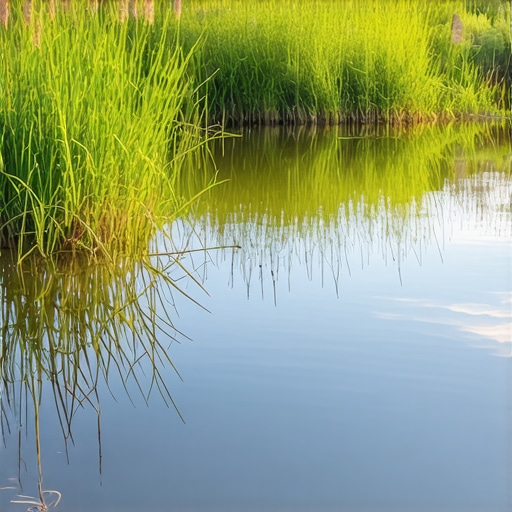
I always drill into my new crew members: if you don’t fix the soil grading first, every plant you put in the ground is just expensive compost. This applies double to aquatic environments. Last season, we were called to a property where a DIY enthusiast had spent four thousand dollars on a ‘state-of-the-art’ pressurized filter system, yet his water looked like thick pea soup. He forgot the biology. He had zero native vegetation and a massive nitrogen runoff problem from his recent sod install. We didn’t sell him a bigger pump; we re-graded his perimeter, installed a buffer zone of Pontederia cordata, and let the plants do the heavy lifting. Within three weeks, the Secchi disk depth went from four inches to three feet. It is not magic; it is civil engineering with a biological component.
The Biological Filtration Power of Native Flora
Native plants maintain pond clarity by aggressively sequestering excess nitrates and phosphates from the water column while providing surface area for beneficial aerobic bacteria. These plants act as a living filter, outcompeting opportunistic algae for the limited nutrient resources that cause unsightly blooms and oxygen depletion. It is the most sustainable way to manage water quality without relying on expensive chemical additives or high-wattage UV clarifiers.
“A managed wetland or pond system utilizes the natural uptake capacity of aquatic macrophytes to mitigate the effects of eutrophication caused by high nutrient loads.” – Penn State Agricultural Extension
The core issue in most murky ponds is an imbalance of Total Suspended Solids (TSS) and dissolved nutrients. When you perform a yard cleanup, many homeowners inadvertently strip away the natural buffer zones that prevent organic debris from entering the water. Without a ring of native plants, every rain event washes nitrogen-rich fertilizer from your lawn or debris from your landscaping directly into the pond. This triggers a massive spike in algae. You need to treat the pond as a closed loop where every input must be processed by biomass. 45-mil EPDM liners and professional-grade underlayment are the foundation, but the plants are the engine.
Selecting the Right Biomass for Nutrient Management
You cannot just throw any green thing into the water and expect results. You need a tiered approach: oxygenators, marginals, and floaters. Each serves a specific engineering purpose. Submerged plants like Ceratophyllum demersum (Coontail) are high-efficiency nutrient sponges that release oxygen directly into the water, which is vital for the nitrifying bacteria living in your gravel bed. Marginal plants, situated on the pond shelves, stabilize the soil and prevent the erosion of your sod install at the water’s edge.
| Plant Category | Common Species | Specific Function | Recommended Planting Depth |
|---|---|---|---|
| Oxygenators | Coontail, Hornwort | Nitrate uptake; DO increase | Submerged (12-24″) |
| Marginals | Pickerelweed, Blue Flag Iris | Erosion control; Perimeter buffer | 0-6″ |
| Floating | American Lotus, Water Lily | UV shielding; Thermal regulation | 18-36″ |
How many plants per square foot do I need?
For professional-grade clarity, you should aim to cover approximately 50 to 60 percent of the pond’s surface with floating or broad-leafed plants by mid-summer. This creates a thermal blanket that prevents the water from overheating. High water temperatures lead to lower dissolved oxygen levels and higher microbial activity, which fuels algae. If you have 100 square feet of surface area, you need at least 50 square feet of leaf coverage. Don’t skimp. It will fail.
Installation Mechanics: Grading, Liners, and Irrigation
The intersection of your pond and your irrigation system is a critical failure point. I see hacks all the time who run irrigation lines too close to the pond edge, leading to hydrostatic pressure issues that heave the pond liner. When we do a landscaping overhaul, we ensure the irrigation zones are set to spray away from the water. You do not want high-phosphorus city water or well water constantly topping off your pond and introducing fresh nutrients for algae to eat.
“Hydrostatic pressure behind a pond shell or under a liner is the primary cause of structural failure in residential water features.” – International Certified Hardscape Professionals (ICPI) Standards
During the excavation phase, we use 18-inch minimum depths for the main basin. This depth is non-negotiable in regions with freeze/thaw cycles. Anything shallower and the thermal mass of the water fluctuates too wildly, stressing your plants and fish. We also install a 10-gauge wire for the pump system and ensure the autofill valve is calibrated to prevent overfilling, which can wash out your sod install and dump sediment into the basin.
How do native plants stop algae growth?
Native plants utilize allelopathy and nutrient competition to inhibit algae. Specifically, they consume the ammonia and nitrates produced by decomposing organic matter before the algae can reach them. Additionally, species like the American Lotus provide significant shade, reducing the UV penetration required for single-cell algae to photosynthesize. This is a passive, 24-hour filtration process that requires zero electricity.
Maintenance and Seasonal Yard Cleanup Protocols
Your yard cleanup routine must be adapted if you have a pond. Most people want to blow their grass clippings and leaves into the perimeter. Stop it. That organic matter sinks to the bottom, creates a benthic layer of anaerobic muck, and releases methane and hydrogen sulfide. This is the ‘rotten egg’ smell people complain about. Instead, use a pond net during the fall and prune your native plants back once they go dormant.
- Spring: Check pH levels (aim for 6.5-7.8) and remove any winter debris.
- Summer: Thin out floating plants if they exceed 70% coverage.
- Fall: Install leaf netting before the first frost.
- Winter: Keep a small hole in the ice for gas exchange using a de-icer, not a heater.
Proper irrigation management also plays a role in the fall. Reduce the frequency of your autofill as evaporation slows down. This prevents the pond from becoming a cold-water sink that can shock the root systems of your marginal plants. Remember, these plants are your employees. If you treat them poorly, they stop working, and your water turns green. It is that simple.