
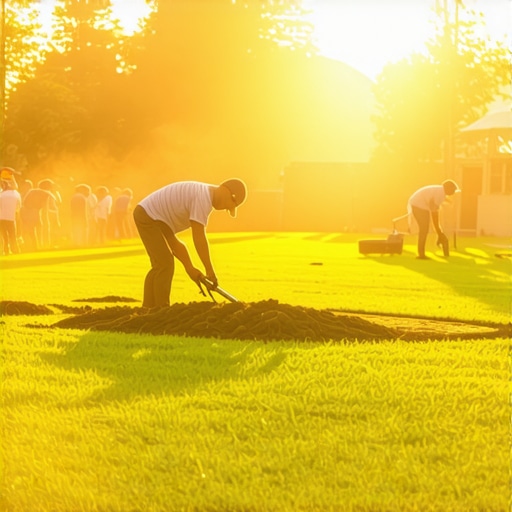
The 2:00 PM Mist Rule: Solving Thermal Stress in Summer Sod
The 2:00 PM Mist Rule is a specific irrigation technique designed to prevent transpirational wilt in newly laid sod by applying a light, five-minute cycle of water to the grass blades during the peak thermal load of the day. This process, known as syringing, lowers the canopy temperature by up to 15 degrees Fahrenheit through evaporative cooling without saturating the root zone to the point of hypoxia.
I always drill into my new crew members: if you don’t fix the soil grading first, every plant you put in the ground is just expensive compost. Last season, I watched a rookie crew lay four thousand square feet of premium Kentucky Bluegrass on a site with zero drainage prep. The homeowner thought they were getting a deal. Three weeks later, the entire yard smelled like a swamp and the roots were black. They had essentially created a giant, expensive petri dish for Pythium blight. We had to rip it all out, regrade the entire lot with a 2 percent slope away from the foundation, and start from the dirt up. This is why we focus on engineering first and aesthetics last.
“A retaining wall doesn’t fail because of the stone; it fails because of the water trapped behind it.” – Hardscape Engineering Axiom
The Physics of Summer Sod Establishment
When you lay sod in the middle of a 90 degree July afternoon, you are fighting a battle against the vapor pressure deficit. The plant is trying to move water from the roots to the blades, but the roots haven’t even knitted into the subsoil yet. This is where the 2:00 PM Mist Rule comes in. By misting the yard at the hottest point of the day, you stop the plant from going into a total shutdown. If the stomata close due to heat stress, the internal temperature of the grass blade can rise to lethal levels in minutes. We are talking about biological masonry here: you have to keep the material cool while the structural bonds form. Don’t drown it. Just cool it. Use a fine nozzle. Big droplets are useless here.
How much water does new sod need in 100-degree heat?
New sod in triple-digit temperatures requires a bifurcated irrigation strategy consisting of deep morning watering to achieve 6 inches of soil saturation and supplemental canopy syringing every two hours between 10:00 AM and 4:00 PM. The goal is to keep the interface between the sod pad and the native soil consistently moist, but never anaerobic. Most hacks will tell you to just leave the sprinkler on all day. That is the fastest way to rot the crown. You want moist soil, not a bog. Check the edges. The edges are the first to die because they have more surface area exposed to the air. If the edges are curling, you are losing the battle.
| Metric | Standard Strategy | The 2:00 PM Mist Rule |
|---|---|---|
| Morning Volume | 0.5 inches | 0.75 inches (pre-dawn) |
| Peak Heat Action | None | 5-minute mist (syringing) |
| Soil Oxygen Level | High risk of hypoxia | Maintained via drainage |
| Leaf Temperature | Over 100 F | 82 to 88 F |
Can you lay sod on top of existing grass?
You cannot lay new sod over existing grass because it prevents root-to-soil contact and creates a layer of decomposing organic matter that generates heat and blocks gas exchange. For a successful landscaping installation, you must remove the old turf using a sod cutter, till the top 4 inches of soil, and incorporate a starter fertilizer with a high phosphorus ratio to encourage immediate root elongation. If you leave the old grass, the new sod will simply sit on top like a rug on a hardwood floor. It will suffocate. It will die. You will waste five thousand dollars. Strip it to the dirt. No exceptions.
- Step 1: Mechanical removal of all existing vegetation and debris.
- Step 2: Soil pH testing. We aim for 6.5 for most cool-season blends.
- Step 3: Rough grading to ensure positive drainage.
- Step 4: Application of 10-20-10 starter fertilizer.
- Step 5: Tight-jointed sod laying with staggered seams.
- Step 6: Rolling with a half-full water roller to remove air pockets.
“The success of any turfgrass establishment depends more on the physical properties of the soil than on the nutrient levels at the time of planting.” – Penn State Center for Turfgrass Science
Soil Microbiology and the Nitrogen Cycle
In the 2026 standards for high-end turf management, we are moving away from heavy synthetic nitrogen during summer installs. High nitrogen forces top growth at the expense of the roots. In 90 degree weather, forcing top growth is a death sentence. We use slow-release bridge products that feed the microbes. Those microbes then make the nutrients available to the plant at a pace it can actually handle. Look at the cation exchange capacity of your soil. If you have sandy soil, that water is going to zip right past the roots. You need to incorporate calcined clay or high-quality compost to hold that moisture. If you have heavy clay, you need to watch for compaction. A compacted soil has no pore space. No pore space means no oxygen. No oxygen means no roots. It is simple math. Don’t skip the aeration before the lay. It is the only time you can truly influence the subsoil structure.
Long-Term Maintenance and the Settling Period
The first fourteen days are critical. By day seven, you should see white root hairs poking into the native soil. Do not mow until the sod is firmly rooted. You test this by trying to lift a corner. If it resists, it is ready. Set your mower to the highest setting. Scalping new sod is a sin. You want a long blade to shade the soil. The longer the blade, the deeper the root. That is the golden rule of agronomy. Once the roots are in, you transition from the 2:00 PM Mist Rule to deep, infrequent watering. You want to force those roots to go down deep to find moisture. If you keep the surface wet, the roots stay lazy. Lazy roots don’t survive the winter. We are building a system that should last twenty years, not twenty days. Plan accordingly. Fix your irrigation heads. Ensure 100 percent coverage. If you have a dry spot, the sun will find it and burn it out before you even get home from work.