
The Slow Suffocation of Suburban Canopies
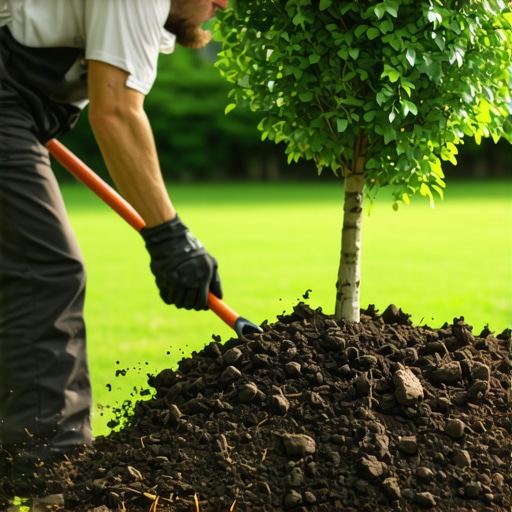
A mulch volcano is an improper landscaping practice where mulch is piled thick against a tree trunk, trapping moisture and heat against the bark. This anatomical error causes bark rot, fungal infections, and the development of girdling roots, which eventually strangle the tree by cutting off nutrient transport through the vascular cambium. Proper mulch application requires a donut shape, not a cone, leaving the root flare visible for gas exchange.
I always drill into my new crew members: if you don’t fix the soil grading and expose that basal flare first, every plant you put in the ground is just expensive compost. I’ve seen 30-year-old Oaks die in three seasons because a ‘mow-and-blow’ crew thought piling six inches of dyed mulch against the trunk looked ‘neat.’ It isn’t neat; it’s a death sentence. The bark on a tree is designed to be dry. It is a protective barrier for the phloem and xylem—the tree’s circulatory system. When you bury it in damp mulch, you turn that armor into a sponge. It gets soft. It starts to slough off. And then the pathogens move in for the kill. We aren’t just doing a yard cleanup; we are performing a horticultural rescue mission.
The Anatomy of Bark Decay and Girdling Roots
When mulch touches the trunk, it creates a dark, anaerobic environment. This is a playground for Phytophthora and other wood-decay fungi. But the chemical rot is only half the battle. The more insidious threat is the girdling root. Trees are biological engines. When they sense moisture in a mulch pile above the ground, they send out adventitious roots into that mulch. Because there is no room to grow outward, these roots circle the trunk. As the root grows in diameter and the trunk grows in diameter, they eventually collide. The root literally chokes the tree, stopping the flow of water from the irrigation system to the canopy. Don’t believe me? Grab a trowel and dig into one of those volcanoes. You’ll find a knotted mess of white roots strangling the main stem.
“A mulch volcano is not a landscaping feature; it is a long-term suicide note for the tree. Bark is the first line of defense against insects and disease, and it must remain dry to function.” – Texas A&M AgriLife Extension
How much mulch is too much for a tree?
For most species, a mulch layer should never exceed 2 to 4 inches in depth, and it must never touch the trunk. In heavy clay soils, even 2 inches might be too much if it prevents the soil from drying out. We use a 3-2-1 rule: 3 feet out from the trunk, 2 to 3 inches deep, and 1 inch away from the flare. If you’re doing a sod install near trees, do not run the grass right up to the trunk. Grass competes for nitrogen and water, and the mower will eventually nick the bark, creating an entry point for borers.
| Mulch Type | Recommended Depth | Airflow Rating | Durability |
|---|---|---|---|
| Shredded Hardwood | 2-3 Inches | Medium | High |
| Pine Straw | 3-4 Inches | Very High | Low |
| Pine Bark Nuggets | 2-3 Inches | High | Medium |
| Double-Ground Cedar | 1-2 Inches | Low | Very High |
How do I fix a mulch volcano without hurting the tree?
Remediation starts with a hand trowel, not a shovel. Carefully pull the mulch away from the base of the tree until you see the root flare—the spot where the trunk widens as it enters the ground. If you find small, circling roots already growing in the mulch, prune them back cleanly with sterilized bypass pruners. Stop once you reach the soil surface. This is a critical part of landscaping maintenance that most homeowners ignore until the leaves start thinning at the top. Once the flare is exposed, you’ve restored the tree’s ability to breathe. Gas exchange is vital. The cells in the trunk need oxygen to maintain the bark barrier. Without it, the tissue dies.
The Role of Soil Physics and Irrigation
Water management is the next hurdle. If you have an automatic irrigation system hitting the trunk of the tree every morning, you’re accelerating the rot. No amount of mulch removal will save a tree that is constantly being power-washed at the base. Adjust your sprinkler heads. We often see ‘volcanoes’ used to hide poorly installed irrigation lines or old stumps. That’s a rookie mistake. A professional crew knows that the soil grade must slope away from the tree to prevent pooling. If we’re performing a yard cleanup, we don’t just haul away leaves; we check the structural integrity of the root zone.
“Root systems require a balance of oxygen and water. Excessive mulching creates a moisture-saturated environment that leads to root asphyxiation.” – Penn State Extension
What are the symptoms of bark rot from over-mulching?
Look for ‘bleeding’ bark—dark, wet patches that never seem to dry out. You might also see fungal fruiting bodies, like mushrooms or ‘conks,’ growing directly out of the base. By the time you see these, the internal wood decay is usually advanced. Another sign is early fall color. If your Maple turns bright red in August while the neighbors’ are still green, the tree is under massive stress. It’s a distress signal. It’s trying to go dormant because it can’t move nutrients. We see this often in new developments where builders throw down cheap sod install kits and pile mulch high to hide the lack of proper planting depth. It’s a hack job, and it’s killing our urban forest.
The Maintenance Checklist: Proper Mulching Protocol
- Identify the root flare: Ensure the trunk flare is visible at the soil line.
- Remove excess: Scrape away old, matted mulch before adding new material.
- Edge the bed: Create a clean edge to contain mulch and prevent it from migrating.
- Select the right material: Use organic mulches that break down and feed soil biology.
- Monitor moisture: Check the soil under the mulch; if it’s soggy, skip the next watering.
- Check for girdling roots: Every spring, inspect for roots wrapping around the stem.
Landscaping is biology. It’s about respecting the physical needs of the plant. A tree isn’t a fence post; you can’t just stick it in a hole and pile dirt around it. It needs to breathe. It needs a stable pH. It needs a soil structure that hasn’t been compacted by heavy machinery. If you want a yard that lasts for decades, stop treating your trees like lawn ornaments and start treating them like the complex organisms they are. Remove those volcanoes. Your trees will thank you with a century of shade.