
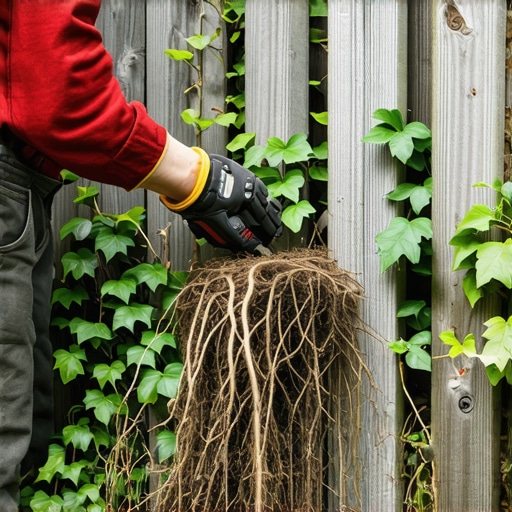
Why Manual Removal of Deep Ivy Roots is the Only Professional Solution
To remove deep ivy roots from fences without chemicals, you must implement a mechanical severance strategy that involves cutting the primary vines at the base, allowing the aerial roots to desiccate, and then excavating the root crown at least 12 inches deep to prevent rhizomatic regeneration. This process ensures the structural integrity of your landscaping and fencing remains intact without leaching glyphosate or triclopyr into the surrounding soil biology.
I always drill into my new crew members: if you don’t fix the soil grading and root management first, every plant you put in the ground is just expensive compost. When a homeowner calls me about English Ivy (Hedera helix) swallowing their perimeter, they usually want a quick spray. I tell them no. Chemicals are the lazy man’s tool and they rarely reach the vascular system of a mature ivy colony anyway. You have to get your hands in the dirt. I’ve seen 30-year-old cedar fences snapped like toothpicks because the lateral load of saturated ivy during a windstorm reached over 400 pounds of pressure. If you want a yard that actually functions, you stop the growth at the source, not the leaf.
The Mechanical Biology of Ivy Attachment
Ivy doesn’t just lean on your fence; it integrates with it. The plant uses adventitious rootlets that exude a polysaccharide-based mucilage—essentially a biological superglue. This glue hardens into the pores of wood or the crevices of masonry. When you rip it off dry, you take the fence with it. This is why our yard cleanup protocol always starts with moisture and patience.
“The persistent nature of invasive vines like Hedera helix requires a multi-stage mechanical approach to ensure the root crown is fully devitalized, as even small fragments of remaining root tissue can lead to aggressive re-emergence in favorable soil conditions.” – Penn State Department of Plant Science
The Ground-Up Build: A Step-by-Step Mechanical Removal Process
Before you even touch a pair of loppers, you need to assess the irrigation patterns in the area. Saturated soil makes root extraction significantly easier, but it also makes the fence posts more prone to shifting during the pull. We start by flagging any utility lines—always call 811 before you start deep excavation near a property line. It’s the law, and it saves lives.
How much of the ivy root system do I need to dig out?
To successfully eliminate ivy permanently, you must remove the entire root crown and the first 18 inches of the primary taproot system using a trenching spade or root-cutting tool. Simply cutting the vine at the surface is insufficient because the stored carbohydrates in the root system will trigger epicormic budding within weeks.
| Tool Type | Specific Use Case | Professional Recommendation |
|---|---|---|
| Bypass Loppers | Severing main trunk vines (1-3 inches) | Fiskars 32-Inch PowerGear2 |
| Trenching Spade | Deep vertical root extraction | Nupla 12-Gauge Steel |
| Reciprocating Saw | Cutting subterranean woody roots | Milwaukee SAWZALL with 9-inch Carbide Blade |
| Pressure Washer | Cleaning suckers off masonry (not wood) | 2000 PSI max with 40-degree nozzle |
The Primary Severance: The “Air Gap” Technique
Step one is the ‘Air Gap.’ We cut a 12-inch section out of every single vine climbing the fence. Do not pull the top part down yet. If you pull live ivy, you’re fighting the plant’s turgor pressure. Let it die. Over the next three weeks, the aerial roots will lose their grip as they dehydrate. They’ll go from being glued on to being brittle. It’s the difference between peeling off a wet sticker and a dry one. Don’t skip this. It will save your fence boards from splintering.
Phase 2: Subterranean Warfare
Once the top is dying, we go for the throat. The root crown of an old ivy plant can be the size of a bowling ball. You need to dig a perimeter around the base of the fence. This is where your sod install prep comes in handy. You’re looking for the ‘octopus’—the point where the vine meets the roots. Using a reciprocating saw with a carbide blade, we cut the roots 12 inches below the surface. We don’t just pull; we extract. If you leave a 2-inch segment of root, it will find a way back.
- Step 1: Clear a 2-foot debris-free zone around the fence base.
- Step 2: Locate the largest ‘mother’ vines and trace them to the soil entry point.
- Step 3: Use a pry bar or ‘Root Slayer’ shovel to lever the crown upward.
- Step 4: Sift the soil for ‘thread’ roots—these are the thin, orange-colored runners.
- Step 5: Backfill the void with a high-drainage sandy loam to prevent water pooling.
How do you kill ivy on a wooden fence naturally?
The most effective natural method to kill ivy on a fence is desiccation through vascular interruption; by cutting the main stem and leaving the foliage to wither, the plant’s photosynthetic cycle is broken. Afterward, a mixture of horticultural vinegar (20% acetic acid) can be applied specifically to the freshly cut stumps to cauterize the tissue.
“Hydrostatic pressure from trapped moisture behind dense vine growth is a leading cause of premature structural failure in both retaining walls and timber fencing.” – Hardscape Engineering Axiom
The Forensic Restoration: Cleaning the Fence
Once the ivy is dead and brittle, it’s time for the cleanup. For a wooden fence, we use a stiff nylon brush. Never use a wire brush on cedar; it will shred the soft grain. If the ivy has left behind those stubborn ‘hairy’ feet, we use a heat gun on a low setting to crisp them up before brushing. It’s tedious. It’s hard work. But it’s the only way to get the wood back to a state where it can be re-stained. If you’re dealing with a chain-link fence, you can be more aggressive, but watch your tension wire. Ivy loves to wrap around the tension wire, and if you cut that, your fence will sag within the month. It’s about precision, not just power.
Final Soil Remediation and Prevention
After extraction, the soil pH might be slightly acidic due to the decaying organic matter. I usually recommend a light application of pelletized lime to balance it out before you consider a new sod install. We also install a 4-inch deep polymeric sand or gravel border at the base of the fence. This creates a dry zone that ivy hates. It can’t crawl over dry, shifting aggregate as easily as it can over moist mulch. Remember: ivy is a moisture-loving opportunist. Deny it the moisture, and you win the war.