
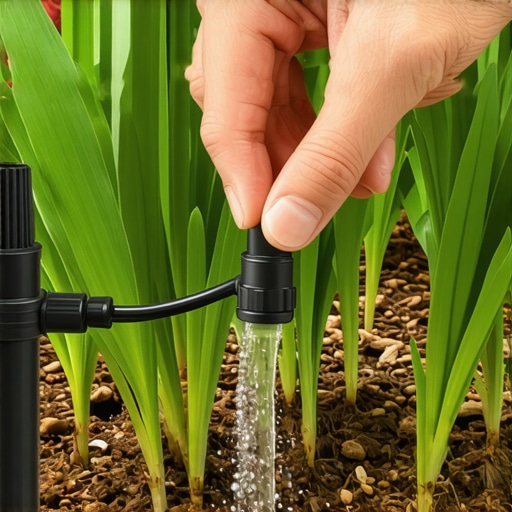
The Sputter of Death: Diagnosing Mineral Scaling in Micro-Irrigation
To repair clogged drip emitters caused by hard water, you must dissolve calcium carbonate deposits using an acidic solution like white vinegar or phosphoric acid, followed by a high-pressure flush of the lateral lines to prevent immediate re-clogging of the irrigation system. This process restores the precise flow rate required for landscaping health and prevents localized plant dehydration. If you ignore the sputter, you are killing your sod install from the roots up. It is that simple.
The $15,000 Sod Disaster: A Hard Water Autopsy
I recently walked onto a job site where a homeowner had spent $15,000 on a premium Kentucky Bluegrass sod install and a custom landscaping package. Six months later, the perimeter plants were scorched. The homeowner blamed the nursery. I knelt down, pulled a 1.0 GPH (gallons per hour) emitter out of the 1/2-inch poly tubing, and bit it open. The internal labyrinth was packed solid with white, chalky calcium carbonate. They were running well water with a pH of 8.2 and 400 ppm hardness. They weren’t watering their plants; they were essentially cementing them. This is the reality of irrigation in high-mineral regions. If you do not manage the chemistry, the hardware fails every single time. It is not a matter of ‘if,’ but ‘when.’ Every yard cleanup should include a forensic check of these emitters, or you are just tossing money into the wind.
“Irrigation water containing more than 150 mg/L of calcium carbonate is likely to cause severe clogging of drip emitters.” – Texas A&M AgriLife Extension
The Science of Scaling: Why 2026 Emitters Fail
The clogging of drip emitters occurs when dissolved minerals—specifically calcium and magnesium—precipitate out of the water as it slows down and warms up inside the emitter’s internal flow path. In a landscaping environment, the sun heats the poly tubing, accelerating the chemical reaction that turns liquid minerals into solid scale. This scaling narrows the orifice, increasing the pressure required to push water through, which eventually leads to a total blockage. You see it as a dry patch in your yard; I see it as a failure of fluid dynamics. Hard water is the silent killer of modern irrigation. Unlike a broken pipe, you cannot see a clog from the street. You have to be on your hands and knees, checking the soil moisture levels at every single plant.
How do I know if my drip emitters are clogged?
You can identify clogged drip emitters by looking for ‘salt crusting’ around the emitter head, observing wilting plants despite a wet main line, or using a pressure gauge to check for unexpected spikes in lateral line pressure. If you see white residue, the minerals are already winning. Don’t wait for the plant to turn brown. At that point, the cellular structure of the leaf is already collapsing. Perform a manual check during every yard cleanup. Turn the system on and walk the line. No water means a clog or a kink. Most people ignore this until the sod install looks like a desert. That is a rookie mistake.
| Water Hardness (PPM) | Classification | Clogging Risk Level |
|---|---|---|
| 0-60 | Soft | Low – Annual Flush Recommended |
| 61-120 | Moderately Hard | Medium – Bi-annual Inspection |
| 121-180 | Hard | High – Acid Treatment Required |
| 181+ | Very Hard | Critical – Monthly Maintenance |
The Forensic Repair: A Step-by-Step Acid Flush
Restoring a landscaping irrigation system requires more than just poking a needle into the emitter hole. That just pushes the debris back into the labyrinth. You need a chemical solution. Start by identifying the ‘end of the line’ for each lateral run. Open the flush valves. You will likely see a milky discharge; that is the loose calcium. To dissolve the stuck scale, you must introduce a mild acid into the lines. For residential landscaping, a 5 percent acetic acid (white vinegar) solution can work for minor clogs, but professional-grade phosphoric acid is required for severe calcification in 2026 systems. You are aiming to drop the pH of the water in the lines to roughly 4.0 for a period of 12 to 24 hours. This dissolves the crystalline structure of the scale without melting the polyethylene tubing. It is a delicate balance. Do not guess. Use a pH test strip.
Can I clean drip emitters without removing them?
Yes, you can clean drip emitters without removal by performing a system-wide acid injection, provided you have a backflow preventer installed to protect your potable water supply. This is a standard procedure in commercial landscaping. You inject the acid through a venturi injector or a pressurized tank, let it sit in the lines, and then flush the system with clean water. If you do not have a backflow preventer, you are violating local municipal drainage codes and risking your family’s health. Check with 811 Dig Safe before any major excavation to install these components. Safety is not optional.
“Water quality is the single most important factor in the longevity of micro-irrigation components.” – NRCS Irrigation Guide
The Maintenance Protocol: Preventing Future Clogs
Prevention is cheaper than replacement. If you just finished a high-end sod install, you cannot afford to let the irrigation fail. First, install a 200-mesh filter at the head of the zone. This catches physical debris like sand and rust, but it won’t stop the minerals. For hard water, you need a scale inhibitor or a water softener specifically designed for landscaping use. I tell my crews: ‘A clean filter is a happy plant.’ We check filters every 30 days. No exceptions. Hard water management is a marathon, not a sprint. If you live in a region with heavy clay, like the red clay of Georgia, your drainage is already poor; don’t make it worse by letting salt and minerals build up in the topsoil. It will rot the roots. Don’t skip the flush.
Irrigation Maintenance Checklist
- Check 200-mesh filters for sediment and bio-slime buildup monthly.
- Walk every drip line to identify emitters with salt-crust accumulation.
- Open lateral end-caps and flush lines for 3-5 minutes every quarter.
- Test well water pH annually to adjust acid injection rates.
- Inspect sod install edges for localized ‘hot spots’ indicating flow reduction.
The Final Verdict on Hard Water Management
Hard water is a reality for 85 percent of the country. You can either fight it or let it destroy your landscaping. A 2026 drip system is a precision instrument. It requires the same level of care as the engine in your truck. If you don’t change the oil, the engine seizes. If you don’t flush the minerals, the emitters clog. Your plants die. Then you’re calling me for a yard cleanup to haul away dead boxwoods that cost you $200 a piece. Save your money. Fix the water, and the plants will take care of themselves. It is biology. It is engineering. It is the only way to do it right. Anything else is just playing in the dirt. Don’t be the homeowner with the $30,000 brown yard. Be the one with the system that actually works.