
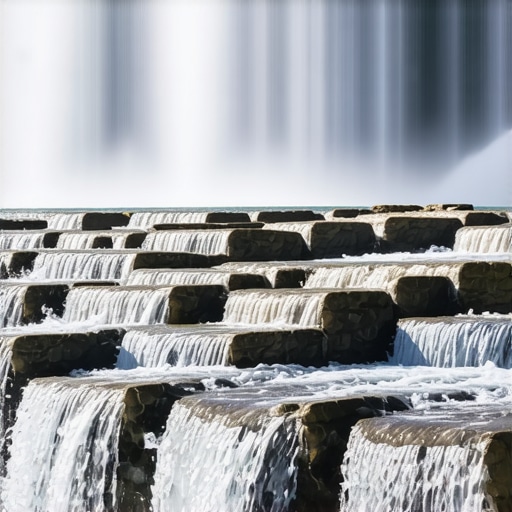
The Anatomy of a Failed Cascade: When Your Waterfall Becomes a Drainage Problem
To stop 2026 waterfall splashing, you must adjust the weir stones to ensure a clean break of water over the leading edge, typically requiring a downward pitch of 1 to 2 degrees and a minimum two-inch overhang past the vertical spillway face to prevent capillary action from pulling water backward into the structure.
I recently got called out to tear up a $30,000 patio that was sinking because the previous contractor didn’t understand the basic physics of water movement. They had installed a beautiful multi-tiered waterfall, but the weir stones were set dead-level. Every time the pump kicked on, about 15% of that water didn’t fall forward; it wicked backward through capillary action, saturating the base-layer gravel of the adjacent patio. Within two seasons, the hydrostatic pressure and constant saturation turned the modified gravel into soup, and the pavers followed. It was a total structural failure. This isn’t just about aesthetics; it is about engineering a system that respects gravity. If you hear a ‘splatter’ rather than a ‘thrum,’ you are losing water, destroying your landscaping, and likely rotting your liner edges. Most homeowners think they need a bigger pump. They don’t. They need better stone placement.
The Physics of Surface Tension and Weir Edge Geometry
The primary reason a waterfall splashes excessively or ‘leaks’ behind the rocks is the failure to break surface tension at the spillway edge. When water moves over a stone, its molecular bond wants to cling to the surface. If the stone edge is rounded or pitched backward, the water follows the curve. This creates a messy spray rather than a sheet. In high-end landscaping, we look for ‘sharp-edged’ weir stones. A ragged or tumbled edge is the enemy of a clean flow. By grinding a slight ‘drip edge’ on the underside of your weir stone with a diamond-blade angle grinder, you force the water to detach and fall vertically. This is a common fix for pond systems where yard cleanup has revealed moss growth behind the stone, a sure sign of backward tracking.
“A retaining wall doesn’t fail because of the stone; it fails because of the water trapped behind it.” – Hardscape Engineering Axiom
How much water is lost to splashing?
An improperly adjusted weir can lose between 5 to 20 gallons of water per day due to splashing and wind-driven spray. This constant moisture ruins sod install projects nearby by causing root rot and creates salt deposits on stone surfaces. In 2026, water conservation is a structural mandate, not a suggestion.
The Forensic Autopsy of a Splashing Weir
When I walk onto a site to diagnose a splash issue, I look for three things: the pitch, the overhang, and the side-wall height. If the weir stone is buried too deep in the side boulders, water ‘climbs’ the walls. This is where most irrigation issues start. The splashing saturates the surrounding mulch, which then washes into the pond, spiking the nitrogen levels and killing your biological balance. It is a chain reaction of bad physics. To fix it, you have to excavate. You have to get down to the liner. We use EPDM liners for a reason; they have the flexibility to be tucked and folded, but if your stone isn’t providing a clear ‘launchpad,’ the liner is just a wet bag.
| Stone Type | Porosity Level | Recommended Overhang | Flow Characteristic |
|---|---|---|---|
| Flagstone (Slate) | Low | 2.0 Inches | Sheet Flow |
| Fieldstone (Granite) | Very Low | 3.5 Inches | Turbulent/Natural |
| Limestone | High | 2.5 Inches | Variable/Soft |
| Sandstone | High | 3.0 Inches | Absorbent/Drip-prone |
How do I calculate the GPH for a quiet waterfall?
To achieve a quiet, splash-free flow, you generally need 1,500 Gallons Per Hour (GPH) for every one foot of weir width. If your pump exceeds this without a deep enough weir pool, the velocity of the water hitting the stones below will create an erratic splash pattern that no amount of stone adjusting can fix.
Step-by-Step Remediation: Re-setting the Weir
First, turn off the pump. You cannot see the structural flaws when water is moving. Remove the decorative ‘trim’ stones around the spillway. You need to see the weir stone in its naked state. Check the level. If it is perfectly level or leaning back, you have found your culprit. You need to shim the back of the stone using non-biodegradable materials like PVC shims or flat pieces of slate. Do not use wood. It will rot. You want a 1:12 pitch—one inch of drop for every twelve inches of stone depth. This ensures gravity is always working in your favor.
- Check the Liner: Ensure the liner is pulled up behind the weir stone and hasn’t slipped down.
- Apply Waterfall Foam: Use black expanding poly-foam to seal the gaps between the weir stone and the side boulders. This forces 100% of the water OVER the stone rather than around it.
- The Drip Edge: Use a grinder to score a 1/4 inch deep groove on the underside of the stone’s leading edge. This acts as a ‘break’ for surface tension.
- Test Flow: Use a garden hose to simulate the pump flow before mortaring or foaming the stone permanently.
Integration with Total Property Health
Proper waterfall management is a pillar of landscaping engineering. If your waterfall splashes, it affects your irrigation sensors, giving false readings of soil moisture. I have seen countless sod install failures where the grass near the pond was drowned while the rest of the yard was thirsty. It all comes back to control. You must control the water, or it will control your budget. When we do a yard cleanup, the first thing we check is the stone scale. Calcium buildup on the front of a weir stone is a sign of ‘wicking.’ It means the water is lingering too long on the stone surface rather than jumping off it. Clean the stone with a stiff brush and a mild acetic acid solution to restore the smooth surface needed for a laminar flow.
“Hydraulic conductivity in the soil adjacent to water features must be managed to prevent localized slope failure.” – USDA Soil Engineering Manual
Why is my waterfall louder than it used to be?
Increased noise usually indicates that the water is hitting a hard surface rather than a ‘landing pool.’ Over time, sediment or shifting stones can shallow out the catch basin. If the water has less than 6 inches of depth to fall into, it will splash and roar. Ensure your landing zone is deep and clear of flat, reflective rocks. A deep pool absorbs energy; a flat rock reflects it. That reflection is the splash you are trying to kill. In the 2026 season, aim for silence and efficiency. Your soil, your plants, and your patio will thank you for the precision.